
Knowledge and advice
A video wall for a trade fair or location
Want a larger image area? See what a video wall demands of the space, content, control and installation.
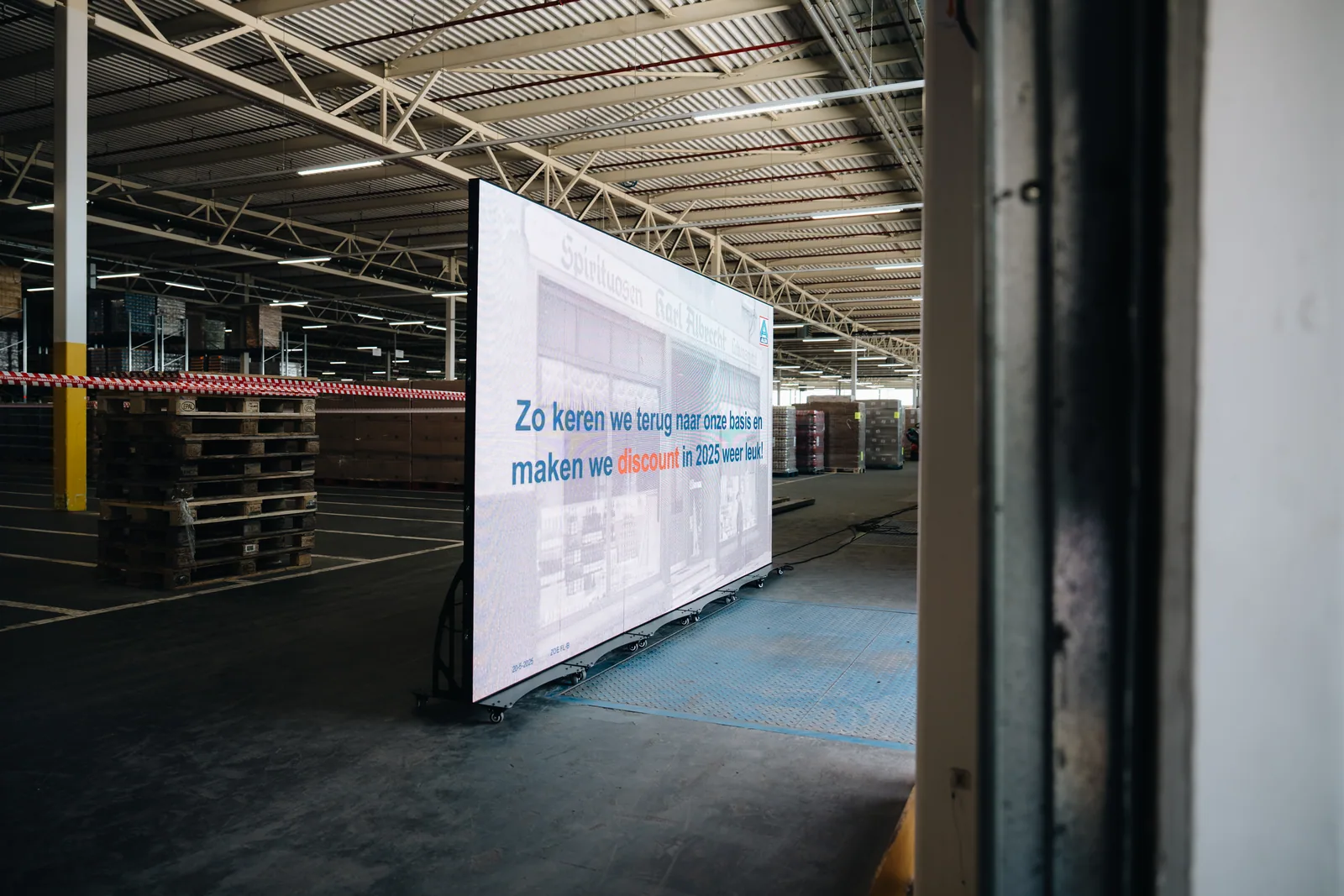
Start with the objective, location and minimum and maximum viewing route. Record whether the wall shows one continuous story, multiple information zones, live images or a temporary event presentation. Measure available space, light, sightlines, audience distance, access and access for installation and maintenance. Only then choose between separate panels or modular display technology. A general distance or size rule does not replace an on-site survey and a test with the real content.
Work out the total visual surface from content and application. Compare seams, pixel density, resolution, brightness, colour, refresh rate and viewing angle only with current documentation for the actual components offered. Design content for the final canvas layout and check text, logos, faces and important details at seams and from different distances. A higher technical figure is not automatically better when source material, processing, viewing route or management does not match it.
Treat construction, power and safety as separately demonstrable work packages. Have weight, supporting structure, mounting, cable route, ventilation, electrical distribution, escape routes and site conditions assessed by the responsible contractors and authorised parties. For an event, also record logistics, build-up and breakdown times, storage, protection and site instructions. Product information alone does not prove that the complete wall, suspension and surroundings are safe or suitable.
Map the full signal chain from content source via player, controller, distribution and cabling to each panel or module. Record resolution, mapping, synchronisation, spare parts, local fallback and recovery steps, and test a realistic configuration before transport or final installation. Check cold starts, source switching, prolonged playback, loss of signal or connection, restart and replacement or switching off of a component without unsafe improvisation.
Compare purchase, hire and support based on the actual project scope and current central prices. Include design, hardware, controller, construction, installation, transport, content production, management, service, storage, spare parts and redeployment, and separate confirmed items from assumptions. After the full on-site test, record model and software versions, configuration, content version, test evidence, responsible persons and handover status. Only then is the chosen video wall route commercially and operationally released.