
Knowledge and advice
Trade fair stand power supply: how many watts do displays need?
How many watts do displays on a trade fair stand consume? Wattages by size, generator sizing and NL/BE safety rules — all in one place.
Trade fair stand power supply: how many watts do displays need?
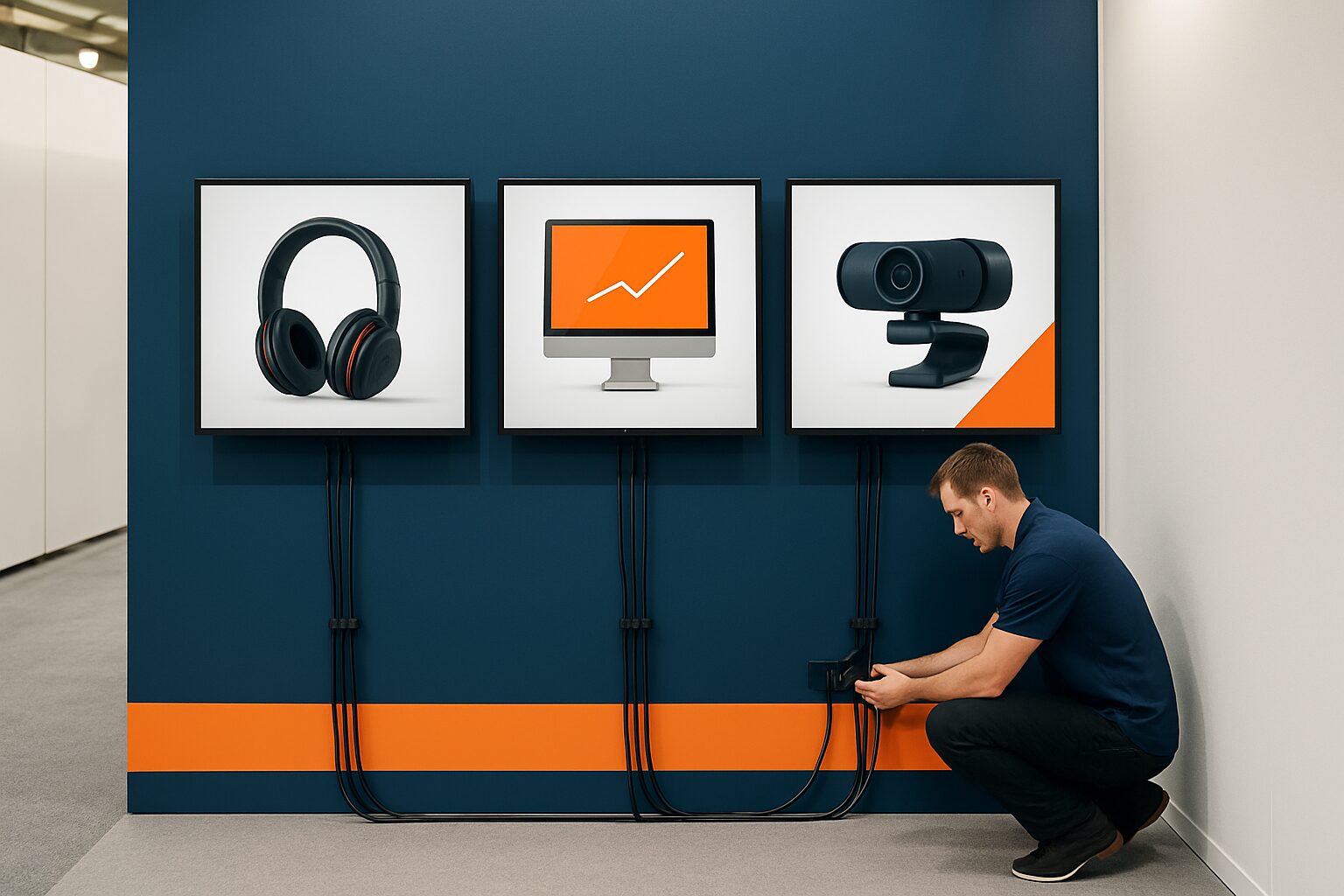
A commercial display of 43″ consumes 80–120 watts, a 55″ screen 120–180 watts. If you add several screens together, add a 20–25% safety margin and also factor in laptops, lighting and other devices. For a stand with three 43″ displays, you quickly reach a total power demand of 500–600 W. If you know that in advance, you avoid surprises on the exhibition floor: too little power means screens cutting out at the busiest time of day.
Power consumption per display size: the reference table
The power consumption of a commercial display differs from that of a standard consumer television. Commercial screens run at higher brightness — 400 cd/m² or more — and are designed for continuous use. That uses more power than an office monitor switched on for four hours a day.
| Size | Typical consumption (commercial) | Peak consumption |
|---|---|---|
| 32″ | 50–70 W | ~90 W |
| 43″ | 80–120 W | ~150 W |
| 49–55″ | 120–180 W | ~220 W |
| 65″ | 150–200 W | ~260 W |
| 75″ | 180–250 W | ~320 W |
These figures are based on standard LED-backlit commercial panels at a brightness of 400–500 nits. A 55″ display running at 700 nits for a sunlit stand location can reach 210 W — the same setup at 350 nits indoors drops back to around 110 W, a difference of almost 50%.
Important rule of thumb: always read the nameplate on the back of the screen. This states the maximum power consumption. Use that figure — not the typical consumption — as the basis for your power calculation.
How do you calculate the total power demand of your stand?
Add up all the power ratings and add a safety margin. For an event, installers recommend a margin of 25–50% above the calculated total so the generator does not become overloaded even at peak consumption.
Worked example: stand with three 43" displays
- 3 × 43″ display: 3 × 120 W = 360 W
- Laptop/media player: 65 W
- Stand lighting (LED spots): 80 W
- Coffee machine (if present): 1.200 W
- Subtotal: 1.705 W
- Safety margin 25%: +426 W
- Required: ~2.130 W (≈ 2,1 kW)
A standard socket delivers a maximum of 230 V × 10 A = 2.300 W. That is tight for this example as soon as the coffee machine kicks in. Always ask the trade fair organiser about the available circuit capacity — and whether you can reserve a separate circuit for the displays.
One practical advantage of the PixioDisplay Mobile (43″, 400 cd/m², price list Q2 2026: buy current price on request) is that the screen has an integrated Android computer. You do not need a separate media player or laptop, which saves 65–100 W of your total power consumption compared with a separate TV + laptop setup.
Generator sizing: calculating kVA for a trade fair stand
If the venue does not provide a fixed mains connection, you rent a generator. Generators are expressed in kVA (kilovolt-amperes). Conversion to kW is done via the power factor (cos phi): for display equipment, this is usually around 0,8.
Formula: kVA = kW ÷ cos phi (0,8)
For the calculation example above: 2,1 kW ÷ 0,8 = 2,6 kVA. Then choose a generator of at least 3,5 kVA to cope with start-up peaks as well — some devices briefly require two to three times their nominal power at start-up.
For a larger stand — say five 55″ screens plus lighting and a coffee corner — you quickly reach 5–7 kW of active power. That calls for a generator of 8–10 kVA. If in doubt, have an electrician validate the calculation; an undersized generator will damage both the equipment and the generator itself.
Tip: always ask the generator hirer about the continue power, not peak power. Generators may only supply peak power for a short time.
Safety rules in the Netherlands and Belgium
In the Netherlands, temporary electrical installations at trade fairs must comply with NEN 1010 — the standard for low-voltage installations up to 1.000 V AC. NEN 1010 is included in the Building Works Living Environment Decree and is therefore effectively mandatory. All connected equipment must have a CE marking to be carried, as set out in the Commodities Act Decree on electrical equipment (Low Voltage Directive 2014/35/EU).
In Belgium, the General Regulations for Electrical Installations (AREI), approved by Royal Decree of 8 September 2019. Every electrical installation — including temporary stand installations — must comply with this regulation.
Three practical obligations for installers:
- Use only CE-certified displays and cables.
- Ensure a RCD (30 mA) on the circuit that powers the displays.
- If in doubt, have temporary installations checked by an approved installer (NL: KvINL-certified; BE: approved inspection body).
Trade fair organisers in the Netherlands and Belgium also apply their own technical regulations. Request these upon registration — they often include maximum power draw per stand metre.
When do you choose a battery-powered display without a mains connection?
Not every stand location has a convenient power socket. The PixioDisplay A-board (43″, price list Q2 2026: current price on request at 1.500 nits or current price on request at 2.000 nits) runs on a built-in battery with a battery life of 14–18 hours. That is enough for a full trade fair day without mains power.
This is the right choice if:
- Your stand location does not have a fixed power connection, or the event organiser's connection costs are high.
- You want to be able to reposition flexibly during the trade fair.
- You want a simple, quick installation without cabling.
The downside: you cannot 24/7 the screen for multi-day trade fairs without charging in between. If continuous power is available, a mains-connected display is the more stable choice.
See the full technical specifications on the PixioDisplay Pavement Board product page or compare rental options on display hire.
Conclusion: start with the wattages, only then move on to the generator
The correct power preparation for a trade fair stand starts with the display specifications — not with a rough estimate. Read the rating plate, add up all power ratings, add a 25–50% margin and convert to kVA if you need a generator. Take account of NEN 1010 (NL) or the AREI (BE) and ensure CE-certified equipment and an RCD protection device.
Do you want the full technical and creative approach for digital signage on a trade fair stand? Then read Digital signage at trade fairs: the complete guide to a standout stand.
Frequently asked questions
How many watts does a 43 inch display use on a trade fair stand?
A commercial 43″ display typically consumes 80–120 watts at normal brightness (400–500 nits). At maximum brightness, this can rise to 150 watts. Always read the nameplate on the back of the screen for the exact maximum power draw of your specific model.
How large does my generator need to be for three displays on a trade fair stand?
Add up all loads (displays, lighting, laptop, other devices), add 25–50% safety margin and divide the result by 0,8 to convert from kW to kVA. For three 43″ displays plus lighting and a laptop, you will usually end up at 3–4 kVA. Always choose a generator with slightly more capacity than calculated, so start-up peaks do not cause problems.
Which electrical safety rules apply to a trade fair stand in the Netherlands?
Temporary installations at Dutch trade fairs must comply with NEN 1010, the standard for low-voltage installations. All equipment must be CE certified under the Low Voltage Directive 2014/35/EU. Use a residual-current device of 30 mA on the circuit supplying the displays, and ask the trade fair organiser for their own technical regulations.
Can I use a display on a trade fair stand without a power connection?
Yes. The PixioDisplay A-board (43", €2.245 at 1.500 nits, price list Q2 2026) runs on a built-in battery with an operating time of 14–18 hours — enough for a full trade fair day. This is useful if your stand location has no connection or if you want to be able to reposition it flexibly.
What is the difference in power consumption between a commercial display and a normal TV?
Commercial displays run at higher brightness (400 cd/m² or more) and are designed for continuous use, which means they consume more power than a consumer TV of the same size. A standard 43" TV typically uses 60–80 watts in normal brightness; a commercial 43" screen at trade fair level uses 80–120 watts. Always use a commercial display for stand installations — a standard TV is not built for eight hours of continuous use.