
Knowledge and advice
Trade fair stand displays and fire safety: standards and certificates NL/BE
Which fire safety standards apply to displays on an exhibition stand in the Netherlands and Belgium? Overview of NEN-EN 13501-1, BGBOP, AREI and CE marking for digital screens.
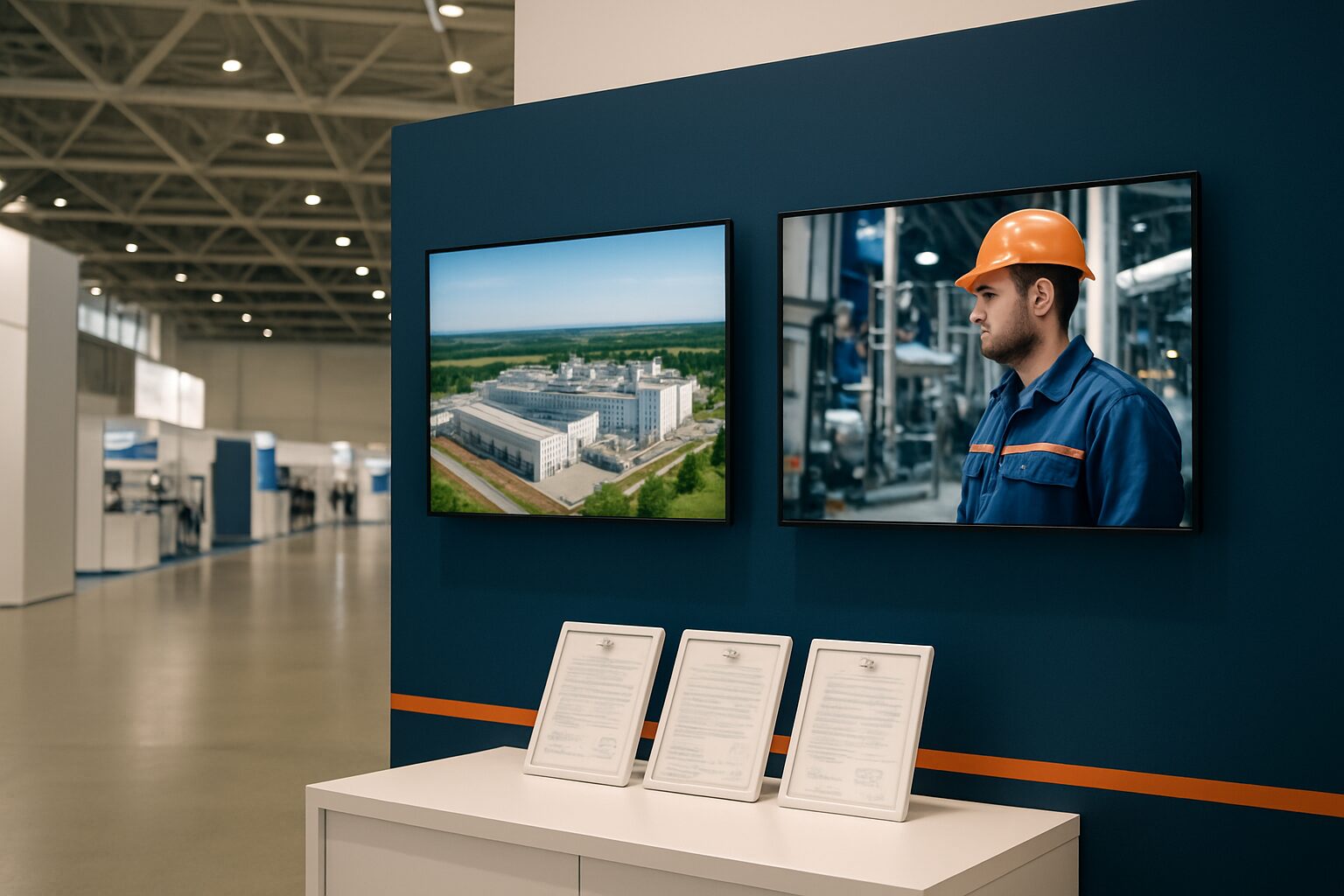
A display on a trade show stand is both an electrical appliance and a stand element — and therefore falls under two separate regulatory tracks: fire reaction of materials (NEN-EN 13501-1 / NEN 6065) and electrical safety (NEN 1010 in the Netherlands, AREI in Belgium). Both tracks are mandatory, not optional. Anyone who builds a stand without the correct certificates risks a stop-work order from the trade fair organiser or the fire brigade.
Why displays specifically need attention
A digital screen combines a plastic housing, printed circuit boards, power cables and — on some models — an integrated computer. That makes its fire behaviour more complex than that of passive stand elements such as aluminium profiles or glass. At the same time, displays are in continuous operation: they generate heat, also during build-up and breakdown.
Trade fair halls are public spaces with high visitor density. That is why organisers impose strict requirements on all electrical equipment on the stand — regardless of what national legislation already requires.
NEN-EN 13501-1: the European fire reaction class
The material classification for fire behaviour in the Netherlands and Belgium follows the same European standard. The European Standard NEN-EN 13501-1 applies to the testing and classification of the fire behaviour of construction products, and will in time replace the Dutch standard NEN 6065. The classification can range from A1 (non-combustible) to E (very combustible) or F (not tested, extremely combustible).
For displays, the enclosure is the critical component. Metal enclosures (aluminium, steel) fall into class A1 or A2 — practically non-combustible. Plastic panels typically score class C or D. Trade fairs, exhibitions and large events are public spaces with thousands of visitors, electrical installations, spotlights, audio equipment and combustible materials. Exhibition organisers therefore often require at least class B or C for all stand elements, including screen enclosures.
If in doubt about the class of a display: ask the supplier for the test report. The only reliable evidence is documentation from your supplier: material specifications, test reports and technical data showing that the material meets the required standard.
Comparison: fire reaction classes NEN-EN 13501-1 for trade fair context
| Euroclass | Description | Typical material | Suitable for a trade fair stand? |
|---|---|---|---|
| A1 | Non-combustible | Glass, steel, aluminium | Yes, always |
| A2 | Practically non-flammable | Mineral wool, plasterboard | Yes |
| B | Very limited contribution | Certain plastics | Yes, most halls |
| C | Limited contribution | Standard plastic | Check hall rules |
| D | Moderate contribution | Wood, MDF | Often not permitted |
| E / F | High / not tested | Untreated textile | No |
Electrical safety in the Netherlands: NEN 1010 and BGBOP
For the electrical connection of displays at a trade fair stand, two frameworks apply in the Netherlands.
New or modified installations must be inspected before commissioning in accordance with NEN 1010. At a trade fair stand, every temporary electrical connection counts as a new installation. That means the power distribution on the stand must comply with NEN 1010 before the fair opens.
In addition, the BGBOP applies. From 1 January 2018 the Decree on fire-safe use and basic emergency assistance for other places (BGBOP) came into force. The rules apply to all locations where events are organised, for example events in tents, festival grounds or exhibition halls. The intention is that the same rules for fire-safe use at events apply throughout the Netherlands.
Specifically, the BGBOP requires materials in an enclosed space to meet fire class B with smoke class s2 (NEN-EN 13501-1), or specific afterflame and afterglow values. One side of a structural component in an enclosed space meets fire class B and smoke class s2, both determined according to NEN-EN 13501-1.
Electrical safety in Belgium: AREI
In Belgium, the framework for electrical installations is the AREI. The AREI (General Regulations on Electrical Installations) is the Belgian federal standard that sets the safety rules for all electrical installations in the country — domestic, professional, low voltage (≤ 1 000 V) and high voltage (> 1 000 V). It applies uniformly in Brussels, Wallonia and Flanders.
All electrical installations at an event must be inspected by an External Service for Technical Control and comply with the AREI. For a trade fair stand in Ghent, Antwerp or Paal-Beringen, this means: the power distribution on the stand must be inspected before use by an approved inspection body (Vinçotte, Bureau Veritas, Socotec or similar).
To promote a uniform approach to fire prevention, all 20 Flemish emergency service zones chose to draw up their own zonal events regulations. All these zonal events regulations are based on the laws and regulations of different authorities. So always check the regulations of the specific exhibition hall and the local emergency service zone.
For the fire reaction of materials, Belgium uses the same European standard NEN-EN 13501-1 as the Netherlands. The system in the European classification and the assessment of the fire behaviour of construction materials consists of three parts: testing the fire reaction, testing fire resistance and testing the fire behaviour of roof coverings.
CE marking and what it does and does not prove
Every display placed on the market in the EU carries a CE mark. That mark shows that the device complies with the European Low Voltage Directive (LVD) and the EMC Directive — but it says nothing about the fire reaction class of the housing.
For trade fair purposes, you therefore need two documents:
- CE declaration of conformity — proves the electrical safety of the device itself.
- Fire reaction report (NEN-EN 13501-1) — proves the fire class of the housing.
Request both documents from the supplier before you build the stand. Trade fair organisers may ask for them during stand inspection.
Practical: choosing displays with fire safety in mind
Commercial-grade displays are designed for continuous use and usually have a metal casing — this gives a better fire reaction class than consumer screens with plastic rear panels. The PixioDisplay Luxe (49″ touchscreen) has a metal housing and is certified for continuous use; the rental price is current price on request per day (1 day) to current price on request per day (3 days) — price list Q2 2026.
For the Summit case, Pixio Display deployed more than 50 displays at one event. That kind of large-scale deployment requires prior coordination with the trade fair organiser about power distribution and fire safety documentation per screen.
A practical tip: start with the hall regulations of the venue. These state the minimum fire class required for electrical equipment. Then ask your display supplier for the fire reaction report and check whether the CE declaration is available. That way you will not get stuck during the stand inspection on build-up day.
For a complete overview of display options for trade fairs and events, see the application page trade fair and event displays.
Related topics in this knowledge base: Digital signage at festivals and events: outdoor screens, power and safety — Trade show stand displays: installation and commissioning checklist — Trade show stand displays for rent: step-by-step request in NL/BE.
Frequently asked questions
What fire rating must a display on an exhibition stand have?
That depends on the venue’s hall regulations. In the Netherlands, the BGBOP prescribes at least fire class B for enclosed spaces with smoke class s2 (NEN-EN 13501-1). Many large exhibition halls apply the same requirement. Always check the hall’s specific regulations before build-up.
Is a CE marking sufficient proof of fire safety at a trade fair?
No. CE proves that the device complies with the European Low Voltage Directive and EMC Directive, but says nothing about the fire reaction class of the housing. For a trade fair, you also need a fire reaction report (NEN-EN 13501-1). Ask your supplier for both documents.
Do the regulations for electrical installations differ in the Netherlands and Belgium?
Yes. In the Netherlands, NEN 1010 applies to temporary electrical installations at events, supplemented by the BGBOP. In Belgium, the AREI (General Regulations on Electrical Installations) applies — a federal standard valid in Brussels, Wallonia and Flanders. In both countries, the power distribution on the stand must be inspected before use.
Do I need a separate fire safety certificate for each display?
Not necessarily per item, but per model. A fire reaction report applies to a specific product (enclosure material and construction). If you use multiple units of the same model, one report is sufficient. If you use different models, you need documentation for each model.
What does a Belgian exhibition hall specifically require regarding electrical documents?
Belgian exhibition halls usually require an inspection certificate from an accredited External Service for Technical Control (EDTC) for the power distribution on the stand, in accordance with the AREI. In addition, each Flemish emergency zone has its own events regulation. Consult the website of the local emergency zone for the specific requirements of the exhibition venue.