
Knowledge and advice
TV screen for your shop: what should you pay attention to when buying and placing it?
A TV screen for your shop requires commercial hardware, the right brightness and smart positioning. Read what you need to know before you buy.
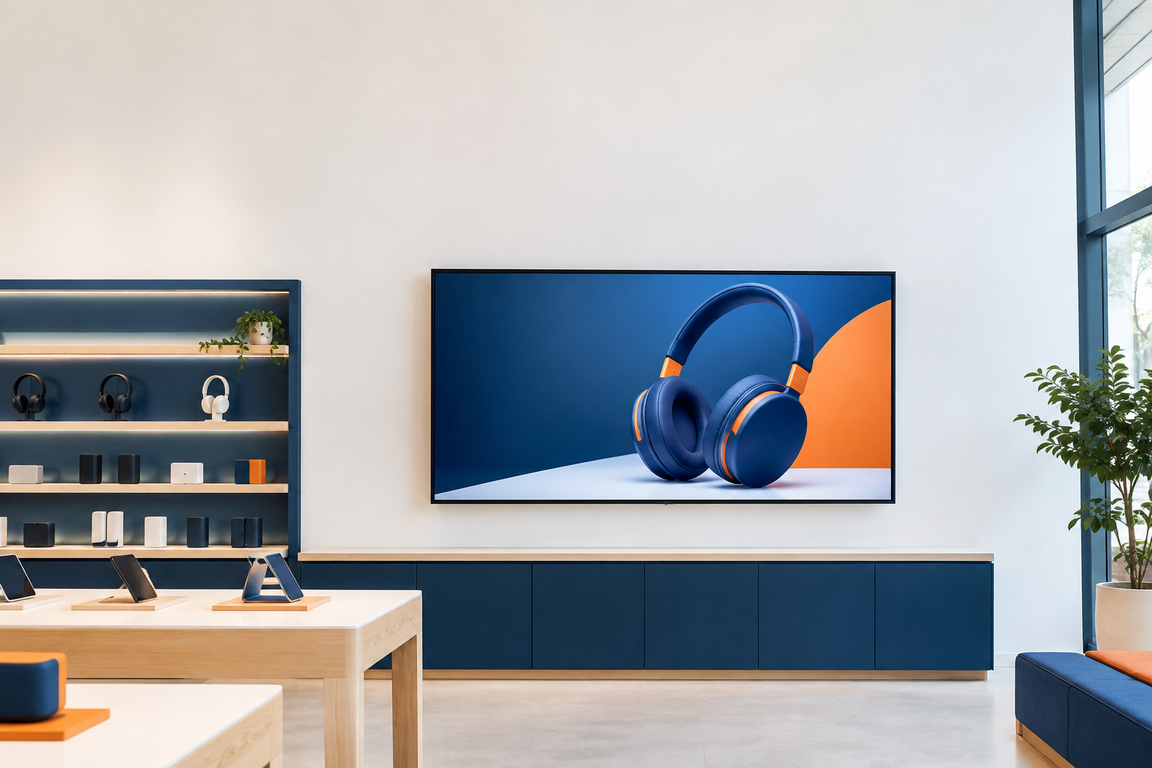
A TV screen for your shop is more than a large monitor on the wall. Commercial displays are designed for continuous use — consumer TVs with around 300 nits are not intended for that. The right choice depends on four factors: the location (indoor, window display or outdoor), the required brightness in nits, the content management solution and the local permit situation. Anyone who runs through those four points in advance avoids costly replacements within a year.
Commercial versus consumer: the difference that matters
A consumer TV is built for an average of four to six hours of use per day. In a shop, a screen runs for eight to twelve hours, sometimes longer. Commercial displays are designed for continuous use and have a higher average lifespan of the backlight. They also include an integrated media computer, so you do not need an external player.
The panel — not the size — determines the surcharge. Indoors, ±400 cd/m² is sufficient, a shop window in full sun requires 3.000 nits, a free-standing outdoor display 3.500. A consumer TV with 300 nits is unreadable in a lit shop window in daylight.
Brightness per location: a practical rule of thumb
The screen's location determines the brightness you need. Use the table below as a starting point:
| Location | Recommended brightness | Example |
|---|---|---|
| Shop interior (little daylight) | 400–700 nits | Clothing store, supermarket |
| Window display (indirect sunlight) | 1.000–2.000 nits | North- or east-facing window |
| Window display (direct sunlight) | 3.000 nits or more | South-facing window |
| Outdoor (freestanding) | 3.500 nits or more | Pavement sign, outdoor totem |
The PixioDisplay Window Full Sun is a shop window screen of 43–55″ with 3.000 nits — designed for shop windows that catch direct sunlight. The PixioDisplay Sidewalk Sign has a 43″ screen and is available with 1.500 or 2.000 nits, runs 14 to 18 hours on battery and can therefore be used without a mains socket. Dunkin' Donuts uses the PixioDisplay Window as digital shop window poster — a concrete example of how a high-bright shop window screen draws in passers-by without sacrificing the inside of the shop.
Installation: height, angle and viewing distance
A screen that nobody can see properly does no work. Hang a screen at eye level or slightly above — preferably with the bottom of the image area at 130 to 150 cm. At a viewing distance of two metres, Full HD is sufficient; only at four metres or more does 4K really pay off.
For shop-window placement: the screen stands behind glass and competes with daylight and reflections. Make sure the screen faces outwards and is not angled in relation to the window. A slight forward tilt of five to ten degrees reduces reflection.
When mounting to a façade or ceiling: always use a certified wall bracket with the correct load capacity. Check whether the wall or ceiling can bear the weight — commercial displays of 43″ typically weigh 12 to 18 kg.
Content: what works in a retail environment
Moving images attract more attention than static images. Keep clips short: five to ten seconds per message is enough for passing customers. Use high contrast and large fonts — text smaller than 10% of the screen height is unreadable from a distance.
PixioDisplays have an integrated Android computer; content can be shown via USB, a website URL or the PixioApp. This makes it easy to switch offers or seasonal content, without needing a technician. If you want to link content to your stock management or till system, read the integration guide for display content and stock management.
Permits: when do you need authorisation?
A screen inside your shop that is not visible from the public road falls outside the permit requirement for advertising displays. As soon as a screen is visible from the public space — think of a window display or a screen on the façade — that changes.
The Environment and Planning Act has been in force since 1 January 2024. Advertising on a façade or as a freestanding structure falls under the permit requirement. You check via the Permit Check on omgevingsloket.nl whether your situation requires a permit. The exact requirements vary by municipality: location, size, brightness and animation speed all play a part. So start checking early — especially if you want to place a screen on the façade or in the shop window that is visible from outside.
More on safety, liability and permits can be found in the knowledge base article Digital displays in shops: safety, permits and liability.
Advice: start with the location, not the size
First choose the location and the desired brightness, then the size. A 55″ consumer TV in a shop window performs worse than a 43″ commercial display with the right nits. If you are buying for indoor use without shop window exposure, a commercial display with 400–700 nits is sufficient. If the screen is in or behind a shop window, always choose a high-bright model.
Want to know which screen suits your retail situation? See the overview on the page digital advertising screen or request the price list on.
Frequently asked questions
Can I use a regular TV as an advertising screen in my shop?
Technically it can be done, but it is not advisable. Consumer TVs are built for around four to six hours of use per day and have a brightness of around 300 nits. In a shop environment a screen runs much longer and the brightness is insufficient in daylight. Commercial displays are designed for continuous use and have a longer lifespan.
How many nits do I need for a screen in my shop window?
That depends on the orientation of your shop window. With indirect sunlight, 1.000–2.000 nits is sufficient. With a south-facing window and direct sunlight, you need at least 3.000 nits. A standard indoor screen of 300–400 nits is unreadable behind glass in daylight.
Do I need a permit for a screen in my shop?
A screen visible only from inside falls outside the permit requirement. Once the screen is visible from the public space — such as a shop window screen or a screen on the façade — the Environmental Act applies. Check your situation via the permit check on omgevingsloket.nl.
At what height should I hang an advertising screen in a shop?
Mount the bottom of the image area at 130 to 150 cm — roughly eye level for a standing adult. At a viewing distance of two metres or less, Full HD resolution is sufficient. Also make sure the screen is not angled relative to the customers' viewing direction.
How do I change content on a commercial display?
Most commercial displays have an integrated media computer. On PixioDisplays, content can be loaded via USB, a website URL or the PixioApp. That way you can change offers or seasonal content without technical help, even remotely.