
Knowledge and advice
Digital signage at festivals and events: outdoor screens, power and safety
Outdoor screens at festivals and events: which IP rating, how many nits and which power standards apply? Practical overview for safe and visible deployment.
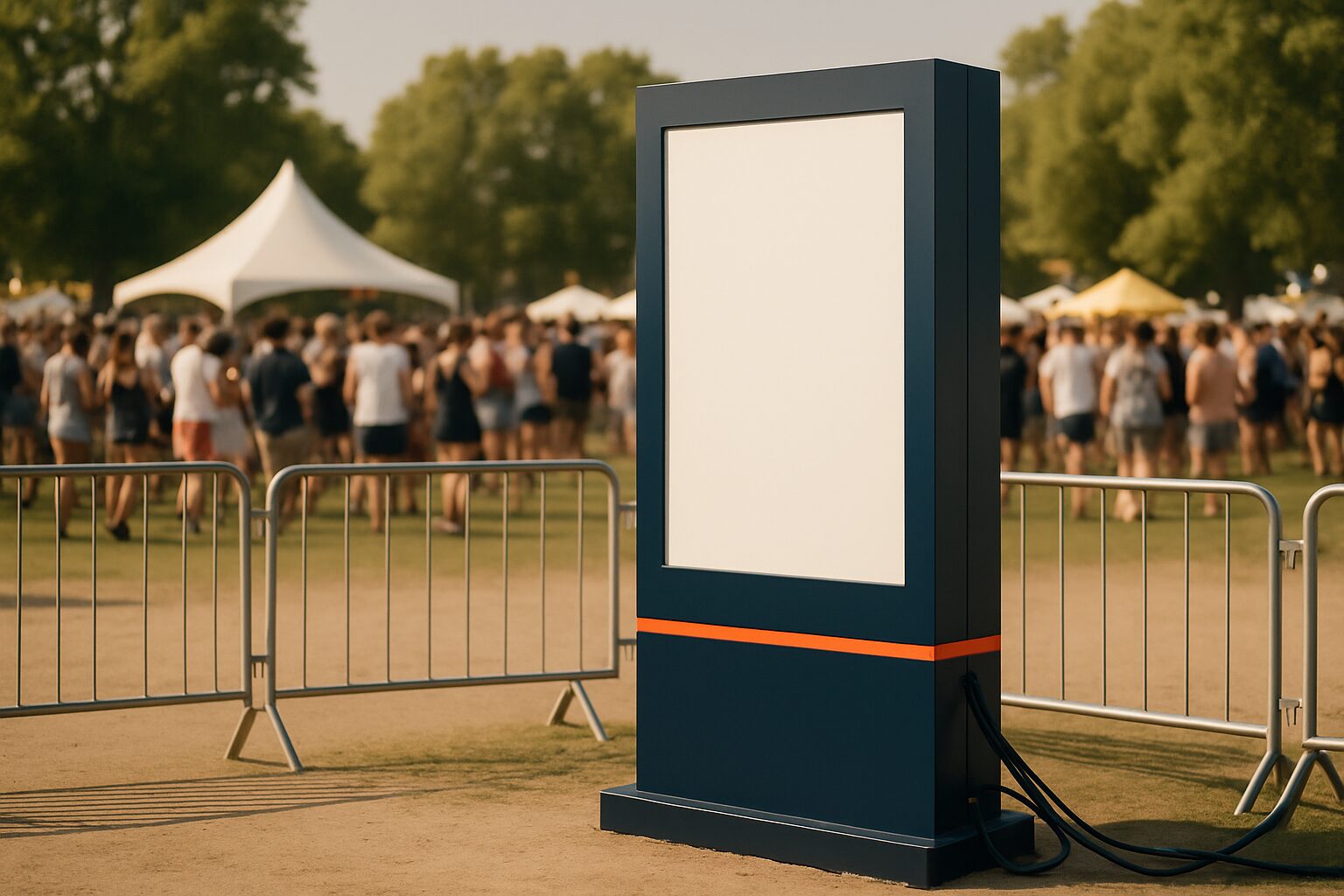
Digital signage at festivals and events: outdoor screens, power and safety
Outdoor digital signage at festivals and events is a discipline of its own. A screen that works perfectly indoors is completely unusable outside: too little brightness, no protection against rain and no suitable power connection. For outdoor use you need at least IP65 certification, a brightness of 3.500 cd/m² or more, and a temporary electrical installation that complies with NEN 8020-20. Good logistical planning prevents failure at the moment it matters.
Which screens work outdoors — and which do not
A standard office display or consumer TV delivers 250 to 400 nits. Outdoors, the screen competes with daylight that can reach up to 100.000 lux on the screen surface on a sunny day — such a screen is then completely unreadable. For semi-sheltered outdoor locations, 2.500 nits is the practical lower limit; in direct sunlight, 5.000 nits or more is needed for consistent daytime readability.
The PixioDisplay Outdoor delivers 3.500 cd/m² and is suitable for free-standing placement or facade mounting. The 49″ version costs current price on request and the 55″ current price on request (price list Q2 2026). That price difference compared with an indoor model is almost entirely in the panel and the casing — not in the size.
For shorter events or changing locations, the PixioDisplay A-board a practical choice: 43″, 1.500 or 2.000 nits, and a built-in battery with 14 to 18 hours of runtime. No power outlet is needed. The purchase price is current price on request (1.500 nits) or current price on request (2.000 nits) (price list Q2 2026). On a private festival site without fixed power connections, this is the fastest solution.
IP rating: what IP65 does and does not protect against
IP65 is the most commonly used class for free-standing outdoor displays: complete dust protection and resistant to water jets from any direction, including heavy rain. IP54 is sufficient only in sheltered locations, such as under an awning or in a covered passageway — never for fully open outdoor installations.
Watch out for one common mistake: some manufacturers list the IP rating only for the front of the panel. Always request the full test report (IEC 60529), so you can be sure that the housing and connections also provide the stated protection. The IP standard says nothing about heat or cold resistance — for that, look at the operating temperature range in the datasheet.
IP67 is relevant when the screen is at risk of immersion or intensive cleaning with a pressure washer. For most festival setups, IP65 is sufficient, provided the cabling and connections are sealed just as well.
Power supply: standards and practical approach
Temporary electrical installations at events in the Netherlands fall under NEN 8020-20, the specific standard for this type of installation. In addition, NEN 1010 (low-voltage installations) and NEN 3140 (safe working on electrical installations) apply. Distribution boards must be fitted with residual current devices with a trip current of no more than 30 mA for personal protection.
Many municipalities require in their event permit that the power supply be independent of the public grid, to prevent overloading of the local network. Always check your municipality’s permit conditions in advance — safety regions may apply stricter standards depending on the expected number of visitors.
A generator is the standard solution at large events. Cables on a festival site must be of the heavy-duty type (H07 rating) and be protected with cable ramps to prevent tripping, dragging and damage. Appoint one person who is reachable during the event for power failures.
An outdoor LCD display of 55″ typically uses 150–300 W. That is manageable, but also include all other consumers — sound, lighting, catering — before determining the generator capacity.
Construction, installation and public safety
A free-standing outdoor display on a festival site is an obstacle in a busy public space. Take three safety points into account:
- Stability: use a weighted base or ground anchor; a display of 30–50 kg that falls over in wind or crowding can cause injury.
- Cable routing: route cables through ducts or under mats, never loosely across walkways.
- Viewing angle and placement: position the screen so that visitors do not walk into the back or side; keep at least 50 cm of free space around it.
For wayfinding — entrance, first aid, emergency exits, stages — several smaller screens are more effective than one large central screen. Visitors can see a screen at 5 metres better than one at 30 metres. The application page for trade fair and event displays gives more context on placement strategies.
Rent or buy: the financial break-even point
The break-even point between renting and buying is around 8 to 10 days of use per year — that is the question organisers ask us most often. If you use an outdoor display for one or two festivals a year, renting is almost always more economical. The PixioDisplay Outdoor is available via the rental page; day rates vary by model and hire period.
For larger deployments, buying is more attractive. At the Summit event, Pixio deployed more than 50 PixioDisplays at one location — a scale at which owning hardware quickly pays off. At ALDI Netherlands, a PixioDisplay video wall supported a staff event, where the integrated Android computer (Android 13/14) meant no separate media player or laptop was needed. That saves current price on request per screen in extra hardware and minutes in setup time.
All PixioDisplays have that integrated Android computer as standard. At an event — where setup time is limited — that is the biggest practical difference compared with a separate TV plus laptop setup.
Checklist for outdoor signage at events
| Point | Minimum requirement | Recommendation |
|---|---|---|
| Brightness | 2.500 nits (sheltered) | 3.500+ nits (open terrain) |
| IP rating | IP55 (sheltered) | IP65 (fully outdoors) |
| Power standard | NEN 1010 + NEN 8020-20 | + check municipal permit requirement |
| Residual-current protection | 30 mA max. cut-off current | Separately per circuit |
| Cable type | H07 (heavy use) | Cable trays on walkways |
| Stability | Weighted base | Ground drilling at wind >5 Bft |
| Power plan | Generator or mains connection | Calculate power before the site visit |
Are you planning an outdoor display deployment at a festival or corporate event and want to know which model suits your location and power situation? See the PixioDisplay Outdoor product page or request the current price list for a complete overview of hire and purchase prices.
For broader context on screen choice, content and interaction at events, also read the related knowledge base articles Hire display screens for trade fairs: step-by-step request in NL/BE and Trade fair stand displays: installation and commissioning checklist.
Frequently asked questions
What IP rating does an outdoor display need at a minimum for a festival?
For fully open outdoor setups, IP65 is the minimum. IP65 provides full dust protection and resists water jets from any direction, including heavy rain. IP54 is only sufficient in sheltered locations, such as under an awning. Always request the full IEC 60529 test report: some manufacturers only state the IP rating for the front of the panel.
How many nits does a screen need to be readable outdoors?
In a sheltered outdoor location, 2.500 nits is the practical lower limit. In an open festival ground in direct sunlight, you need 3.500 nits or more. Standard office screens and consumer TVs deliver 250–400 nits and are completely unreadable outdoors. The PixioDisplay Outdoor delivers 3.500 cd/m² and is designed for free-standing outdoor placement.
Which power standards apply to temporary installations at events in the Netherlands?
Temporary electrical installations at events fall under NEN 8020-20 (specific to events), NEN 1010 (low-voltage installations) and NEN 3140 (safe working). Distribution boards must have residual-current devices with a trip current of no more than 30 mA. Many municipalities impose additional requirements through the event permit, such as a power supply independent of the public grid.
Can I use an outdoor display at a festival without a mains connection?
Yes, provided you choose a model with a built-in battery. The PixioDisplay A-board (43″) has a battery life of 14 to 18 hours and does not need an external power point. The purchase price is €2.245 (1.500 nits) or €2.950 (2.000 nits) (price list Q2 2026). For longer events or higher brightness requirements, a generator with distribution board is the better choice.
When is renting more economical than buying for event displays?
The arithmetic break-even point lies around 8 to 10 usage days per year. If you organise one or two festivals a year, renting is almost always cheaper. For structural use — multiple events per year or a fixed location — your own hardware quickly pays for itself. Pixio offers rental from daily rates that vary by model and rental duration.