
Knowledge and advice
Public displays and privacy law: what is and is not allowed
What are you allowed to do with a public touchscreen or information column under the GDPR? Read the rules on data, cameras and facial recognition and implement them compliantly.
Public displays and privacy law: what is and is not allowed
A public display processes personal data as soon as it records interaction, films visitors or stores form entries. The GDPR (General Data Protection Regulation) then applies — regardless of whether you are a municipality, healthcare institution or business. Purely informative screens that store nothing and identify no one fall outside the law. As soon as a kiosk processes a name, email address or camera image, you become the data controller with all associated obligations.
When does a display fall under the GDPR?
The GDPR defines personal data as "all information about an identified or identifiable natural person" (article 4 section 1 GDPR). That sounds abstract, but in practice it is concrete:
- An information kiosk where visitors enter their name: GDPR applies.
- A screen with a built-in camera that analyses faces: GDPR applies.
- A digital sidewalk sign that only plays an advert video without storage or network connection: no processing, no GDPR obligation.
- A touchscreen on which visitors fill in a form and that sends data to a server: GDPR applies.
The distinction is not in the screen itself, but in what it does with data. So always start your implementation with the question: does this system store anything, or does it recognise someone?
What is allowed: informative and passive displays
A purely informational screen — think of a floor plan, a duty roster or an advertising message — does not process personal data. You do not need a processing basis, no privacy notice and no DPIA. That makes passive digital signage the simplest choice for organisations that want to minimise GDPR compliance.
The PixioDisplay A-board (43", battery-powered, 14–18 hours’ operating time, no power socket needed) is a good example of hardware that can be used purely for information: it plays content via an integrated Android computer, stores no visitor data and has no camera. Price from current price on request (price list Q2 2026). As long as you manage the content without user interaction or tracking, you remain completely outside the GDPR scope.
What may not be done without a legal basis: interaction and data storage
As soon as a display becomes interactive, the legal situation changes. The GDPR requires that you have a valid legal basis for every processing activity. The six legal bases are set out in Article 6 GDPR; for public displays, two are most relevant:
- Consent — the visitor gives active and voluntary consent. Consent must be "freely given, specific, informed and unambiguous" (Europa.eu GDPR explanation). A pre-ticked box is not valid. The visitor must tick the box themselves.
- Legitimate interest — you have a demonstrable interest that outweighs the privacy interests of the data subject. This works for security cameras at an entrance, but not for marketing profiling.
A touchscreen kiosk in which visitors complete a form always falls under the GDPR. Do you store that data? Then the principles of data minimisation (no more than necessary) and storage limitation (no longer than necessary) also apply.
Facial recognition: almost always prohibited
Facial recognition is a special category. A facial image used to uniquely identify someone is a biometric personal data item. Under the GDPR, processing biometric data is in principle prohibited (Dutch Data Protection Authority). There are exceptions, but they are narrow:
- Explicit consent of the data subject.
- Need for authentication in the case of a compelling public interest — think of securing a nuclear power plant, not a shop entrance.
The Dutch Data Protection Authority has already warned supermarkets: protecting property is not a sufficient justification. The same applies to municipalities and public organisations. Still want to use facial recognition? Then a Data Protection Impact Assessment (DPIA) is mandatory before you start (ondernemersplein.overheid.nl).
Practical advice: choose anonymous visitor counting (pixel counters without facial recognition) if you want to measure audience flows. These do not process personal data and fall outside the GDPR.
Cameras on or in a display: the rules
A built-in camera in a kiosk or information pillar falls under the same rules as security cameras. As soon as recognisable images of people are recorded, you are processing personal data. That also applies if images are only broadcast live without storage.
The main obligations at a glance:
| Obligation | What does it involve? |
|---|---|
| Basis | Legitimate interest or consent |
| Information duty | Visible sign or pictogram by the screen |
| Retention period | Maximum 28 days, unless incident |
| DPIA | Mandatory for large-scale or intensive camera surveillance |
| Processing register | Mandatory to keep as data controller |
Large-scale or long-term camera surveillance — more than 10 cameras or continuous monitoring of public flows — makes a DPIA mandatory. You record that risk analysis in your processing register.
Practical example: a GDPR-compliant registration kiosk
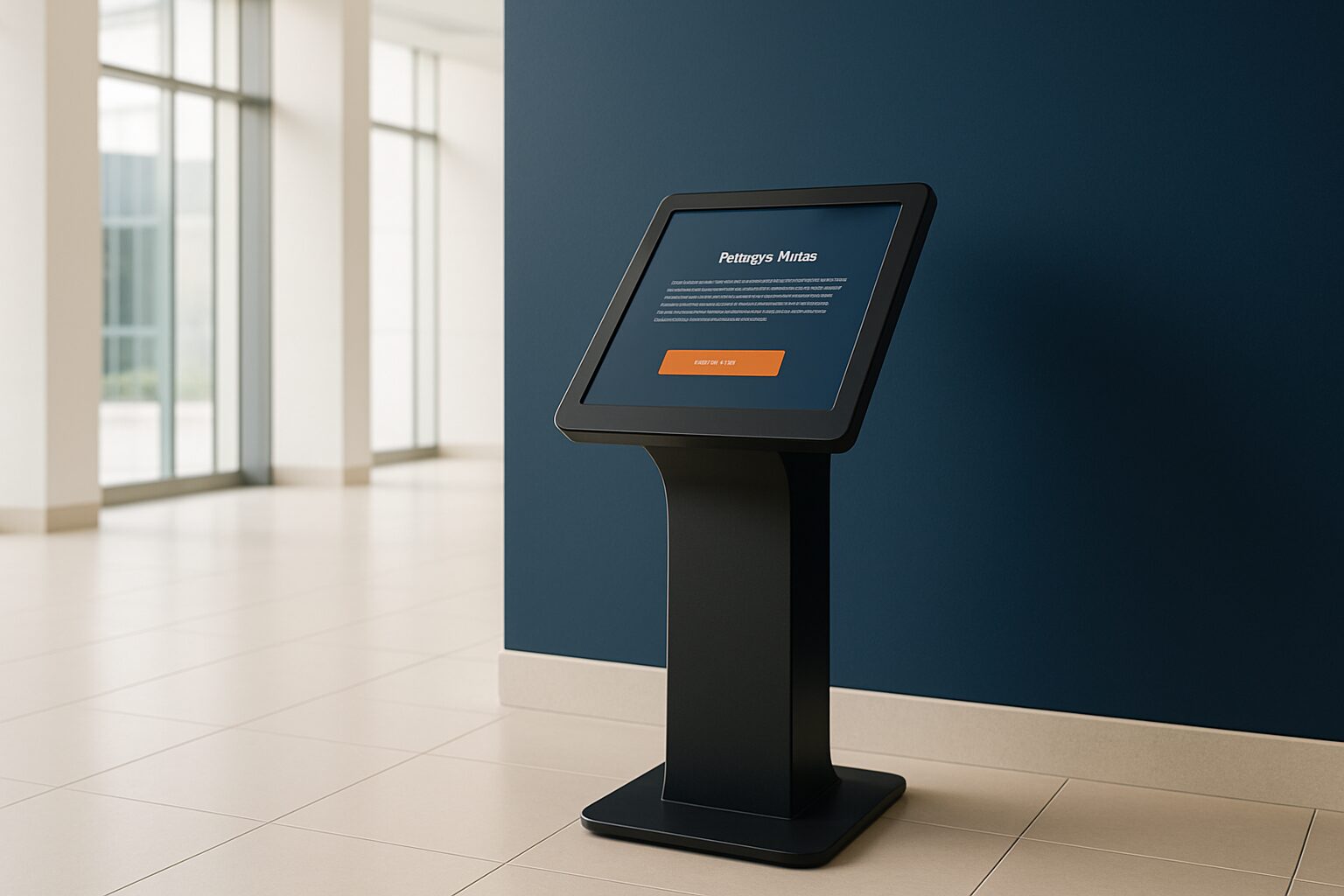
Imagine: a municipality places a PixioKiosk (information kiosk, touchscreen) at the town hall for visitor registration. The 32" variant costs current price on request (price list Q2 2026). Visitors enter their name and appointment details.
This can be implemented in GDPR-compliant fashion if you:
- A privacy notice appears on the screen before input, with an explanation of the purpose, retention period and contact details of the Data Protection Officer (DPO).
- Consent is requested via an active checkbox — unticked by default.
- Automatically deletes data after the agreed retention period (maximum 28 days for camera footage; for appointment registrations you determine your own period based on the purpose).
- Include the processing in the organisation's processing register.
- Does not pass on data to third parties without a separate legal basis.
A paper guest book rarely complies with GDPR, because other visitors can see the data. A digital system with encrypted storage and automatic deletion is structurally safer.
Sanctions: what is at stake?
The Dutch Data Protection Authority (AP) is authorised to impose fines for GDPR infringements. The law has two fine categories:
- Up to current price on request million or 2% of global annual turnover for administrative infringements, such as failing to keep a processing register.
- Up to current price on request million or 4% of global annual turnover for breach of the processing principles or rights of data subjects (Dutch Data Protection Authority, fine policy rules).
In practice, the Dutch Data Protection Authority often first issues a warning for minor infringements. But recent cases show that the regulator actively enforces the rules: the Tax and Customs Administration received a current price on request million-euro fine, DPG Media current price on request Governments are emphatically not an exception — a decentralised government that does not comply with the GDPR may receive a fine (europadecentraal.nl).
Conclusion: start with the question, not the screen
The GDPR status of a public display depends entirely on what the system does, not on how it looks. Store nothing and identify no one? Then there is no problem. Do you record interactions, names or camera images? Then you need a lawful basis, a privacy notice and a processing register — and for large-scale use, a DPIA as well.
Choose hardware that supports your privacy design. A kiosk without a camera and with local processing gives you more control than a cloud-connected system with extensive analytics. For the design of the interaction, also read the article Touchscreen displays for customer interaction: design and best practices in this knowledge base.
Frequently asked questions
Does a digital information screen without interaction fall under the GDPR?
No. A screen that only plays content — video, text, images — without storing data or identifying visitors does not process personal data. The GDPR therefore does not apply. As soon as the screen has a camera, shows forms or records interaction, that changes.
May I use facial recognition in a public kiosk?
Almost never. Facial recognition processes biometric data, a special category under the GDPR. That is prohibited unless the data subject gives explicit consent, or there is a compelling public interest such as securing a nuclear power plant. A shop, municipality or events venue does not meet that threshold. Always carry out a DPIA before even considering using it.
How long may I keep display camera footage?
The Dutch Data Protection Authority uses a guideline maximum of 28 days. Have images of an incident been recorded? Then those images may be kept for longer until the case has been dealt with. Set automatic deletion in your system and record the retention period in your processing register.
Is a DPIA mandatory for a touchscreen kiosk?
Not always. A DPIA is mandatory if there is a high privacy risk — for example with large-scale camera surveillance, facial recognition or continuous monitoring of crowds. For a single sign-in kiosk in a town hall, a DPIA is usually not required, but it is sensible to record a brief written risk assessment.
What should be on the screen when I collect visitor data?
Display a privacy notice before the form with: the purpose of the processing, the retention period, the contact details of the controller or DPO, and how the visitor can exercise their rights (access, deletion). You request consent via an active unticked checkbox.