
Knowledge and advice
Storefront displays in city centres: permits, placement and best practices
Digital shop-window displays in the city centre: when do you need a permit, what brightness is allowed and how do you fit a screen into the streetscape intelligently?
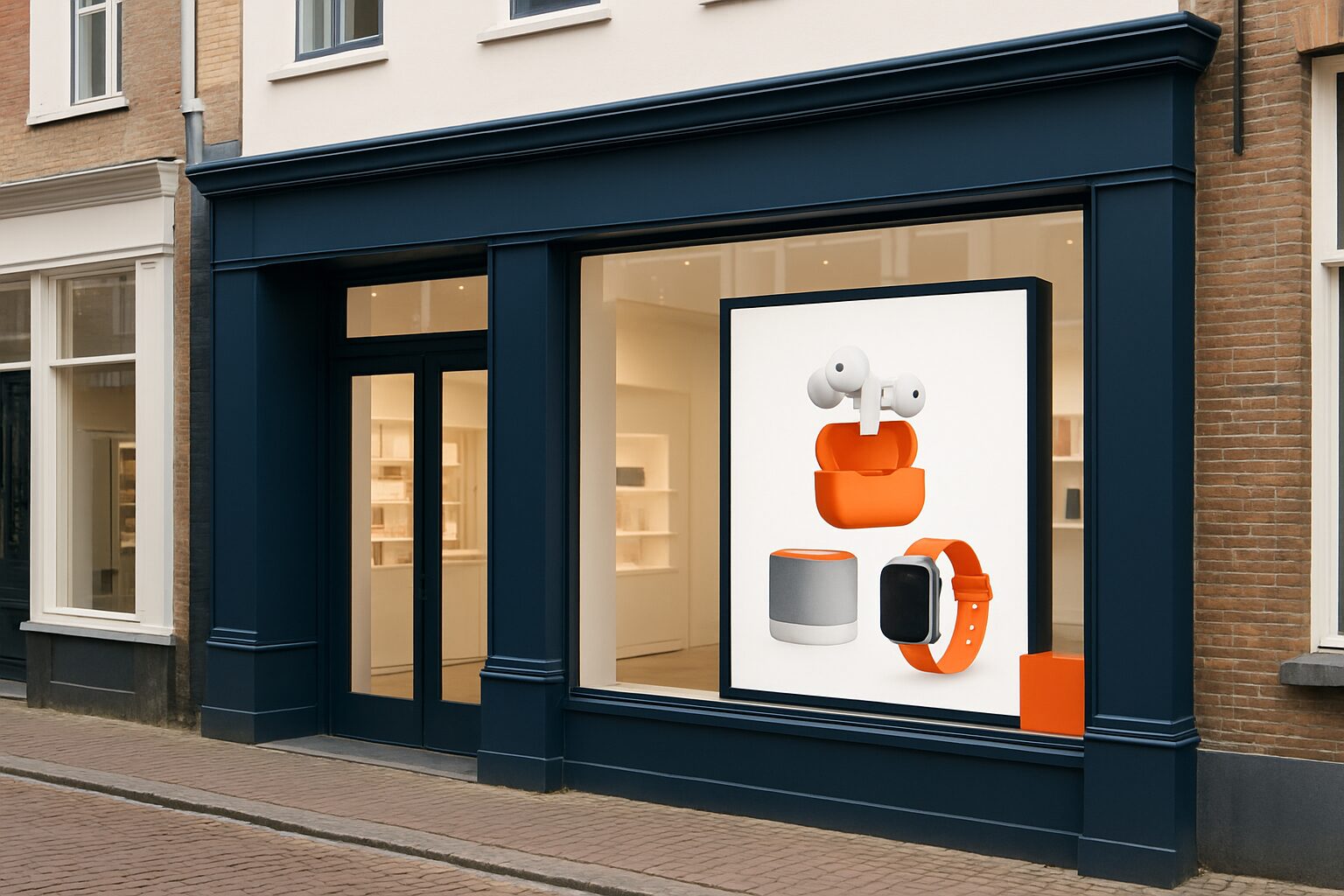
Storefront displays in city centres: permits, placement and best practices
A digital storefront display in a city centre is an advertising medium that falls under municipal advertising policy. As soon as a screen is visible from the public road, a permit may be required. In historic town centres, the requirements are usually stricter than on business estates. Knowing the rules in advance helps prevent enforcement action, fines or mandatory removal.
When do you need a permit?
For placing advertising that is visible from the public road, you usually need an environmental permit. Sometimes a notification is sufficient. Since 1 January 2024, the environmental permit has been regulated in the Environment and Planning Act, which replaces the former Wabo.
Advertising directly behind the shop window aimed at the public realm is regarded by municipalities as façade advertising. That means a screen you place inside but face towards the outside may also require a permit. In many municipalities the rule is: smaller than 0,5 m² is permit-free, but this threshold differs by municipality.
It is prohibited to place or install illuminated or moving advertising without an environmental permit. This explicitly applies to digital screens with changing images. The municipality decides within 8 weeks whether you get an environmental permit. So submit your application well before the planned installation date.
Permit check step-by-step plan:
- Go to omgevingsloket.nl and run the permit check for your address.
- Also check your municipality's local APV (General Local By-law).
- If in doubt, request a preliminary consultation with the Permits department — that saves time.
Historic city centre: stricter rules
Every municipality has its own rules for façade advertising. What is allowed without problems in one municipality may be prohibited in another. Particularly in historic city centres or at listed buildings, strict conditions often apply. The aim is to protect the character of the streetscape.
Under the Environmental Act, differentiation by area and location can be made in the environmental plan, such as a distinction between the historic centre and other parts of the jurisdiction. For example, the municipality of Leiden does not in principle allow digital advertising in the historic city centre and within the protected townscape. A historic city with many listed buildings is not suited to digital and animated advertising. In principle, digital advertising has no place in the historic city centre.
Utrecht municipality goes even further: advertising may not have moving parts or images and no changing or moving light. A scrolling text display is not permitted, and an LED screen may also not be used — at least not without a specific permit and custom approval.
For protected townscapes and listed buildings, a visual amenity review always applies. In the case of advertising near monuments or protected areas, assessment is always carried out by the Image Quality committee.
Light nuisance rules: brightness and times
Brightness is the most critical technical point for digital window displays. To prevent light nuisance from advertising, municipalities assess these against the NSVV (Dutch Foundation for Lighting Science) guidelines and the local bye-law.
LED screens in shop windows must not shine out onto the street or cause nuisance to residents. Businesses are asked to dim screens after 19.00 hours and switch them off after closing time. The Municipality of Groningen uses the following principle: digital screens are only on during opening hours and are switched off after 22.00 o'clock (with the exception of nightlife streets). For digital advertising display, the principle is 'almost still images' only: an image may change once every 10 seconds, provided the transition is gradual.
This has direct implications for screen selection. A window display in a shopping street has different light conditions in the morning than in the full afternoon sun. Pixio Display supplies the PixioDisplay Window Full Sun with 3.000 nits brightness (price list Q2 2026: current price on request for a single-sided 43–55" model), specifically designed for window applications where direct sunlight falls on the glass. For shaded windows, the PixioDisplay Window Shadow (43", 1.000 nits, current price on request) is sufficient. Both models are dimmable, which aligns with the municipal requirement that screens may shine less brightly in the evening.
| Situation | Minimum brightness | Recommended model |
|---|---|---|
| Shaded shop window | 1.000 nits | PixioDisplay Window Shadow |
| Shop window with direct sunlight | 3.000 nits | PixioDisplay Window Full Sun |
| Free-standing outdoors (pavement) | 3.500 cd/m² | PixioDisplay Outdoor |
| Indoors (no daylight) | ~400 cd/m² | Standard display |
Placement on the pavement: display or permit?
If you want to place a display on the pavement rather than behind the window, different rules apply. With a view to maintaining and promoting accessibility of the public outdoor space and limiting nuisance, any display has a maximum permitted width, depth and height. The exact dimensions are set out in the local APV or zoning plan.
In some municipalities you pay advertising tax or a precinct tax. Advertising tax is payable if the advertisement can be seen from the public road, for example on advertising boards or light boxes. Precinct tax is payable for advertising on or above municipal land.
A practical alternative to the pavement is a battery-powered display. The PixioDisplay A-board (43", price list Q2 2026: current price on request for the 1.500 nits version or current price on request for 2.000 nits) has a battery life of 14–18 hours and requires no power outlet. That solves a common practical bottleneck: most municipalities do not allow power cables across the pavement.
Dunkin' Donuts applied a similar approach with digital shop window posters via the PixioDisplay Window. By placing the screen behind the window — and therefore not on the pavement — the installation fell outside the shopfront display rules and the threshold for permit approval was lower.
Best practices for aesthetic integration
A display that fits the streetscape increases the chance of permit approval and prevents complaints from residents and the municipality. Keep these points in mind:
- Size: choose a screen size that is proportionate to the shop window opening. A 55" screen in a narrow boutique attracts more attention than the local authority allows.
- Image switching: allow a changeover time of at least 8–10 seconds. Faster changes are explicitly prohibited by several municipalities and lead to traffic distraction.
- Dimming function: set automatic dimming schedules. In the evening after 19.00–22.00 o'clock (depending on the municipality) the screen should be dimmer or off.
- Content: keep content focused on your own range or services. An advertising column must have a functional relationship with the building on or near which it is placed. Standalone columns erected solely with the intention of advertising for third parties are not permitted.
- Colour and style: the municipality assesses whether your advertising fits the streetscape and whether the design meets local requirements, such as size, colour use and lighting. Choose calm colour palettes in protected cityscapes.
Start with a preliminary discussion with the municipality if you are unsure. It is not compulsory, but it saves you weeks of lead time if the application later needs changes.
Conclusion: start with the municipality, then the screen
The permit request comes before the screen choice — not after it. Check via the Environment and Planning Portal whether your location requires a permit, request the local by-law and, if in doubt, hold preliminary consultation. Only then choose the screen that suits the lighting conditions and the municipality's requirements for brightness and image changes.
For a full overview of digital displays for retail and shop window communication, including technical specifications and application examples, read the complete retail guide to digital window displays and shop displays.
Frequently asked questions
Do I always need a permit for a digital screen in my shop window?
Not always, but often. As soon as a screen is visible from the public road, it counts as façade advertising and in many municipalities a planning permit is required. In historic town centres, the requirements are stricter than on business parks. Do the permit check via omgevingsloket.nl for your specific address.
What brightness may a shop window display have in the city centre?
That varies by municipality and by time of day. During the day in full sun, you need at least 3.000 nits for a readable image; in the evening, screens must be dimmed. Several municipalities require displays to be switched off after 22.00 hour or run at minimum brightness, in accordance with the NSVV Light Nuisance Guideline.
May I place a digital pavement sign in front of my shop in the city centre?
That depends on the local bye-law and the municipality’s display policy. Some municipalities prohibit sandwich boards or set requirements for width, depth and height. A battery-powered display on the pavement also avoids a power cable across the footpath, which is a common municipal requirement.
How quickly may my digital shop window display change images?
Several municipalities apply a minimum transition time of 10 seconds per image, with a gradual transition. Faster changes or flashing effects are banned in almost all municipal advertising policies because of traffic distraction and light nuisance.
What is the difference between advertising tax and precariobelasting for a shop window display?
Advertising tax is payable if your display is visible from the public road. Precario tax is payable if the display is on or above municipal land, such as the pavement. Some municipalities have included precario tax in the permit costs. Check with your municipality which taxes apply.