
Knowledge and advice
Shop window displays in city centres: permits, placement and safety
Everything about permits, safety standards and placement rules for digital window displays in Amsterdam, Brussels and Antwerp. With checklists for installers and retailers.
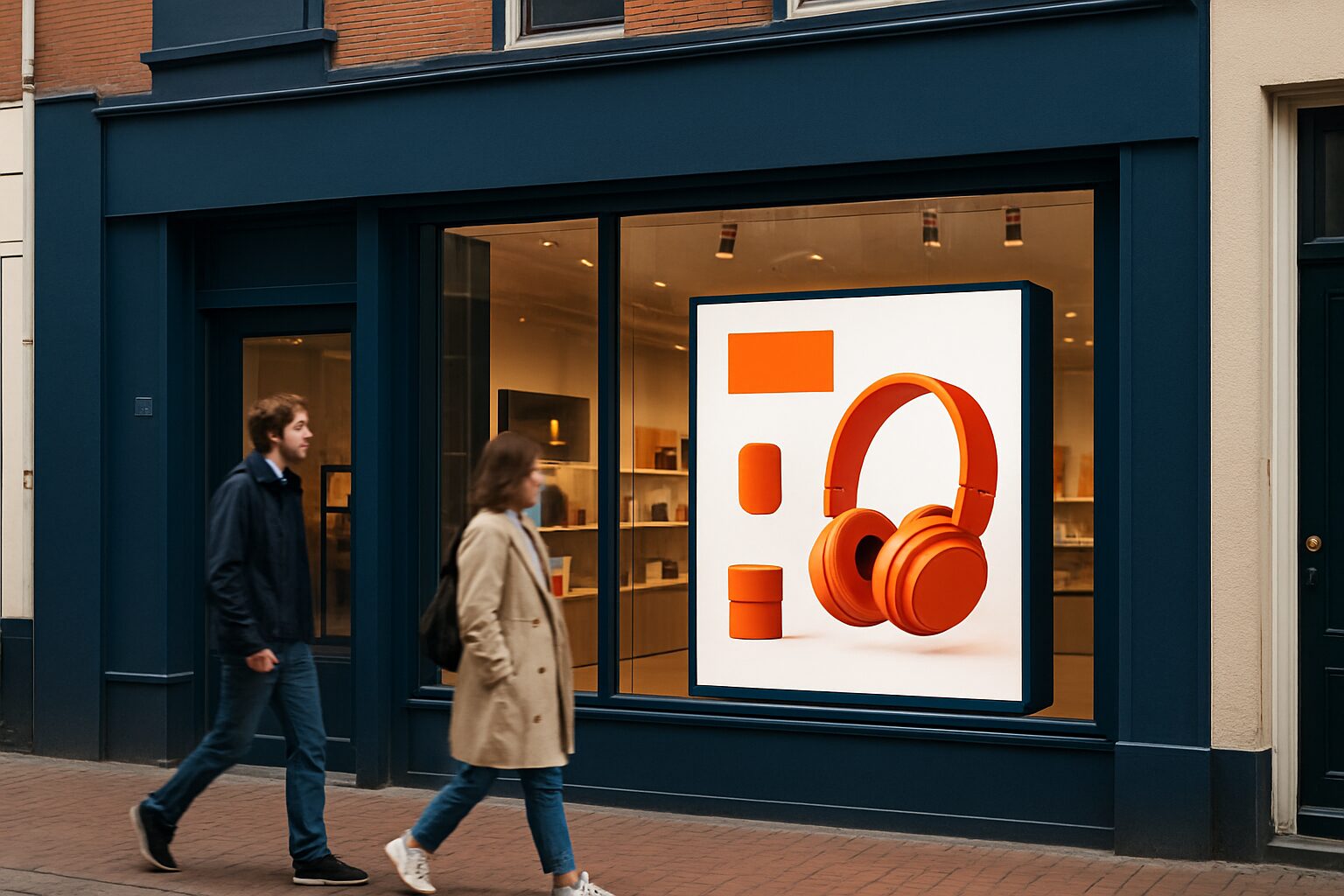
Shop window displays in city centres: permits, placement and safety
A digital shop window display is a screen visible from the public road through a shopfront and showing commercial or informational messages. Such displays legally fall under the municipality's advertising policy, the aesthetic requirements of the Environmental Act and the electrical safety standards (NEN 1010, IP classification). Whether a permit is needed depends on the location, the type of mounting and the municipality. Anyone who does not check this in advance risks a penalty payment or an order for removal.
In short
- A display behind the shop window legally counts as a public announcement and in many municipalities falls under advertising tax and sometimes a permit requirement.
- Amsterdam applies strict urban design rules; displays that dominate the façade are not permitted in protected cityscapes without an environmental permit.
- In Flanders (including Antwerp), the Flemish Advertising Regulation applies (in force since 1 January 2024); LED displays without automatic brightness adjustment cannot be granted a permit.
- In Brussels, a planning permit for advertising installations is always temporary in nature.
- For electrical installations, NEN 1010 applies; for outdoor installation, at least IP54 is required, IP65 is the recommended standard.
What counts as a public announcement?
A display does not need to be outdoors to fall under advertising rules. Announcements in shop windows are visible from the public road and are therefore chargeable as public notices. This also applies to advertising on the inside of shop windows or windows that face and/or are visible from the public road.
It does not matter whether the screen is mounted on the wall or on a floor stand. As soon as the display is visible from the pavement, it is a public announcement in the sense of the municipal advertising tax. In Amsterdam, the advertising tax is calculated on the total number of square metres visible from the public road.
For installers, this is an important starting point: always ask the retailer whether the municipality is already expecting an advertising tax declaration. That is a different procedure from the permit requirement, but both may apply.
Permit requirement: when does it apply?
The licensing requirement depends on three factors: the municipality, the mounting method and the location (protected townscape or not).
A display that is connected to the ground or forms a structural part of the façade is regarded as a structure. Structures require a planning permit for construction before installation. The objects must be assessed against reasonable aesthetic requirements, considering whether an advertising object fits its surroundings and whether it has been expertly designed.
A free-standing screen on a floor stand inside the shop, not attached to the façade or floor, usually falls outside the building permit requirement — but still under the APV rules for commercial advertising. Under article 8.5 of Amsterdam's APV, it is prohibited to place objects in public space for advertising purposes without an exemption from the Mayor and Aldermen.
So always start with two questions:
- Is the display attached to the facade, floor or structure? → Planning permission is probably required.
- Is the display visible from the public road? → APV exemption and advertising tax may apply.
Amsterdam: aesthetics as the strongest brake
Amsterdam has the strictest advertising policy for the city centre of all major Dutch cities. Private displays in public space are in principle not permitted. The outdoor advertising policy framework explains how the municipality of Amsterdam deals with advertising in public space; the scope covers all advertising located in public space.
Concrete example: In 2021, Amsterdam imposed an order subject to a penalty payment on a shop that had placed large LED screens with moving images in the shop window without an environmental permit. The screens had to be removed. The Committee for Beauty and Monuments had already issued a negative opinion in 2018: the advertising screen had been positioned in such a way that it effectively became part of the facade image.
This does not mean that digital window displays in Amsterdam are impossible. Displays that are not attached to the structure, do not show moving images that dominate the public space, and fit within the visual standards of the relevant district can operate without objection. Permits for a district are applied for at the relevant district and are valid only for that district.
Practical advice for Amsterdam: always hold a pre-consultation with the district before installing a screen. Ask specifically about the aesthetic criteria for the property and the street.
Antwerp and Brussels: Belgian regulations in brief
In Belgium, a different administrative structure applies. Antwerp and other Flemish cities fall under the Flemish Advertising Ordinance, which came into force on 1 January 2024. If the advertising is visible from public roads, it falls under the Flemish Advertising Ordinance. All advertising installations must meet the general requirement of good spatial planning.
A critical technical point for Flanders: LED signs without automatic brightness adjustment cannot be granted a permit, in order to limit nuisance and traffic safety risks. Anyone placing a display in Antwerp must therefore show that the screen automatically adjusts its brightness to ambient light. If you want to place advertising on the facade of your company premises in the city of Antwerp, you must apply for an environmental permit.
In Brussels, the situation is similar but based on the Brussels Spatial Planning Code. Unlike other planning permits, the permit for advertising installations and signs is always limited in time. Illuminated signs and screens visible from public space explicitly fall under Regional Town Planning Regulation Title VI.
Comparison: permit requirements by city
| City | Regulations | Permit required? | Particulars |
|---|---|---|---|
| Amsterdam | APV + quality of life policy note | Yes, in the case of façade mounting or protected cityscape | Strict planning review; moving image in city centres is risky |
| Antwerp | Flemish Advertising Regulation (2024) | Yes, when visible from a public road | Automatic brightness adjustment required for LED |
| Brussels | Brussels Code RO + GSV Title VI | Yes, always temporary in nature | Advertising installations permit never permanent |
| Other Dutch municipalities | APV + local advertising policy | Depending on municipality and installation | Many municipalities use fast-track criteria |
Electrical safety: NEN 1010 and IP ratings
Every display installation is an electrical installation. In the Netherlands, electrical installations in buildings must comply with the Building Decree, which refers for low-voltage installations (up to 1.000 V AC) to NEN 1010. When an electrical installation complies with NEN 1010, compliance with the legal requirements is presumed.
This has direct implications for installers. NEN 1010 focuses on the installation of new electrical systems and describes how wiring, earthing and overload and short-circuit protection must be installed correctly. NEN 3140 deals with the safe use and maintenance of existing systems.
For displays placed outdoors or in shop windows where moisture plays a role, the IP classification (Ingress Protection) is decisive. The standard is based on IEC 60529. The recommendation:
- IP54: suitable for covered outdoor locations, such as an indoor shop window with shelter. Protected against splashing water from all directions.
- IP65: the standard for free-standing outdoor displays. Completely dust-tight and resistant to water jets, including heavy rain.
- IP67: necessary in case of flood risk or cleaning with a pressure washer.
IP65 is the most commonly used class for freestanding outdoor displays. It offers full protection against dust and keeps out water jets — including heavy rain. A display with an IP65 rating can still overheat at high ambient temperatures if there is no active cooling: IP rating and thermal specifications are complementary requirements, not substitutes for each other.
Watch out for a common mistake: some manufacturers only state the IP rating of the front of the panel. Always request the full test report based on IEC 60529 to check whether the housing and connections also provide the stated protection.
Brightness: the technical requirement that determines the choice
In addition to permit and safety, brightness is the most underestimated technical parameter. A standard indoor monitor reaches 300 to 500 nit. In a sunny location, that is unreadable: direct sunlight quickly reaches 10.000 lux or more.
The rule of thumb:
- Indoor setup, no direct sun: 400 cd/m² is sufficient.
- Shop window with direct sunlight: minimum 3.000 nits.
- Free-standing outdoors: at least 3.500 cd/m².
The panel — not the size — determines the extra cost. The PixioDisplay Window Full Sun (3.000 nits) is available from 43 to 55 inches, single-sided from current price on request and double-sided up to current price on request (price list Q2 2026). The PixioDisplay Outdoor (3.500 cd/m²) starts at current price on request for 49 inches. Dunkin' Donuts used the PixioDisplay Window for digital shop window posters: a practical case where brightness and visibility from the street were decisive in the product choice.
For the Flemish market, automatic brightness adjustment is also a legal condition for permit approval. So always choose a screen with an integrated light sensor that adjusts brightness to the ambient light.
Placement rules and pavement use
Anyone who wants to place a display outside the shop — as a digital pavement sign or free-standing screen — will face additional rules. In Amsterdam, retailers may place up to two pavement signs of limited size directly in front of their shop. These signs must not obstruct the passage and must be removed from the pavement after closing time.
In Flanders, a minimum pavement width of 1,5 metres applies for pedestrians. Always check with the road authority and the municipality what the exact dimensional requirements are.
A battery-powered digital pavement sign — such as the PixioDisplay Stoepbord (43", 1.500 nits, 14–18 hours runtime, no power point needed) for current price on request (price list Q2 2026) — solves the cable problem but does not exempt you from placement rules. Check whether the municipality requires a permit for digital pavement signs and whether the screen must be removed after closing time.
Checklist for installers and shop owners
Use this checklist as a starting point. Each municipality has its own rules; this overview does not replace preliminary consultation with the local authority.
Before purchase
- Check the municipal advertising policy (APV + visual quality policy or Flemish/Brussels regulations).
- Determine whether the screen will be attached to the facade or structure → apply for an environmental permit.
- Check whether the building is in a conservation area or monument zone.
- Check whether the municipality levies advertising tax on shop window announcements.
At the product selection
- Choose the right brightness: 400 cd/m² (indoor), 3.000 nits (shop window sun), 3.500 cd/m² (outdoor).
- Check the IP rating: at least IP54 for covered locations, IP65 for open outdoor installations.
- Request the full IEC 60529 test report, not just the frontal rating.
- Check whether the screen has an automatic light sensor (mandatory in Flanders for LED displays).
During installation
- Ensure that the electrical installation complies with NEN 1010 (low voltage).
- Have the installation carried out by a certified installer.
- Document the installation for insurer and municipality.
- Check whether the display must be switched off or removed after closing time.
After installation
- Submit an advertising tax return if the municipality requires it.
- Schedule periodic NEN 3140 inspection of the electrical installation.
- Keep the environmental permit and test report available for inspection.
Conclusion
Installing a digital shop-window display in a city centre requires three parallel tracks: the permit process with the municipality, the technical choice for brightness and IP protection, and the electrical installation in accordance with NEN 1010. Start with the municipal pre-consultation — that determines the room to manoeuvre for the rest. Anyone in Amsterdam with a protected cityscape chooses an indoor screen without façade mounting. Anyone in Antwerp or Brussels who wants an illuminated display arranges the environmental permit before purchase.
For the hardware choice, the PixioDisplay Outdoor a certified solution for free-standing outdoor installation (3.500 cd/m², from current price on request), while the PixioDisplay Window Full Sun the standard is for shop windows with direct sunlight.
Frequently asked questions
Do I need a permit for a digital screen in my shop window?
That depends on the municipality and the method of installation. A screen attached to the façade or structure is legally considered a structure and requires an environmental permit. A freestanding screen on a floor stand usually does not fall under the building permit requirement, but it does fall under the APV rules for commercial advertising. In protected townscapes, such as the centre of Amsterdam, additional aesthetic requirements apply. Always have a preliminary consultation with the relevant district or municipality.
Does advertising tax also apply to a screen behind my shop window?
Yes, in many municipalities. Announcements in shop windows are visible from the public road and therefore fall under advertising tax. Amsterdam calculates the tax based on the total number of visible square metres. Check with your municipality whether you need to file a return and which rate applies.
What are the rules for digital window displays in Amsterdam?
Amsterdam applies a strict advertising policy, especially in the city centre. Displays that dominate the façade image or show moving images are not allowed in protected cityscapes without an environmental permit. The Committee for Urban Design and Monuments assesses whether a screen fits the streetscape. Permits are applied for per district and only apply to that district. Always consult the district council in advance.
Which rules apply in Antwerp for a digital advertising screen?
In Antwerp, you must apply for an environmental permit for advertising on the façade of your business location. In addition, the Flemish Advertising Regulation applies (in force since 1 January 2024). LED displays without automatic brightness adjustment cannot be permitted. The advertising must also be related to the products or services offered at that location.
How does it work with permits in Brussels?
In Brussels, a planning permit for advertising installations and signs is always limited in time — unlike other planning permits. Illuminated signs and screens visible from public space fall under Regional Town Planning Regulation Title VI. Apply for the permit from the competent regional or municipal planning department.
What IP rating does a shop window display need?
For a display behind glass in a dry indoor space, an IP rating is not critical. For a screen in a covered outdoor location (such as a canopy or recessed entrance), IP54 is sufficient. For a freestanding outdoor display, IP65 is the recommended standard: fully dust-tight and resistant to water jets. Always request the full IEC 60529 test report — some manufacturers only state the IP rating of the front side.
What brightness does a shop window screen need?
A standard indoor monitor reaches 300–500 nits, which is unreadable in direct sunlight. For a shop window with direct sun, at least 3.000 nits is needed. For a free-standing outdoor display, 3.500 cd/m² is the guideline. The panel — not the screen size — determines the extra cost. In Flanders, always choose a screen with an automatic light sensor, because that is legally required for permit approval.
Can I place a digital pavement sign on the pavement?
In Amsterdam, shop owners may place a maximum of two small A-boards directly in front of their shop. They must not obstruct the passage and must be removed after closing time. In Flanders, a minimum pavement width of 1,5 metres for pedestrians applies. Always check with the road authority and the council whether a permit is required for a digital A-board.
Which electrical standard applies to the installation of a display?
In the Netherlands, electrical installations must comply with NEN 1010, the standard for low-voltage installations in buildings. This standard is designated in the Building Decree. For the safe use and maintenance of existing installations, NEN 3140 applies. Have the installation carried out by a certified installer and document the work for the insurer and any municipal inspection.
Can I use an ordinary consumer TV as a window display?
This is strongly discouraged. Consumer TVs reach around 300 nits and are not designed for continuous use. They are also not certified for outdoor installation and lack the IP protection that may be needed for window display placement. Commercial displays are designed for 24/7 use and usually have higher brightness, better thermal management and a longer warranty. The warranty on a consumer TV is also void in commercial use.