
Knowledge and advice
E-ink displays: when is that a smart alternative?
E-ink displays use barely any power and are ideal for static information. Discover when e-paper beats LCD — and when it does not.
E-ink displays: when is that a smart alternative?
An e-ink display (also known as e-paper or electronic paper) is a screen technology that displays text and images by moving charged pigment particles in microcapsules. The screen only uses power when the image changes — not to retain the content. That makes e-ink fundamentally different from LCD or LED: no backlight, no continuous power consumption, and paper-like readability even in direct sunlight.
How does e-ink work technically?
E-ink uses small microcapsules with positively charged white and negatively charged black particles in a clear liquid. When an electric field is applied, the particles rearrange into text or images on the screen surface.
E-ink is "bistable": the screen usually does not need a constant power supply to retain the display. This principle — energy only when changing, not when showing — is the basis of all the benefits.
Refresh rates are slow: typically 1 to 15 seconds for a full screen refresh. That is the direct consequence of the technology. For video or animation, e-ink is therefore unsuitable.
The three concrete benefits of e-ink in signage
1. Extremely low power consumption
Depending on usage, e-paper displays use only one to two percent of the annual electricity costs of an LCD display. That delivers significant cost savings compared with conventional digital signage solutions.
An e-paper display is the most energy-efficient choice when the application requires fewer than four image changes per day. Think of meeting room signs, opening hours or floor plans.
2. No cable to the socket
The ultra-low power consumption means e-ink screens run for months on a single battery charge, without cabling to every location — a significant installation convenience in office environments.
Because e-paper displays do not need to be connected to power, they can be mounted quickly and easily anywhere. Wherever needed, you can provide visitors with relevant information, and the displays are also easy to move.
3. Excellent readability in sunlight
Readability in sunlight is excellent because e-ink reflects ambient light instead of emitting its own light — making it perfectly readable in direct sunlight without the high brightness required by LCD technology.
An LCD display for outdoor use needs at least 3.000 nits to remain readable — the PixioDisplay Window Full Sun achieves that with its 3.000 nits panel. E-ink achieves the same result without a backlight, purely by reflection.
When do you choose e-ink — and when not?
The choice depends on two variables: how often the content changes, and does the screen need to show video or colour?
| Criterion | E-ink wins | LCD/LED wins |
|---|---|---|
| Update frequency | Less than ~4× per day | Several times per hour |
| Content type | Text, schedules, prices, floor plans | Video, animations, live data |
| Installation | No power socket available | Fixed cabling present |
| Readability | Direct sunlight, no backlight needed | Dark space, high brightness required |
| Colour reproduction | Limited (grey, limited colour) | Full colour spectrum |
| Sustainability/ESG | Priority | Less relevant |
E-ink is not a replacement for LCD — it is a supplement. Each technology has a clearly different field of application.
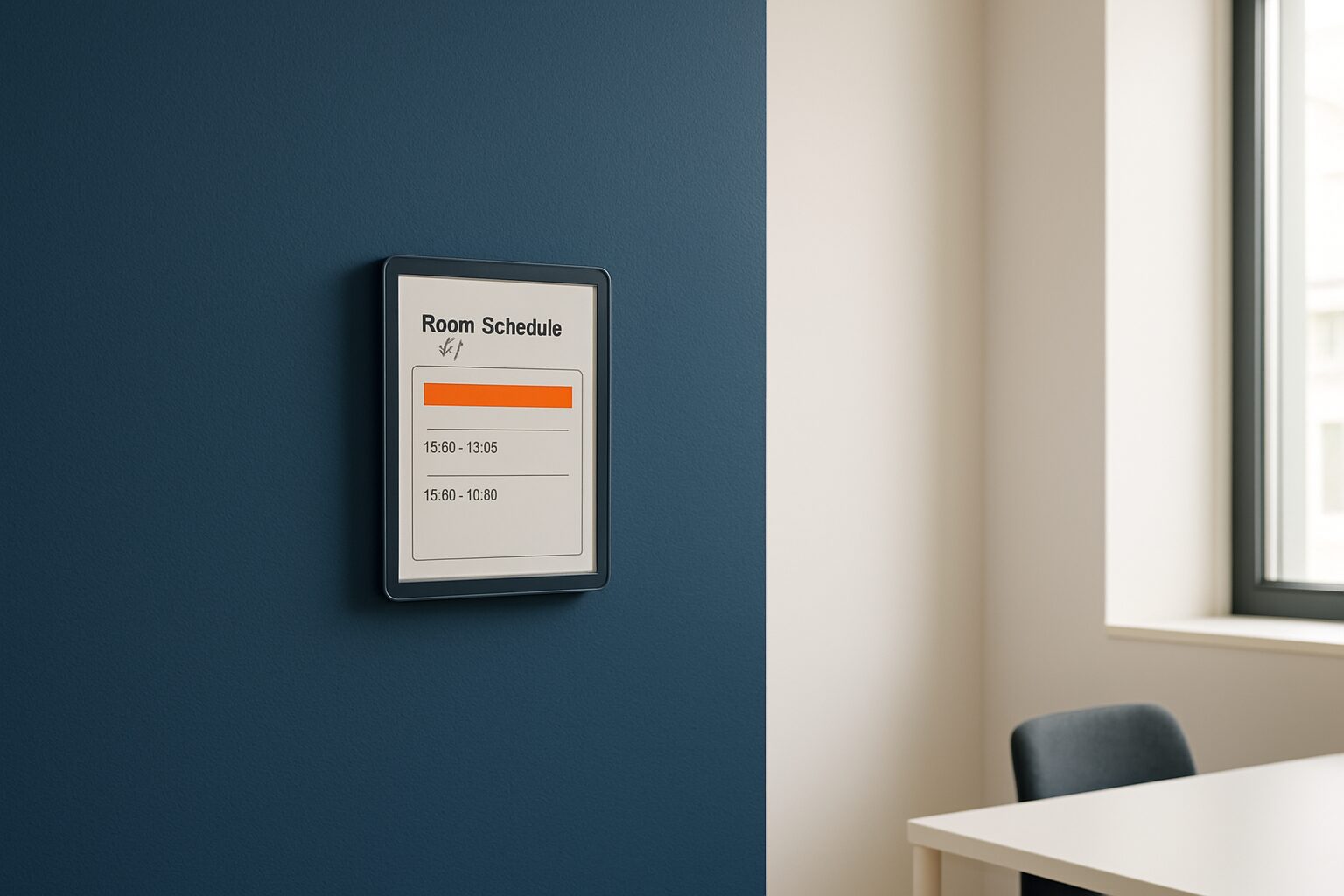
A concrete example: the most successful commercial application of e-ink in signage today is meeting room signs next to the door. Providers such as Joan, Visionect and Roomz offer e-ink displays that show availability, current and upcoming meetings, and booking information. Because meeting information only changes a few times a day, the slow refresh rate of e-ink is no problem at all.
Where e-ink makes a difference in practice
Meeting room signs and office wayfinding
E-ink panels outside meeting rooms show the bookings for that day, synchronised with Google Calendar or Outlook. The screen updates when a meeting starts or ends and uses no power in between.
Electronic shelf labels in retail
Electronic shelf labels are the largest e-ink signage market. Retailers update prices across thousands of labels from one central system — no more printed paper labels that need replacing. The displays remain readable under shop lighting and last for years on a small battery.
Public transport and bus stations
Bus and train timetables on e-ink boards remain readable in full sun and rain, provided they are fitted with IP-certified enclosures. Professional models are usually resistant to temperatures from -20 °C to +50 °C, although refresh times may be slightly affected in extreme conditions.
When do you still choose an LCD display?
E-ink has clear limits. Colour reproduction with current colour e-ink is limited compared with LCD: muted tones rather than saturated colours. Want to run a promotional video, show a live social media feed or switch dynamic campaigns? Then LCD is the right choice.
A digital pavement sign with battery — such as the PixioDisplay A-board from Pixio Display (from current price on request for 1.500 nits, price list Q2 2026) — combines the cable-free installation convenience of e-ink with full LCD colour reproduction and 14 to 18 hours of runtime. That is the better choice when you want to show colourful campaigns without a socket, but still need full visual impact.
For locations where a power socket is available and content changes regularly, offers a digital information column with a touch screen more flexibility than e-ink could ever offer.
E-ink vs LCD: the key question
Start with e-ink if your content mainly consists of text or schedules, changes less than four times a day, and there is no mains socket available. Choose LCD as soon as you need video, animation or full colour — or if the content changes several times an hour.
For a broader overview of all display technologies and their specifications, read the article Display specifications explained: what you need to know to make the right choice.
Frequently asked questions
How long does an e-ink display last on battery?
That depends heavily on the update frequency and the size. Smaller e-ink displays last for months on a single charge. Larger models of 32 inch with two batteries can, under optimal conditions, last for up to a year without recharging. The more often the content changes, the faster the battery drains.
Is e-ink suitable for outdoors?
Yes, e-ink is highly readable in direct sunlight because it reflects ambient light rather than emitting its own light. Professional outdoor models are usually resistant to -20 °C to +50 °C. Do choose a model with a suitable IP rating (for example IP65) for damp or outdoor environments.
Can e-ink display video or animations?
No. E-ink has a refresh time of typically 1 to 15 seconds per full screen change. That makes the technology unsuitable for video, animations or rapidly changing content. For those applications, an LCD or LED display is the right choice.
What is the difference between e-ink and a battery-powered LCD display?
E-ink uses virtually no power in a static state and can therefore run for months on battery power. A battery-powered LCD display — such as the PixioDisplay Pavement Sign — uses power continuously and has a runtime of 14 to 18 hours per charge, but offers full colour reproduction and is suitable for video and animations.
For which sectors is e-ink most suitable?
E-ink is most commonly used for meeting room signs, office wayfinding, electronic shelf labels in retail, maps, opening hours and information boards in public transport. The common feature: static or only slightly changing textual information, without the need for video or bright colours.