
Knowledge and advice
Trade fair stand displays and GDPR: privacy in visitor tracking and analytics
What may you measure on your exhibition stand? Read which GDPR rules apply to visitor tracking, camera analytics and touchscreen data — and how to remain compliant.
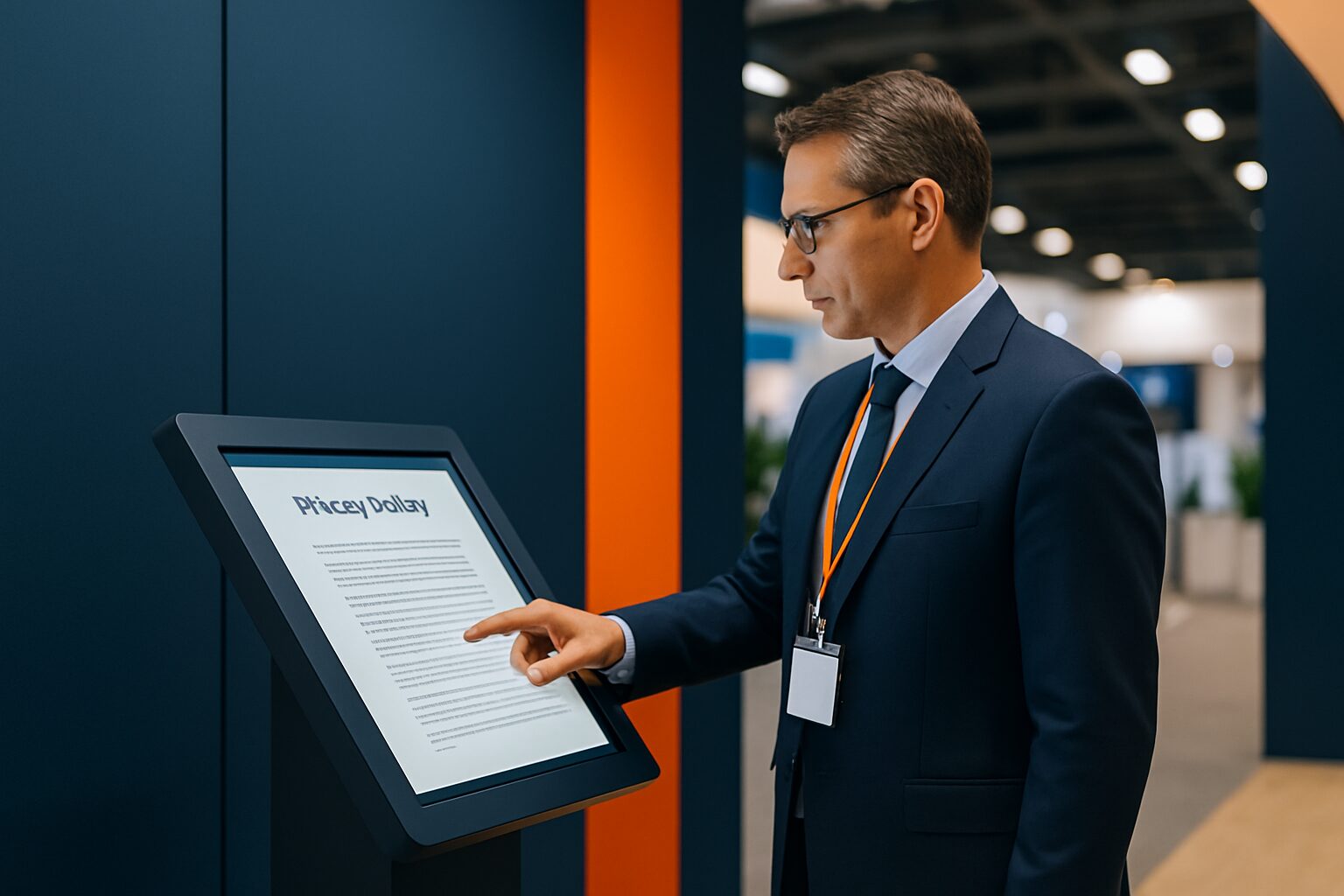
Visitor tracking on a trade fair stand falls fully under the GDPR (General Data Protection Regulation, also known as GDPR). As soon as you use screens, cameras or touch kiosks to identify, count or profile visitors, you process personal data. Biometric data — such as facial recognition — are legally special personal data and in principle prohibited without explicit consent. Anonymous count data (footfall figures without linkage to individuals) falls outside that category and is permitted without additional legal basis.
What counts as personal data at a trade fair stand?
Not every measurement is legally the same. The distinction determines which GDPR obligations apply to you as a stand builder or exhibitor.
| Type of data | Personal data? | Need a legal basis? |
|---|---|---|
| Anonymous visitor counting (infrared, pressure sensor) | No | No |
| IP addresses or device IDs via WiFi tracking | Yes | Yes (legitimate interest or consent) |
| Facial recognition / demographic analysis via camera | Yes — special | Explicit consent required |
| Name + email via touchscreen form | Yes | Permission or contract |
| Heatmaps based on camera images (without ID) | Grey area | Depending on the processing method |
The Autoriteit Persoonsgegevens (AP) states that biometric data are special categories of personal data when they are used to identify someone. Processing it is in principle prohibited.
Biometric tracking: two exceptions, strict requirements
If you want to use facial recognition or demographic camera analytics on your stand, only two legal exceptions apply. In principle, it is prohibited to use biometric data to identify someone. There are only two exceptions: the filmed people have given explicit consent, or facial recognition is used for security or authentication purposes to serve a 'substantial public interest' — such as the security of a nuclear power plant.
A trade fair stand does not fall under that overriding general interest. Permission is therefore the only realistic basis — and it places high demands. At events, facial recognition may only be used on the basis of explicit consent from visitors. That consent must really be freely given — ordinary consent is not enough. Consent must be free, specific and informed, and visitors must also be able to attend the event without facial recognition.
In practical terms, this means you may not require a visitor to walk past a face scanner in order to enter your stand. There must always be an equivalent alternative.
When is a DPIA mandatory?
A Data Protection Impact Assessment (DPIA) is a risk analysis you carry out before you start processing. A DPIA is mandatory if personal data are processed to track people on a large scale and systematically in a publicly accessible area.
The AP has published an official list of processing activities for which a DPIA is mandatory. This includes, among other things: large-scale and/or systematic monitoring of publicly accessible areas using cameras, webcams or drones. A busy trade fair floor qualifies as such a publicly accessible area.
If the number of cameras is greater than 10, or if intensive, long-term monitoring takes place — such as continuous monitoring of large crowds — you are required to carry out a DPIA. Record this risk assessment in your processing register and include technical and organisational measures to reduce risks for data subjects.
For an average trade fair stand with one or two anonymous counting cameras, a DPIA is usually not required. If you use multiple cameras with AI analysis, or link image data to CRM profiles, the DPIA threshold is reached quickly.
Touchscreen kiosks and form data: consent and retention period
Touchscreen kiosks at a trade fair stand often actively collect personal data: contact forms, quizzes, product configurators with e-mail opt-in. According to GDPR, you must ask for permission to store data, inform visitors what you do with the data and indicate how long you keep it.
The PixioKiosk (21,5" to 49", rent from current price on request per day with a minimum rental period of two weeks — price list Q2 2026) runs on Android 13/14 with an integrated computer. This means form data is stored locally or via a cloud connection. If using cloud storage, ensure you have a data processing agreement with the software supplier, as data may not be stored outside the EU/EEA without Standard Contractual Clauses.
Practical checklist for touchscreen forms on your stand:
- Ask for active consent (tick box, no pre-ticked box)
- State the processing purpose (e.g. follow-up after the trade fair)
- Specify a retention period (for example, 6 months after the event)
- Offer an opt-out option (by email or on site)
- Store data within the EU or with valid SCCs
Anonymous analytics: what is allowed without consent?
Not all measurement is prohibited. Anonymous visitor counting — where no individual is identifiable — falls outside the GDPR. Think of:
- Infrared counters that only record numbers
- Heatmaps based on aggregated walking patterns without personal characteristics
- Screen interactions on touch displays that only log click paths without user ID
As soon as you link this data to a device ID, timestamp and location, the combination can still be traceable back to a person. Be careful with that: under the GDPR it is about purpose, basis, timing and transparency — even with data that at first sight seems anonymous.
Want to know how many visitors your stand attracted and how long they stayed? You can do that in a GDPR-compliant way with a simple infrared counter or via the interaction data from your touch screen, provided you do not build personal profiles.
Belgian context: DPA and the same GDPR rules
In Belgium, the Data Protection Authority (GBA) monitors compliance with the GDPR — the same European regulation. The substantive rules are identical to those in the Netherlands. One of the grounds for exception for processing biometric data is the explicit consent of the data subject. The GBA emphasises that in an employment-related or dependency relationship, consent is rarely considered 'freely given' — a principle that may also apply to trade fair visitors if access is effectively linked to consent.
If you are organising a stand at a Belgian trade fair (such as Brussels Expo or Antwerp Expo), the same DPIA obligations and consent requirements apply as in the Netherlands.
Set up compliantly: start here
If you choose a touchscreen display or information column for your trade fair stand, start with the least privacy-invasive option: anonymous interaction data, no facial recognition, and a clear consent screen for forms. That is not only legally safer — it also lowers the threshold for visitors to interact.
At trade fair stand displays hire or buy, we always advise determining in advance which data you want to collect. That determines which screen type and software integration you need — and which GDPR obligations are associated with it.
Want to know more about the practical setup of your trade fair stand? Also see the article Exhibition stand hire in the Netherlands: complete cost breakdown per location for a complete overview of what goes into a stand.
Frequently asked questions
May I use a camera at my trade fair stand to count visitors?
Yes, provided the camera only collects anonymous counting data and does not identify individuals. As soon as the camera recognises faces or creates demographic profiles, you are processing biometric data — and that requires the explicit consent of each visitor. A simple infrared counter or aggregated heatmap without personal characteristics falls outside the GDPR.
Is a DPIA mandatory for my trade fair stand?
That depends on the scale and nature of your processing. If you use one or two anonymous counting cameras, a DPIA is usually not required. If you deploy multiple cameras with AI analysis, facial recognition or linkage to CRM profiles, the DPIA threshold is reached quickly — and you must carry out the assessment before you start processing.
How do I correctly request consent via a touchscreen kiosk on my stand?
Use an active consent moment: an unticked box where the visitor makes the choice themselves. State the processing purpose, retention period and how someone can withdraw consent. Pre-ticked boxes or 'continuing means consent' are not valid under the GDPR.
Do different privacy rules apply to trade fair stands in Belgium than in the Netherlands?
No, the GDPR is a European regulation that applies in both countries. In the Netherlands, the Dutch Data Protection Authority (AP) supervises compliance, in Belgium the Data Protection Authority (GBA). The substantive requirements — consent, retention periods, DPIA obligation — are identical.
May I store visitor data from my trade fair stand in an American cloud service?
Only if valid Standard Contractual Clauses (SCCs) have been agreed with the cloud provider. Under the GDPR, data may not simply be stored outside the EU/EEA. Check this with your software supplier and record the arrangements in a data processing agreement.