
Knowledge and advice
Trade fair stand displays: which power cable and socket do you need?
Which power cable, cable diameter and socket do you need for displays on a trade fair stand? Concrete specs per display type, amperage and earthing requirements.
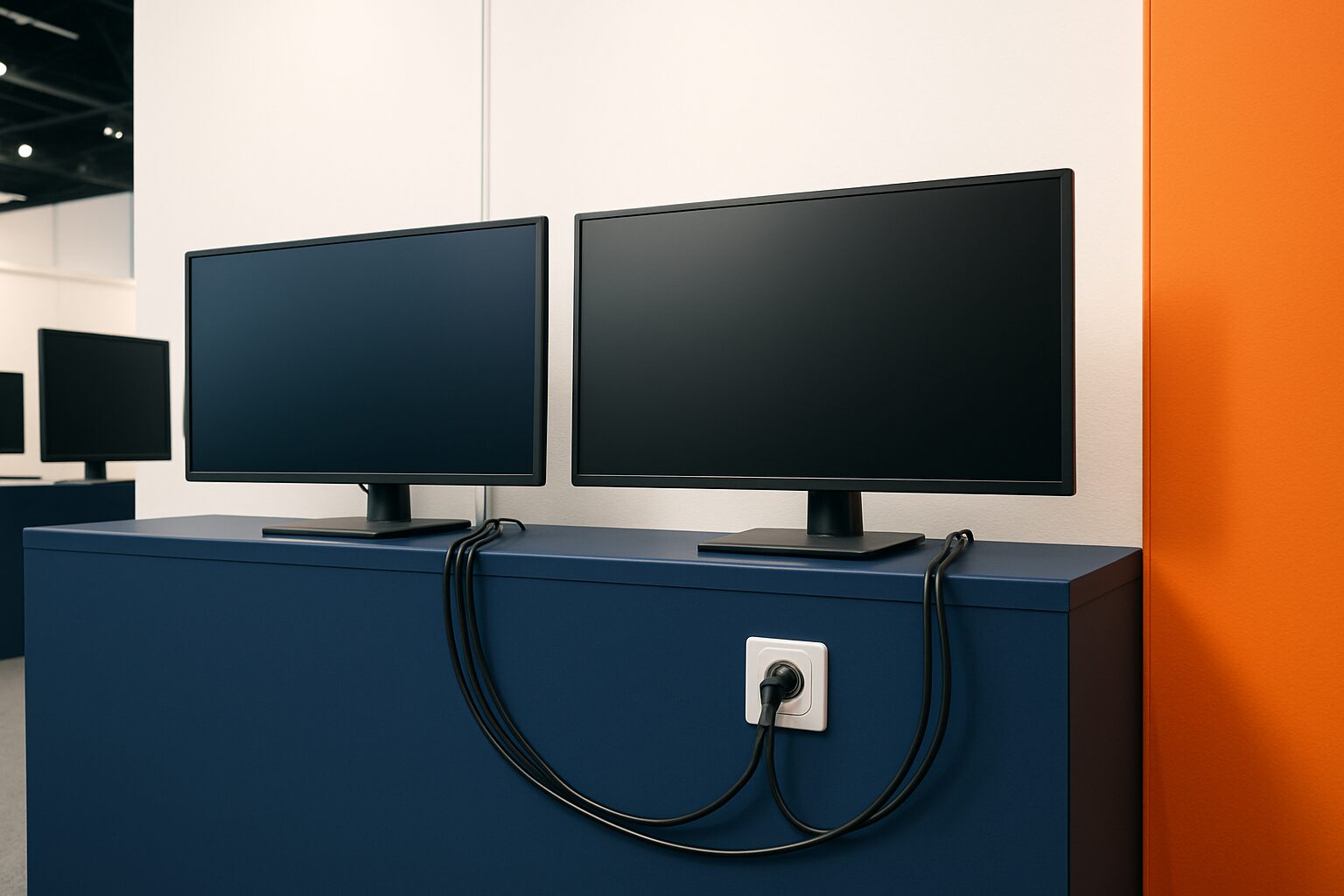
For most trade fair stand displays, an earthed Schuko socket (type F, side earthing) on a standard 16A circuit at 230V is sufficient. A standard socket in the Netherlands and Belgium delivers a nominal voltage of 230 volts. Most circuits are fused at 16 amps, which amounts to a maximum power of 3.680 watts per connection point. That is more than sufficient for one or more displays at one stand location — provided you choose the cable diameter and cable length correctly.
Why earthing is mandatory for displays
Displays with a metal enclosure fall into the category of equipment for which earthing is legally required. In the event of a fault, the exterior of a metal-cased device can become live. The earth conductor diverts leakage current directly to ground, after which the residual current device interrupts the circuit. So never use an adapter on a trade fair stand that bypasses the earth connection.
In the Netherlands, a basis of earthed socket outlets is used to ensure compatibility and safety. This is set out in NEN 1020-1, the Dutch standard for plugs and sockets. Always ask the trade fair organiser in advance whether the stand connections have protective earth — not every hall provides this as standard.
Cable diameter by display type
The cable diameter is determined by the amperage and the cable length. For professional 16A use at 230V, a minimum of 3G2,5 mm² is recommended. Choose 2,5 mm² at 16A with a cable that is fully unrolled; for longer lengths or heavy load, choose a thicker wire gauge.
The table below gives the practical guidelines per situation:
| Situation | Cable type | Min. diameter | Socket |
|---|---|---|---|
| 1 display, cable ≤ 10 m | H05VV-F or H07RN-F | 3G1,5 mm² | Schuko 16A earthed |
| 1–3 displays, cable 10–25 m | H07RN-F (rubber) | 3G2,5 mm² | Schuko 16A earthed |
| 4+ displays or cable > 25 m | H07RN-F or H07BQ-F | 3G2,5–4 mm² | CEE 16A or separate circuit |
| Outdoor display (3.500 cd/m²) | H07RN-F | 3G2,5 mm² | Schuko 16A earthed |
A cable coiled on a reel heats up more — always unroll it fully and choose the correct wire gauge. This is a common mistake when quickly building a stand.
How many displays per group?
One 16A circuit at 230V delivers a maximum of 3.680 W. Commercial displays typically consume 80–200 W each, depending on size and brightness. That means you could theoretically run 18 to 45 displays on one circuit — but in practice you should always allow a safety margin of 80%.
Practical calculation example: four 43″ displays at 120 W each = 480 W in total. That fits comfortably on one 16A circuit. Add a touchscreen kiosk and a laptop, and you are still well below the 3.680 W limit.
For events with multiple zones, professionals recommend a layered set-up: a main distribution at 125A or higher, followed by sub-distributions of 63A or 32A per zone, and compact 16A distribution boxes at the end users. This approach prevents overload and makes it easy to switch off specific zones separately in the event of problems. For a large trade fair stand with five or more displays, it is wise to discuss this scheme with the trade fair organiser in advance.
Extension leads: what is and is not allowed
An extension lead is permitted on a trade fair stand as a temporary measure, but strict rules apply. Do not use unnecessary numbers of couplers: every extra connection is an extra chance of damage or poor contact, especially with frequent build-ups and dismantling.
Practical rules for extension leads on a trade fair stand:
- Always use an earthed extension lead (3-core with earth contact).
- Minimum cable diameter: 3G2,5 mm² for professional use.
- Fully unroll the cord before use — a coiled cable heats up and can trip the fuse.
- Do not use a multi-socket extension into another multi-socket extension (double extension).
- Never leave cables loose across floor space without a cable protector or tape — this is both a safety and an insurance risk.
If the installation does not comply with the NEN standards and regulations, you may run into problems with your fire insurance.
Displays without power cable: the battery option
Not every stand location has a convenient power socket. The PixioDisplay A-board runs on an integrated battery with a runtime of 14 to 18 hours — you do not need a single power point (price list Q2 2026: current price on request for 1.500 nits or current price on request for 2.000 nits). That makes this model suitable for stand locations where the trade fair organiser provides no or only limited power connections.
All other PixioDisplays run on 230V via a standard Schuko plug. They have an integrated Android computer on board, so you do not need a separate media player or laptop — that saves one extra power group and one extra cable at your stand location. At the Summit event more than 50 PixioDisplays were used at one location; the integrated power supply per screen made power distribution across the stand locations considerably easier than with separate TV + laptop setups.
Want to know how much power your trade fair stand displays consume together? Then read the article Power consumption of trade fair stand displays: calculation by screen type for a step-by-step calculation. Want to know more about renting displays for your trade fair stand? See the rental page for current daily rates and availability.
Frequently asked questions
What socket do I need for a display at a trade fair stand?
An earthed Schuko socket (type F, side earth) on a 16A circuit at 230V is sufficient for almost all commercial displays. Never use an adaptor that bypasses earthing — this is both unsafe and contrary to NEN standards.
What cable diameter do I use for an extension lead to my display?
For a cable length of up to 25 metres and normal display use (16A, 230V), use at least 3G2,5 mm². For shorter cables (≤ 10 m) and light consumption, 3G1,5 mm² may suffice, but 2,5 mm² is the safe standard for professional use. Always fully unwind the cable — a coiled cable heats up.
How many displays can I connect to one 16A circuit?
A 16A group at 230V delivers a maximum of 3.680 W. Commercial displays use 80–200 W each. With a safety margin of 80%, you can connect about 24 displays to one circuit at 120 W per display — in practice, you work with 4 to 8 per circuit for a manageable installation.
What if the exhibition hall does not provide an earthed socket?
Check this in writing in advance with the trade fair organiser. If the hall only offers unearthed connections, a temporary earthing solution via a certified installer is mandatory. Otherwise, consider the battery-powered PixioDisplay Pavement Sign (14–18 hours runtime), which does not need a power connection at all.
Can I connect an extension lead to another extension lead at a trade fair stand?
That is strongly discouraged. Every extra connection increases the risk of poor contact, overheating and failure. Use one continuous cable with the correct diameter and length. Multiple connectors in a row also often do not meet the NEN installation standards used by exhibition halls.