
Knowledge and advice
Digital signage in municipalities: GDPR, tenders and contracts
Everything about GDPR compliance, procurement thresholds and contract requirements for digital signage in municipalities. Practical and up to date for civil servants.
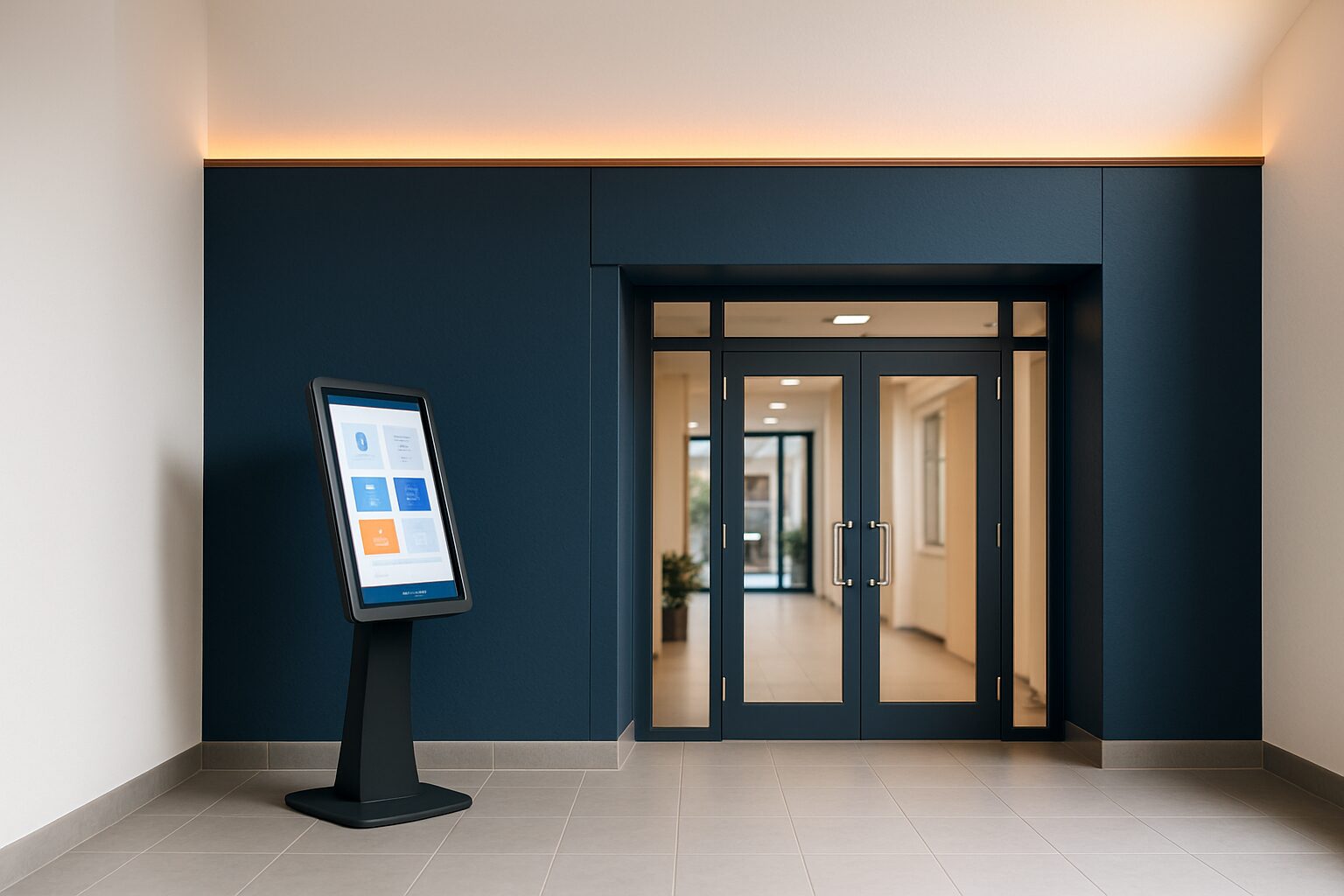
Digital signage in municipalities: GDPR, tenders and contracts
Digital signage in a municipal context is not a purely technical choice. Once a municipality deploys an information kiosk, narrowcasting screen or interactive touchscreen, three legal domains are involved: the General Data Protection Regulation (GDPR), the Public Procurement Act 2012 and the contractual procurement conditions. Mapping those domains in advance prevents rework afterwards — and keeps the accountant happy.
When does the GDPR apply to a municipal screen?
Not every screen processes personal data. A screen that only shows static text or video without any sensor data falls outside the GDPR. The boundary shifts as soon as the system observes or recognises people.
The Dutch Data Protection Authority makes clear that advertising panels in public space with a built-in camera also fall under specific rules. As soon as a person is recognisable in camera footage, that footage counts as personal data under the GDPR. That means: a processing basis is required, an information duty, retention periods must be set and security arranged.
For municipalities there is an additional layer. Filming the public highway is, under section 151c of the Municipalities Act reserved to the government, but requires a decision by the municipal council. A screen with an anonymous visitor counter (no facial recognition, no link to individuals) usually falls outside GDPR obligations — provided the data cannot be traced back to individuals.
Facial recognition: a hard limit
Some digital signage systems offer 'audience analytics': recognising age, gender or facial expressions. For local authorities, there is a clear limit here.
Facial recognition falls under the processing of biometric data. The GDPR classifies this as special category personal data if the images are used to identify someone — and that is, in principle, prohibited. The Dutch Data Protection Authority states that there is unlikely to be a need for facial recognition. An exception exists only in the case of a compelling public interest, such as securing critical infrastructure — not for a municipal information desk or waiting area.
If, as a municipality, you choose a screen with an anonymous counter that records only aggregated visitor numbers without personal identification, you remain outside the ban. Ask the supplier to confirm in writing that the system does not process or store biometric data.
DPIA: when is it mandatory?
Article 35 of the GDPR requires a Data Protection Impact Assessment (DPIA) when processing is likely to result in a high risk to the rights of data subjects. Large-scale CCTV in publicly accessible areas is explicitly on the Dutch DPA's list for which a DPIA is mandatory.
For municipal digital signage, this means in concrete terms:
| Situation | DPIA required? |
|---|---|
| Screen without camera, content only | No |
| Screen with anonymous visitor counter (aggregated) | Probably not |
| Screen with camera that stores images | Yes |
| Screen with facial recognition or behavioural analysis | Yes, and probably not allowed |
| Multiple screens with cameras at multiple locations | Yes |
A DPIA ensures that privacy risks are managed proactively, while a data processing agreement legally binds the relationship between controller and processor. If you, as a municipality, engage a software supplier that processes personal data, you are required to draw up a data processing agreement. Also record the retention period in it: the AP guideline is a maximum of four weeks for camera images.
Public Procurement Act 2012: which procedure applies?
Municipalities are contracting authorities within the meaning of the Public Procurement Act 2012. That means the value of a digital signage contract determines which procedure is mandatory.
From 1 January 2026, new European threshold values apply (set at 23 October 2025 in the Official Journal of the EU). For supplies and services by decentralised authorities — including municipalities — the threshold value is current price on request (excl. VAT). Above this amount, you are obliged to tender at European level.
A practical example: suppose a municipality signs a multi-year contract for digital signage hardware plus content management software. The hardware costs current price on request and the software licence current price on request per year over five years. Total: current price on request — below the European threshold, but above the national limit of current price on request for supplies and services. In that case, a negotiated procedure without prior publication applies: you request at least three quotations.
Important points to consider in the estimate:
- Calculate the total contract value, including renewal options and content management.
- Do not split artificially to stay below a threshold — that is not permitted under the Dutch Public Procurement Act.
- Use TenderNed for the publication of national and European tenders.
- The threshold amounts have been lowered per 2026 compared with 2024-2025, which means assignments reach the European procurement threshold more quickly.
Contract requirements: what must be included in the agreement?
Many municipalities apply the VNG Terms and Conditions for Supplies and Services. They expressly exclude the supplier's general terms and conditions from applying. For ICT-related assignments — and digital signage with content management software falls under that — the GIBIT 2023 (Municipal Procurement Conditions for IT) applicable.
Check at least the following points with every quotation:
- Data processing agreement: present and GDPR-compliant?
- Retention periods: are camera images and usage data deleted in time and demonstrably?
- Ownership of content and data: who manages the content, and what happens when the contract ends?
- Warranty and maintenance: a standard commercial display has a 1-year warranty; ask in writing for an extension if the operational lifetime is longer.
- Transport costs and installation: quotes very often fail to mention these costs.
This last point is familiar in practice: in the showroom in Montfoort, customers regularly compare quotations from several suppliers, with transport, extended warranty and content management strikingly often missing. For a municipality that wants to procure lawfully, these are hidden risks that only emerge during the audit.
A concrete example of what a municipality purchases: the PixioKiosk information kiosk (32″) cost current price on request (price list Q2 2026) and has an integrated Android computer — no separate media player is required, which makes the TCO calculation in a tender document simpler. For a lease of current price on request per month (60 months), the total contract value remains well below the European threshold of current price on request, so a restricted competitive procedure is sufficient.
Conclusion: start with the legal basis, then the estimate
The order matters. First determine whether the system processes personal data and, if so, on which lawful basis. Only then establish the contract value and choose the correct procurement procedure. Skip that step, and you risk both a GDPR fine and an unlawful procurement.
Want to know more about the broader laws and regulations surrounding digital signage in the Netherlands and Belgium? Then read the article Digital signage legislation and regulations in the Netherlands and Belgium for a complete overview of permits, advertising rules and standards.
Frequently asked questions
Does a municipality always have to tender digitally for digital signage?
Not always. From 1 January 2026, for deliveries and services by decentralised authorities, a European threshold value of € 216.000 (excluding VAT) applies. If the total contract value remains below that, a national or negotiated procedure with several parties is sufficient. When estimating, also include software licences, content management and any renewal options.
Is a DPIA mandatory if the municipality places a screen with a camera?
Yes, for large-scale camera surveillance in publicly accessible spaces, a DPIA is required under Article 35 of the GDPR. The Dutch Data Protection Authority has explicitly added this type of processing to the DPIA list. Carry out the DPIA before the system goes live, and record the findings in the processing register.
May a municipal information kiosk use facial recognition?
In virtually all cases, no. Facial recognition processes biometric data, which the GDPR classifies as special category personal data. Processing is in principle prohibited unless there is a compelling public interest — which does not apply to an information pillar in a town hall or library. Anonymous visitor counters without personal identification are permitted.
Which procurement conditions apply to digital signage software for local authorities?
For ICT-related assignments, municipalities usually apply the GIBIT 2023 (Municipal Procurement Conditions for IT). These make the supplier terms inapplicable and set requirements for, among other things, data processing agreements, audit rights and data portability. Always check whether the supplier can provide a GDPR-compliant data processing agreement.
How long may camera footage from a municipal screen be stored?
The guideline from the Dutch Data Protection Authority is a maximum of four weeks. If an incident has been recorded, the relevant images may be kept longer until the incident has been handled. Record the retention period in writing in the processing agreement and ensure automatic deletion at the end of the period.