
Knowledge and advice
Digital signage privacy and GDPR: what is and is not allowed?
What does the GDPR say about cameras, tracking and personal data in digital signage? Read the rules for NL and BE and what you are safely allowed to do.
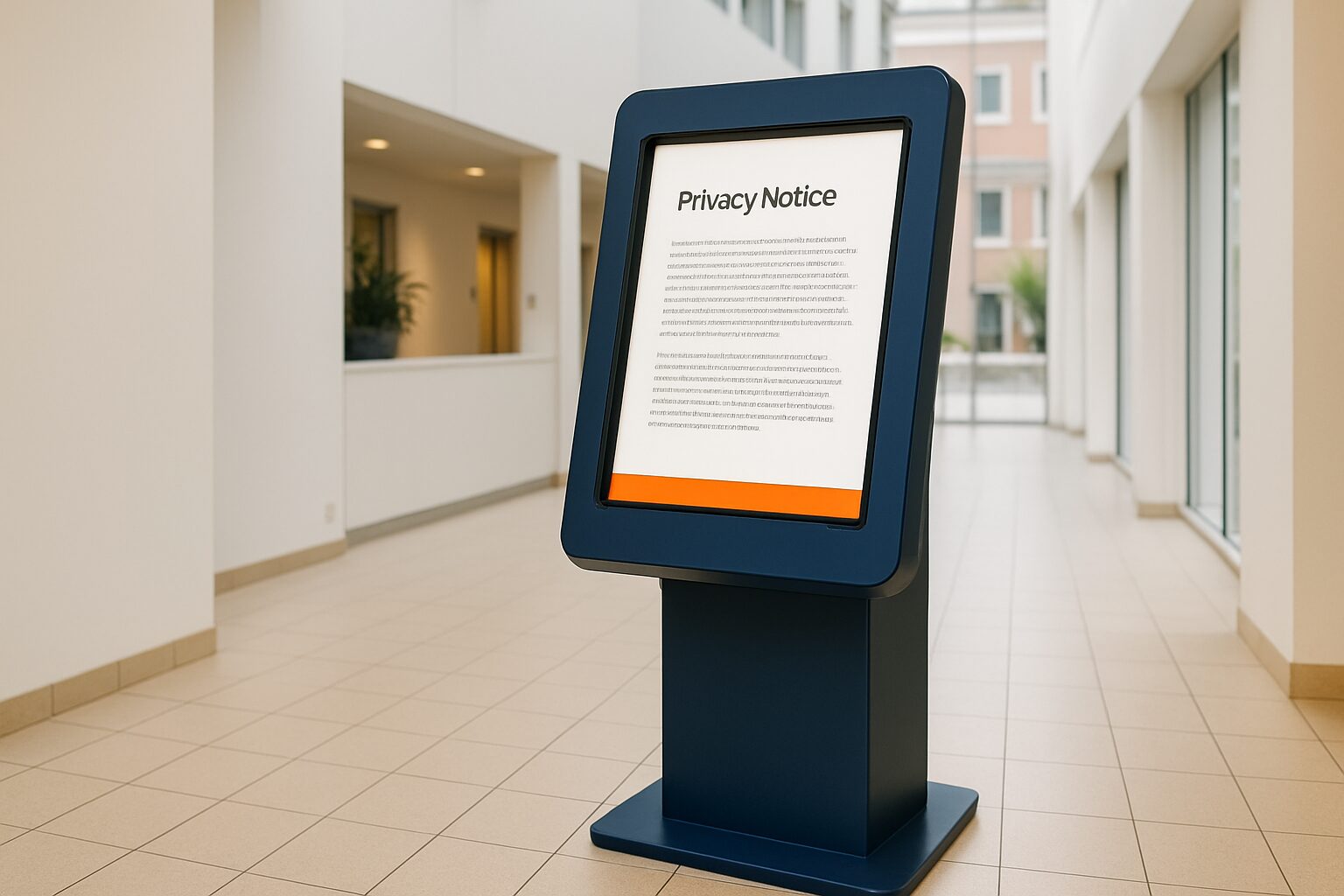
Digital signage privacy and GDPR: what is and is not allowed in NL and BE?
Digital signage falls under the GDPR as soon as the system processes personal data. This is the case with cameras that capture recognisable people, with touchscreens that log user behaviour and with networks that store device IDs or IP addresses. Purely static or animated content — without any data collection whatsoever — does not fall within the GDPR. The distinction between a 'screen that displays' and a 'system that measures' determines your compliance obligation.
When does the GDPR apply to your screen?
A digital screen that only plays content does not process personal data. The GDPR becomes relevant as soon as you measure, record or analyse. Three situations trigger the law immediately:
- Cameras that capture identifiable people — even if you do not actively watch the footage
- Touchscreen interaction in which session data, location or behavioural patterns are stored
- Network tracing via Wi-Fi probing, Bluetooth scanning or cookies on interactive kiosks
Ondernemersplein (Rijksoverheid) confirms: you may only install cameras if you comply with the GDPR requirements and have a demonstrable legal basis for processing.
A screen without a camera, without network tracking and without interaction logging falls outside the GDPR scope. Start your analysis there.
Cameras in digital signage: the hard rules
As soon as a person is recognisable in CCTV images, those images are personal data under the GDPR. You then need a lawful basis, must inform the data subject, may not keep the images longer than necessary and must secure them — as the gdprwise.eu.
For standard security cameras at a shop display or information kiosk, 'legitimate interest' is the most commonly used legal basis. That only works if you can show that the purpose — for example theft prevention — cannot be achieved in a less privacy-invasive way. According to new guidelines of the Dutch Data Protection Authority a maximum retention period of 14 days applies to camera footage, unless an incident investigation justifies longer retention.
Three specific prohibitions you need to know:
| What | Why prohibited |
|---|---|
| Camera aimed at public road or pavement | You may only film your own property |
| Share images via WhatsApp or email in case of an incident | Counts as a data breach under the GDPR |
| Do not place an information board | The information obligation is legally required |
The information sign must at least state that there is CCTV, for what purpose and who is responsible.
Facial recognition: almost always prohibited
Facial recognition is a category of its own. A facial image used to uniquely identify someone falls under 'special category personal data' in the GDPR. Processing it is in principle prohibited unless a legal exception applies — as stated ictrecht.nl.
The Dutch Data Protection Authority recognises two exceptions:
- Explicit consent of each filmed person individually
- Need for authentication or security — but this requires a compelling public interest, such as securing a nuclear power plant
The AP has explicitly warned supermarkets: protecting property is not a sufficient exception for facial recognition. A shop, hospitality venue or municipal information pillar does not fall under this. If you still want to use facial recognition, a mandatory Data Protection Impact Assessment (DPIA) is the first step — before the technology goes live.
Practical advice: do not use facial recognition in retail or public environments. The risk of enforcement by the AP (NL) or the GBA (BE) is real, and the legal exception threshold is extremely high.
Anonymous audience analysis: permitted
There is a technical alternative that does comply with GDPR: anonymous video analysis (AVA). Here, the sensor processes the camera images locally on the device. Individual frames are analysed and immediately deleted — nothing is recorded. Only aggregated counts (for example, 'today 340 people passed by') reach the system, never data about a specific person. There is no facial recognition and no memory of individuals, as fingoweb.com describes.
Because no personal data is stored, anonymous video analytics generally sits on the right side of the GDPR — but it is not a blank exemption. Always place a clear sign that public analysis is taking place, even if the data is fully anonymous. Transparency is a core principle of the GDPR, regardless of whether personal data is involved.
Concrete example: a municipality places a digital information column in the town hall. The column counts anonymously how many visitors look at the screen in order to optimise content planning. Frames are removed immediately; only the daily average is stored. That is GDPR-compliant — provided an information sign is in place.
Touchscreens and interactive kiosks: additional points to consider
Touchscreens and interactive kiosks, by definition, collect more data than passive screens. Think of search behaviour, selected menu items, dwell time per screen element or — in the case of forms — personal data entered directly. Each category requires separate legal assessment.
At the PixioKiosk — available in sizes from 21,5″ (current price on request) to 49″ (current price on request, price list Q2 2026) — if the kiosk only shows public information without storing user data, there is no GDPR issue. Once the kiosk processes forms, logs sessions or links users to an account, you become the controller and all GDPR obligations apply: privacy notice, processing register, retention periods and the right of access and erasure.
Practical checklist for interactive kiosks:
- Do not store session IDs or device IDs that can be traced back to a person
- Provide a visible privacy statement on the screen itself
- Set automatic deletion for all log files
- Conclude a data processing agreement with your software supplier
The Netherlands vs Belgium: two regulators, one law
The GDPR applies identically in both countries — it is European legislation. However, there are national nuances in enforcement and implementation.
The Netherlands: The Dutch Data Protection Authority (AP) is the supervisory authority. The AP actively enforces: every month it contacts organisations that do not comply with GDPR rules and has previously warned supermarkets about facial recognition. The Dutch implementing act is called the UAVG (Implementation Act General Data Protection Regulation).
Belgium: The Data Protection Authority (GBA) is the independent supervisory authority, established by law of 3 December 2017. In December 2025, the GBA published its Strategic Plan 2026–2028, with as a priority more proactive enforcement for large-scale high-risk processing — including ad tech and audience analytics.
| Aspect | Netherlands (AP) | Belgium (GBA) |
|---|---|---|
| Supervisor | Dutch Data Protection Authority | Data Protection Authority |
| Implementation Act | UAVG | WOG (Act of 3 Dec. 2017) |
| Enforcement style | Active, monthly outreach | Proactive from 2026 |
| Data breach notification obligation | 72 hours after discovery | 72 hours after discovery |
For organisations active in both countries — such as retailers with branches in NL and BE — the AP and GBA work together within the European EDPB network. A complaint in one country can lead to an investigation in the other.
What you can arrange immediately
Compliance does not have to be complex. Start with the most impactful steps:
- Map out which data your screens and kiosks collect — including passively via logs
- Remove facial recognition from your setup, unless you have a demonstrable legal exception and have carried out a DPIA
- Place information signs at every camera and at kiosks that process data
- Set retention periods — maximum 14 days for camera footage
- Put data processing agreements in place with your software supplier and any cloud provider
- Document your considerations, so that in the event of an AP or GBA inspection you can show that you have thought carefully
The PixioDisplay screens run on an integrated Android computer (Android 13/14) without an external media player. That also means you manage the data streams of one device rather than multiple separate components — which makes your record of processing activities easier.
Want to know more about the technical setup of your installation? Then read the article Digital signage legislation and regulations in the Netherlands and Belgium for the broader legal framework, or view the application page for digital information kiosks for concrete deployment scenarios.
Frequently asked questions
Do I need to show a privacy statement on my digital screen?
That depends on what your screen does. If it only shows content without collecting data, then no. If it processes user interactions, session data or camera images, you are required to inform data subjects — preferably directly on or near the screen, and more extensively via an online privacy notice.
Can I build a camera into my digital pavement sign or window kiosk?
Yes, but under strict conditions. The camera may only film your own premises, not the public road. You need a legal basis for processing, must display an information sign and may retain images for a maximum of 14 days. Facial recognition is almost always prohibited without the explicit consent of each person filmed.
Is anonymous audience analytics with digital signage permitted under GDPR?
Yes, provided the data is truly anonymous. That means: processing on the device itself, immediate deletion of frames, no storage of personal data and only aggregated counts being sent on. Transparency remains mandatory: always place a sign stating that audience analysis is taking place, even with fully anonymous systems.
What is the difference between the AP (Netherlands) and the GBA (Belgium) for digital signage?
Both enforce the same GDPR rules, but with their own national implementing laws. The AP (NL) uses active outreach and contacts organisations that do not comply on a monthly basis. The GBA (BE) is choosing a more proactive approach from 2026, focusing on large-scale processing. For companies in both countries, the supervisory authorities work together within the EDPB network.
Do I need to carry out a DPIA for my digital signage installation?
Not always. A DPIA is required for high privacy risk: large-scale camera surveillance, facial recognition, or systematic tracking of individuals. A single screen without a camera or data storage does not require a DPIA. Always document your considerations so that you can show, in the event of an inspection, that you assessed the risks.