
Knowledge and advice
Digital signage ROI: realistic payback period by sector
Calculate the payback period of digital signage for retail, hospitality and office. Concrete formulas, sector figures and an honest cost overview for every situation.
Digital signage ROI: realistic payback period by sector
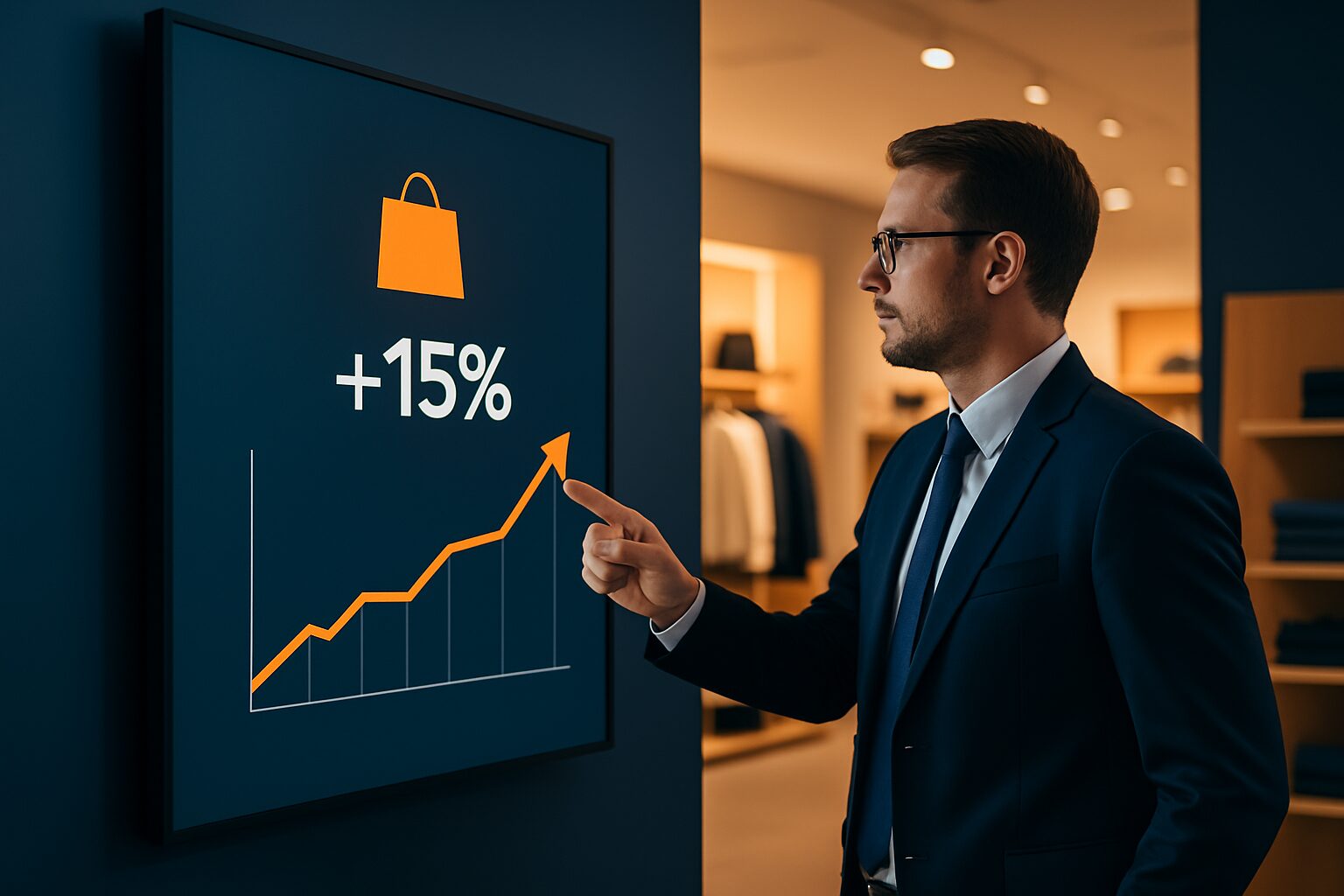
Digital signage ROI is the ratio between the total investment in screens, software and content and the measurable return in the form of increased turnover, cost savings or efficiency gains. Payback time varies by sector: retail generates returns from higher conversion and lower print costs, hospitality from upselling and a faster ordering flow, offices from lower communication costs and greater employee engagement. A realistic average lies between 12 and 24 months, depending on use and the chosen KPIs.
In short
- Retail: revenue growth on promoted products is the fastest ROI driver; average payback 12–18 months with active content management.
- Hospitality: ordering kiosks demonstrably increase the average bill; average payback period 12–20 months.
- Office: ROI lies in communication efficiency and reduced print costs; payback period 18–36 months, but harder to measure directly.
- Hidden costs (content management, warranty extension, transport) also determine the actual payback period — always include them in the calculation.
- Start with one location, measure baseline data for four weeks, then scale up.
What is ROI in digital signage — and what is not
ROI stands for Return on Investment: what an investment yields compared with what it costs. With digital signage there are two types of return. The first is direct return: more sales of a promoted product, a higher average basket value, lower printing costs. The second is indirect return: better brand experience, shorter perceived waiting time, higher employee engagement.
Directly measurable return leads to shorter payback periods. Indirect return is real but requires more time and a good measurement plan. Choose your KPIs before installation — not afterwards.
The basic formula:
Payback period (months) = Total investment ÷ Monthly net return
Total investment = hardware + installation + software (year 1) + content production. Monthly net return = turnover increase + cost savings − monthly management costs.
ROI in retail: conversion and printing costs as levers
Retail is the sector where digital signage delivers the fastest measurable return. The two main levers are higher conversion on promoted products and savings on printing costs.
A supermarket chain using digital signage at the fresh produce section saw a sales increase of 18 percent on promoted products in the first three months (pixiodisplay.com/knowledge-base). A major supermarket chain adjusted promotions in real time based on the weather: in warm weather, ice cream and cold drinks sales rose by 15 per cent in that product category (ictportal.nl).
In addition, retailers who replace printed material with digital signage save an average of 30 percent on printing costs, according to an analysis by the Digital Signage Federation (pixiodisplay.com/knowledge-base).
Retail calculation example (one location):
| Post | Amount |
|---|---|
| Hardware (e.g. PixioDisplay Window Full Sun 43″, single-sided) | current price on request |
| Installation and mounting | current price on request |
| Software year 1 | current price on request |
| Content production start-up phase | current price on request |
| Total investment | current price on request |
| Monthly print costs saved | current price on request |
| Monthly sales uplift of promoted products (conservative) | current price on request |
| Monthly net return | current price on request |
| Payback period | ± 11 months |
This is a conservative scenario. With multiple screens or higher visitor numbers, the payback period decreases further. Price level: Q2 2026.
Important note: shop window screens require a brightness of at least 3.000 nits to remain visible in daytime. A standard consumer TV (approx. 300 nits) does not achieve that and is not designed for continuous use. Always specify commercial hardware.
ROI in hospitality: upselling and a faster ordering flow
Hospitality has two clear ROI routes: a higher average bill through upselling and time savings for staff.
Research shows that guests spend an average of 23 percent more when they place an order via an ordering kiosk or order kiosk (vebodigital.nl). This is because guests browse the range interactively and are more quickly tempted by combination offers. Dynamic content also shortens the perceived waiting time by an average of 35 percent (impaqtmedia.nl), which directly contributes to customer satisfaction.
Hospitality calculation example (café, 80 covers):
| Post | Amount |
|---|---|
| PixioKiosk 32″ touchscreen (buy) | current price on request |
| Digital menu board 43″ (purchase) | current price on request |
| Installation | current price on request |
| Software year 1 | current price on request |
| Total investment | current price on request |
| Average basket increase (23% on 60 orders/day × current price on request on average × 20 working days) | current price on request/mth |
| Savings on menu printing costs | current price on request/mth |
| Monthly net return | ± current price on request |
| Payback period | ± 8 months |
Price level: Q2 2026. The kiosks in this example are the PixioKiosk (21,5″ current price on request / 32″ current price on request / 43″ current price on request / 49″ current price on request, lease from current price on request per month).
A practical advantage that hospitality businesses often underestimate: the digital menu board automatically adjusts content by time of day. Breakfast promotions in the morning, lunch deals at midday, cocktail offers in the evening — without extra staff effort.
Advice for hospitality: start with one ordering kiosk in the busiest zone. Measure the average bill four weeks before and four weeks after installation. Only then adjust the content strategy based on that data and scale up.
ROI in office environments: communication efficiency and engagement
Office is the sector with the longest payback period, but also the most underestimated ROI. The return does not lie in direct turnover, but in lower communication costs, less meeting time and higher employee engagement.
According to Gallup, global employee engagement fell in 2025 to 20 per cent, the lowest level since 2020 (businessapps.nl). That makes targeted internal communication a strategic priority. Digital signage also reaches employees who rarely sit behind a laptop — the so-called non-desk workers.
A concrete example from the Netherlands: KPN implemented more than 100 digital signage screens at strategic locations in its Dutch branches, with the aim of improving communication with non-desk employees and strengthening the company culture (digitalpixelmarketing.nl).
Office example calculation (200 employees, 3 locations):
| Post | Amount |
|---|---|
| 6 displays (e.g. PixioDisplay Luxe 49″ × 6) | current price on request |
| Installation (3 locations) | current price on request |
| Software year 1 | current price on request |
| Total investment | current price on request |
| Savings on printing costs internally (posters, flyers, briefings) | current price on request/mth |
| Time savings in meetings (conservative 0,5 hours/week × 50 employees × current price on request/hour) | current price on request/mth |
| Monthly net return | ± current price on request |
| Payback period | ± 33 months |
Price level: Q2 2026. The PixioDisplay Luxe (49″ touchscreen, 67×185 cm) costs current price on request per unit or current price on request per month via lease (60 months). Leasing makes the business case for offices immediately more attractive: the monthly net investment then falls to current price on request for six screens, and the payback period is positive from the outset.
Payback comparison by sector
| Sector | Primary ROI driver | Typical payback period | Measurability |
|---|---|---|---|
| Retail | Conversion + printing costs | 10–18 months | High |
| Hospitality | Upselling + basket value increase | 8–20 months | High |
| Office | Communication efficiency | 18–36 months | Average |
| Trade fair/event | Brand visibility + leads | Not linear (per event) | Low–medium |
The payback period in retail and hospitality is shortest because the return is directly measurable at the till. Office use requires more patience, but the investment is also lower per employee.
Hidden costs that distort the ROI calculation
A digital signage quote does not always include all costs. In the showroom in Montfoort, customers regularly compare quotes from multiple suppliers; transport, extended warranty and content management are often notably missing.
Always calculate with:
- Transport and installation: courier delivery within the Netherlands from current price on request; installation by a third party costs on average current price on request per screen.
- Warranty extension: standard is 1 years. Extension to 2 years costs current price on request, to 4 years current price on request depending on the model (price list Q2 2026).
- Content management: without regular updates, digital signage loses its effectiveness. Allow for 1–2 hours per month in-house, or current price on request per month externally.
- Software licence: some providers charge monthly subscription costs per screen. Always compare this over a period of 3 years.
- Power consumption: a 43″ commercial display uses an average of 80–120 Watts. With continuous use (12 hours/day, 250 days), that is approx. current price on request per year.
A practical advantage of PixioDisplays: they have an integrated Android computer (Android 13/14), so you do not need a separate media player. Elsewhere, a media player costs current price on request per screen — that immediately reduces the total investment.
Buying, leasing or renting: impact on the ROI calculation
The financing method partly determines how quickly you break even.
Buy has the lowest total cost over 4–5 years. The payback period is shortest when you use the screen for a long time.
Lease spreads the investment. The PixioKiosk 21,5″ is, for example, available from current price on request per month (60 months, price list Q2 2026). That makes the monthly net investment comparable to the monthly return — allowing you to operate almost immediately cash-flow neutral.
Rental is useful for one-off events or pilots. The question customers ask most often is: buy or rent? The arithmetic break-even point is around 8–10 usage days per year. If you use a screen more often, buying or leasing is cheaper. Less? Then renting is more favourable.
Bol.com chose hire for the stand at the Negenmaandenbeurs — an event-specific deployment where flexibility and rapid build-up are central (Pixio Display references). For long-term use in a retail chain or hospitality chain, buying or leasing is always more economical.
This is how you measure ROI in practice: three steps
A good ROI measurement starts before installation, not afterwards.
Step 1 — Determine your baseline measurement. Measure the baseline for four weeks: average basket value, conversion rate on the target category, or print costs per month. Without a baseline measurement, you cannot make a comparison.
Step 2 — Define one primary KPI. Choose the most direct metric for your situation: sales uplift on promoted products (retail), average basket increase (hospitality) or savings on print costs (office). Add secondary KPIs later.
Step 3 — Compare after 8 weeks. Eight weeks is long enough to filter out seasonal effects, short enough to adjust course. Adapt the content strategy based on the data — not on assumptions.
The digital signage ROI calculator helps you calculate the payback period in months for your specific situation.
Conclusion: choose your sector as the starting point
The payback period of digital signage is realistic and achievable — provided you choose the right KPIs and include hidden costs. Retail and hospitality achieve the fastest return through direct revenue measurement. Offices require more patience, but leasing makes the business case attractive straight away.
Start with one location, measure your baseline and scale based on data. Review the application page for retail and shop window communication or schedule a visit to the showroom in Montfoort to compare screens in practice.
Frequently asked questions
How long does it take on average before digital signage pays for itself?
That depends heavily on the sector and use. Retail and hospitality often break even within 10–18 months thanks to direct sales measurement. Office environments are more likely to be at 18–36 months. If you lease the screens instead of buying them, you operate at almost cash-flow-neutral from day one.
Which KPIs do I use to measure the ROI of digital signage?
The most direct KPIs are: conversion rate on promoted products (retail), average ticket uplift (hospitality) and savings on print costs (all sectors). You can also measure dwell time, footfall and perceived waiting time. Establish your baseline before installation so you can make a fair comparison.
Is digital signage also profitable for a small hospitality business?
Yes. A single digital menu board or ordering kiosk can pay for itself within 8–12 months if the average spend increases. Research shows that guests spend an average of 23% more via an ordering kiosk. Start with one screen in the busiest spot and measure the effect for four weeks.
What are the hidden costs of digital signage that I should include in my calculation?
In addition to hardware, also allow for: transport (from € 95 within the Netherlands), installation (€ 150–€ 350 per screen), warranty extension (€ 115–€ 535 depending on model and term), software licence and content management (1–2 hours per month in-house or € 50–€ 150 externally). Quotations regularly leave out these items.
When is renting more cost-effective than buying for digital signage?
The break-even point is around 8–10 usage days per year. If you use a screen less than 8 days per year — for example only for trade fairs or seasonal campaigns — renting is cheaper. If you use the screen structurally, buying or leasing over a period of 3–5 years is always more advantageous.
Does screen brightness affect ROI?
Indirectly, yes. A screen that is not visible generates no conversion. Indoors, ±400 cd/m² is sufficient, but a shop window screen in full sun needs at least 3.000 nits. If you buy a screen that is too dim for a sunny shop window, your ROI will drop immediately. The panel, not the size, determines the extra cost.
How do I measure the ROI of digital signage in an office environment?
Office ROI is less directly measurable than retail or hospitality. Useful metrics are: savings on print costs (posters, flyers, briefings), time savings on internal communication and employee engagement (via periodic surveys). Lease structures make the business case more attractive because the monthly costs are directly comparable with the savings.
What is the difference in ROI between a touchscreen kiosk and a standard information screen?
A touchscreen kiosk generates active interaction and higher upselling — which is why the direct ROI in hospitality and retail is often higher than with a passive information screen. A passive screen has lower purchase costs and scores better on brand experience and reducing waiting times. Which one you choose depends on your primary KPI.
Can I improve ROI by leasing digital signage instead of buying it?
Yes, especially for higher investments. Leasing spreads the costs over 60 months and makes the monthly net investment comparable to the monthly return. The PixioKiosk 21,5″ is, for example, available from € 31 per month (60 months, price list Q2 2026). Downside: the total costs over 5 years are higher than with direct purchase.
How quickly do I need to refresh my content to maintain ROI?
Outdated content quickly reduces attention value. Refresh promotional content at least weekly and seasonal content with every campaign change. Static content that remains unchanged for weeks leads to 'screen blindness' among regular visitors. Plan content management structurally — allow for 1 to 2 hours per month.