
Knowledge and advice
Digital signage trends 2026: what is changing in NL/BE retail
The seven most important digital signage trends for 2026 in Dutch and Belgian retail: AI content, retail media, interactivity and sustainability. Discover what already works.
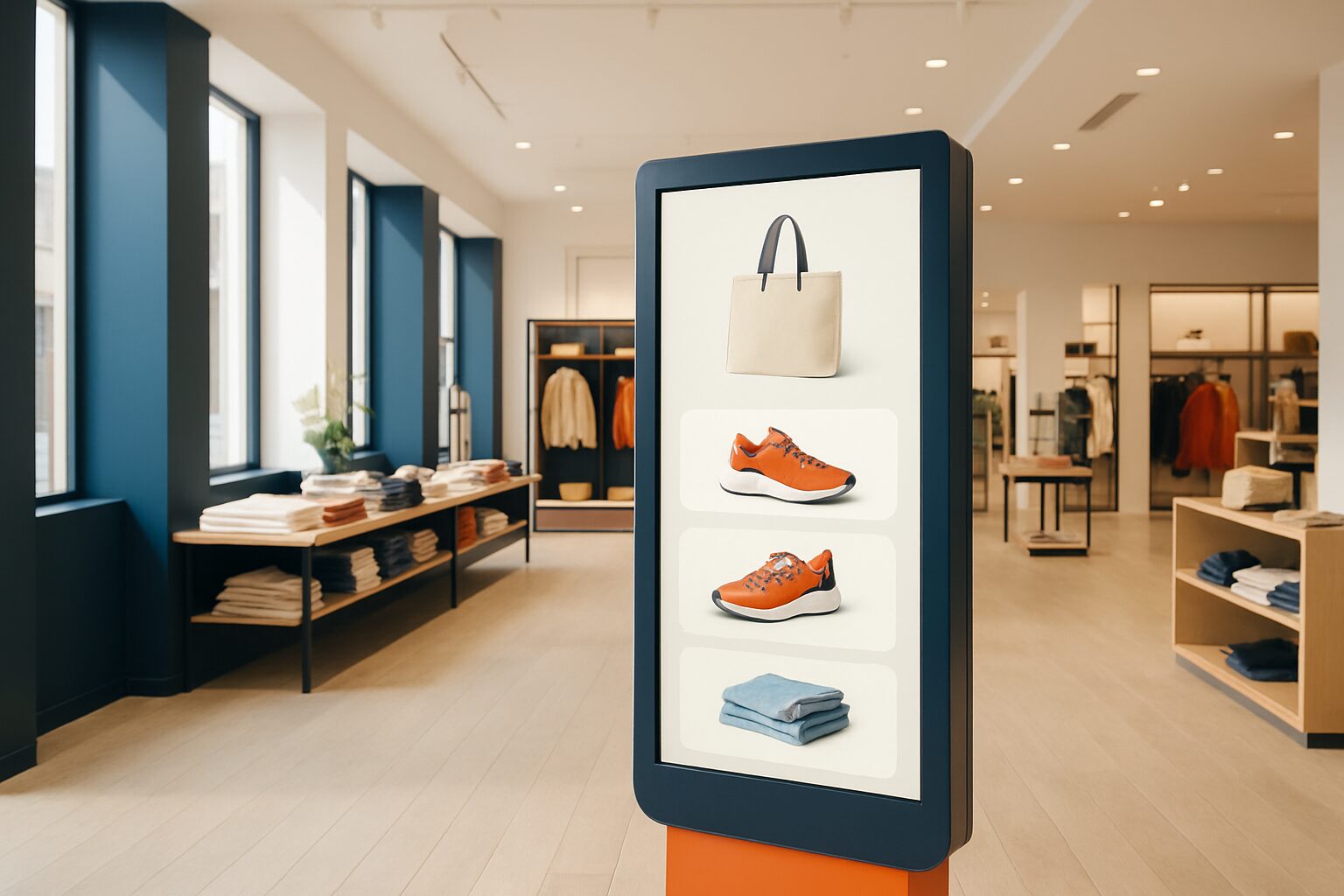
Digital signage trends 2026: what is changing in NL/BE retail
In 2026, digital signage in retail is no longer a promotional board, but a measurable media channel. Screens automatically adapt content based on time, weather and audience. Retail media networks turn shop screens into advertising space for third parties. Touchscreen kiosks increasingly replace staff for self-service tasks. The global market grows from $31,1 billion in 2025 to a projected $58,4 billion in 2033 — with retail as the biggest driver.
In short
- AI content generates and plans campaigns automatically; 41% of all deployments worldwide already use AI in 2026.
- Retail media turns shop screens into advertising platforms: Jumbo has 2.200 digital screens in 520 stores, Albert Heijn proved impact with 120 Kantar studies.
- Interactivity is growing strongly: touchscreen kiosks reduce waiting times and replace repetitive staff tasks.
- Sustainability shifts from wish to purchasing criterion: energy consumption and hardware lifespan weigh into the purchase decision.
- Brightness determines the price, not the size: a shop window screen requires 3.000 nits, an outdoor display 3.500 — the panel makes the price difference.
Trend 1: AI automatically generates and schedules content
AI is changing digital signage at the level of content production. Campaigns are generated from a text prompt, templates adapt to time of day, weather or stock. Manual scheduling of playlists is gradually disappearing.
Worldwide, 41% of all signage deployments in 2026 already use AI functionality — a rise that is expected to continue to 65% in 2028 (source: Grand View Research / CrownTV statistics). For Dutch retailers this means concretely: a screen at the checkout that shows breakfast products in the morning and lunch options in the afternoon, without manual intervention.
Start with AI if you manage more than five locations or change content weekly. With one or two screens, the setup investment does not yet outweigh the time savings.
Trend 2: Retail media networks — from cost item to revenue source
The biggest shift in Dutch retail: shop screens are becoming advertising space for major brands. Jumbo Retail Media now has 2.200 digital screens in 520 stores and reaches around 9 million people monthly via combined channels. Albert Heijn demonstrated through 120 Kantar studies that DOOH screens contribute to both sales conversion and brand awareness, on top of other channels.
HEMA has 289 digital screens across 280 branches, reaching more than 500.000 consumers a day — including window screens that also reach passers-by. Retail media are growing almost four times faster than the overall advertising market.
For medium-sized retail chains, this is relevant in two ways. You can use your own screens as media space for suppliers. And as an advertiser, you can join larger networks to reach your target audience at the point of purchase.
Trend 3: Interactive kiosks as a self-service layer
Touchscreen kiosks are growing strongly in retail, partly due to ongoing staff shortages. They handle product information, stock enquiries, loyalty programmes and returns without an employee. The benefit is immediate: shorter queues, consistent information provision and lower operating costs.
A concrete example: bol.com used Pixio screens for the information pillar at the Negenmaandenbeurs — an environment where visitors wanted to obtain information quickly and independently without queueing. The PixioKiosk is available from 21,5" (current price on request) to 49" (current price on request) and can be leased from current price on request per month (price list Q2 2026). That makes a permanent installation financially accessible for chains with multiple branches.
Start with a kiosk at the location with the most recurring customer questions. Measure the number of interactions in the first four weeks. Then scale up.
Trend 4: Context-sensitive content — the right screen at the right moment
Screens react to external data in 2026: the weather forecast, the time, the day of the week, current stock levels. This is called context-sensitive or programmatic content. The difference from a static playlist is measurable: dynamic content generates on average 22% more conversion than fixed schedules.
In the Dutch context there are practical examples: a garden centre in Amsterdam that automatically promotes barbecue accessories in sunny weather, or a clothing chain in Antwerp that shows rainwear when the rain radar API reports a precipitation chance above 60%. The technology is available through almost any modern CMS and requires no custom development.
Note the GDPR: context-sensitive content based on public sensors (cameras that estimate age groups) falls under the GDPR if there is even a chance that individuals are identifiable. Use anonymous aggregate data, not personal profiles. Read more in the article GDPR and privacy in digital signage: what are you allowed to film and store?
Trend 5: Sustainability as a purchasing criterion
Sustainability is shifting from a communication theme to a technical specification when buying screens. Energy consumption, hardware lifespan and modular repairability are all factors in quotation processes. The Dutch government has set this out in the Sustainable Digitalisation Action Programme 2026–2028, which actively encourages energy monitoring of business equipment — including digital signage.
Modern LED displays are considerably more energy-efficient than earlier generations and use smart brightness control to further limit power consumption. E-paper is gaining ground for static information (opening hours, direction signs) because it uses virtually no power outside content updates.
A practical rule of thumb: if you replace print materials with digital signage, you eliminate the logistics CO₂ emissions of printing and distribution. That argument carries increasing weight for retailers with sustainability targets.
Trend 6: Brightness as a technical dividing line — and a price-determining factor
One technical specification influences the choice and price of a display more than any other: brightness in nits. This is not a marketing term, but a hard specification that determines whether a screen is readable in the environment where you place it.
| Application | Minimum brightness | Example Pixio product | Price (Q2 2026) |
|---|---|---|---|
| Indoor space (shop, lobby) | ~400 cd/m² | PixioDisplay Mobile 43″ | current price on request |
| Window display (indirect sunlight) | 1.000 nits | PixioDisplay Window Shadow 43″ | current price on request |
| Storefront (full sun) | 3.000 nits | PixioDisplay Window Full Sun 43–55″ | current price on request |
| Outdoor free-standing | 3.500 cd/m² | PixioDisplay Outdoor 49–55″ | current price on request |
A consumer TV typically reaches ±300 nits — insufficient for almost any retail application with daylight. Commercial displays are designed for continuous use; a consumer TV is not. The panel, not the size, determines the additional cost.
Choose a shop window screen with at least 3.000 nits if your shop faces south or west and receives direct sunlight in the afternoon. For a north-facing façade or a shaded shop window, the 1.000-nit variant is sufficient.
Trend 7: Buy, lease or rent — the calculation changes
The question retailers ask us most often is: buy or rent? The arithmetic break-even point is around 8–10 days of use per year. If you use a screen more often, buying or leasing is more economical; if you use it less, renting is the logical choice.
Leasing makes investing more accessible: the PixioDisplay Luxe (49″ touchscreen, 67×185 cm) can be leased for current price on request per month over 60 months — less than an average software subscription. Renting is interesting for seasonal peaks, trade fairs or pop-up stores: the PixioDisplay Mobile can be rented for current price on request per day (price list Q2 2026).
When reviewing quotations, pay attention to what is not included: transport, warranty extension and content management are often notably absent. Extending the warranty to 4 years costs current price on request depending on the model — an amount that pays for itself with a single fault outside the standard warranty.
For trade fairs and events, Pixio also offers display hire and Hire a TV screen for trade fair or event as direct options.
Conclusion: start with one trend, measure, scale
The seven trends reinforce each other, but you do not have to implement them all at once. Start with the trend that will deliver a measurable result fastest for your situation: replace static promotions with dynamic content, or install one kiosk at your busiest location. Measure for four weeks, draw conclusions, then scale up.
The Netherlands leads in retail media adoption in Europe — that gives chains investing now an advantage. Those who wait will have to catch up by 2027 with competitors already collecting data.
View the applications for retail and window communication or schedule a visit to the showroom in Montfoort to compare screens by brightness and size.
Related articles in this knowledge base: Digital signage in retail: applications by shop type — Digital signage ROI: realistic payback period by sector — Digital signage vs narrowcasting: what is the difference? — GDPR and privacy with digital signage: what may you film and store? — LED, LCD or e-ink outdoors: screen choice for the Dutch climate
Frequently asked questions
What are the most important digital signage trends for retail in 2026?
The seven trends that matter in NL/BE retail are: AI-driven content generation, retail media networks (screens as advertising space), interactive touchscreen kiosks, context-sensitive content based on weather and time, sustainability as a procurement criterion, brightness as a technical dividing line, and the choice between buying, leasing or hiring. Retail remains the sector worldwide with the fastest adoption of new signage technology.
What is retail media and how does it work in Dutch supermarkets?
Retail media means that shop screens are used as advertising space for suppliers and leading brands. Jumbo has 2.200 digital screens in 520 stores available for advertisers. Albert Heijn demonstrated via 120 Kantar studies that these screens have an impact on both sales and brand awareness. For mid-sized chains, the model is twofold: you can rent out your own screens to suppliers, or as an advertiser join larger networks.
How many nits does a window display need in the Netherlands?
A shop window in full sun requires at least 3.000 nits to remain readable. For a shaded shop window or north-facing façade, 1.000 nits is sufficient. Inside the shop, 400 cd/m² is the standard. A consumer TV typically reaches only around ±300 nits and is therefore unsuitable for almost any retail application with daylight.
Is it sensible to lease or buy digital signage?
The arithmetic break-even point is around 8–10 days of use per year. If you use a screen more often, buying or leasing is financially more advantageous. Leasing spreads the investment: the PixioDisplay Luxe (49″ touchscreen) is available for €54 per month over 60 months (price list Q2 2026). Hiring is the better choice for trade shows, pop-up shops or seasonal peaks.
Can I use cameras in digital signage to adapt content to the audience?
Context-sensitive content based on audience sensors falls under the GDPR if individuals are identifiable or can be identified. Use only anonymous aggregate data (for example: 'group of 3 people, average age 35–45 years') and do not store personal data. Refer to the article GDPR and privacy in digital signage in this knowledge base for the full legal framework.
What does a touchscreen kiosk for a shop cost?
The PixioKiosk is available from 21,5″ for €1.395 to 49″ for €2.295 (price list Q2 2026). Leasing is available from €31 per month over 60 months. Renting is possible from €65 per day with a minimum rental period of two weeks for the smallest variant. All models have an integrated Android computer — no separate media player or laptop is needed.
How does digital signage differ from narrowcasting?
Narrowcasting is a specific form of digital signage in which content is targeted at a defined audience in a specific location. Digital signage is the broader term: it includes everything from a simple advertising screen to an interactive kiosk or outdoor display. Narrowcasting is always digital signage, but digital signage is not always narrowcasting. See the article Digital signage vs narrowcasting: what is the difference? for a detailed decision tree.
What are the sustainability benefits of digital signage compared with print materials?
Digital signage eliminates the logistical CO₂ emissions of print, transport and distribution to branches. Modern LED displays are considerably more energy efficient than earlier generations and automatically adjust brightness to ambient light. E-paper displays consume virtually no power outside content updates and are suitable for static information such as opening hours.
Which screen size is best suited for a retail environment?
The best-selling sizes in retail are 43–55 inches, which corresponds to the largest market category worldwide. For a checkout area or information pillar, 21,5–32 inches is sufficient. For a window display or central shop wall, 43–55 inches is standard. Always choose size in combination with the required brightness: a larger screen with too few nits is unreadable in daylight.
How quickly can I update digital signage content without technical knowledge?
All PixioDisplays have an integrated Android computer. Content can be updated via USB, a website URL or the PixioApp — without a separate media player or IT department. For chains with multiple locations, a cloud CMS is the logical next step: content is managed centrally and pushed directly to all screens. See also the article Digital signage content management for hospitality: planning and updates for practical planning strategies.