
Knowledge and advice
Digital signage vs narrowcasting: decision tree for retailers
Choosing digital signage or narrowcasting as a retailer? Learn the difference, work through the decision tree and choose the approach that suits your shops and audience.
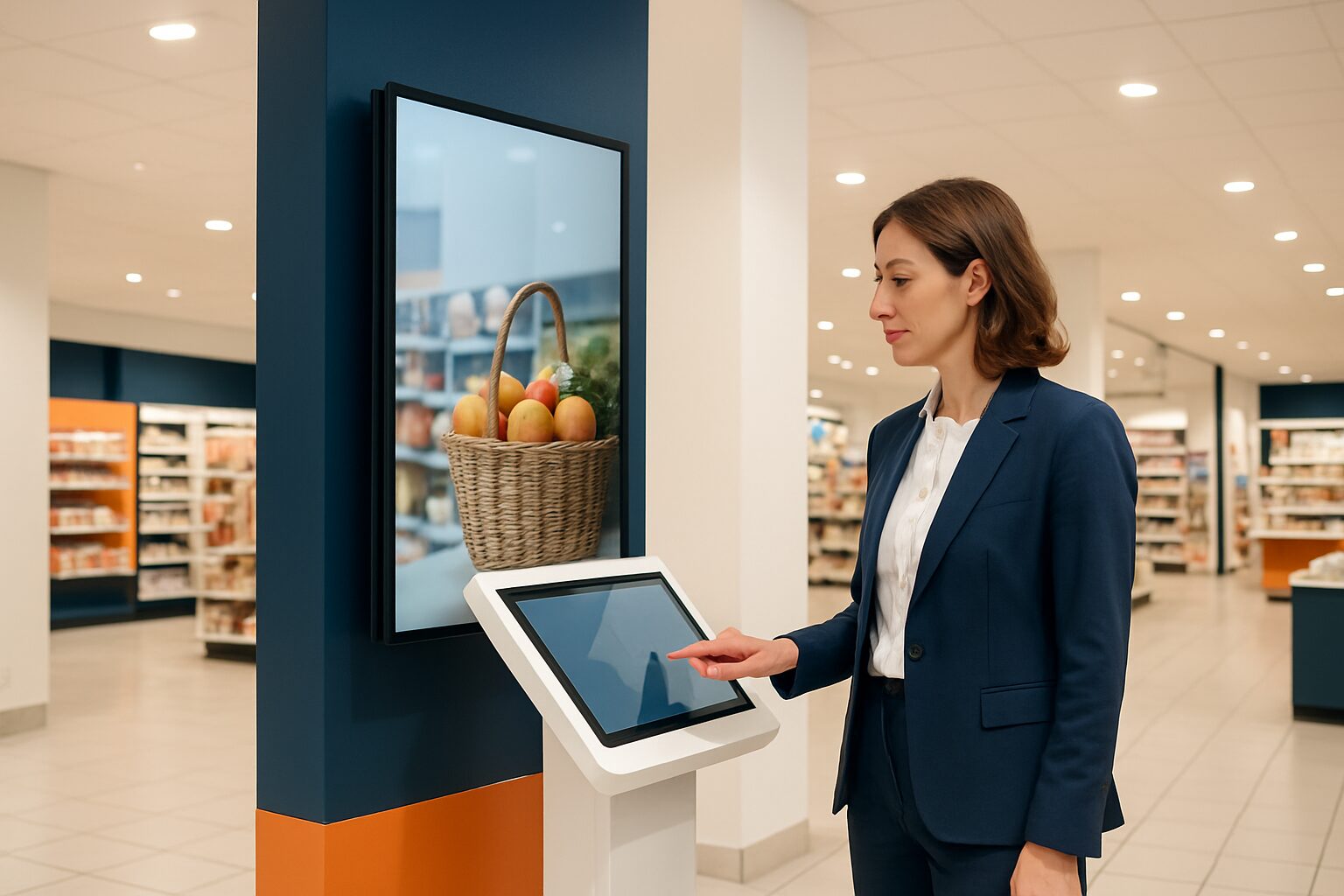
Digital signage is the umbrella term for all communication via digital screens — from a shop-window screen to a touchscreen kiosk. Narrowcasting is a specific application within digital signage: you broadcast targeted content to a precisely defined audience at a fixed location. Narrowcasting is therefore always digital signage, but digital signage is not always narrowcasting. The difference is not in the hardware, but in the intent and setup of the content.
Why the terminology is confusing in the Netherlands
The term narrowcasting is used almost only in the Netherlands and Belgium. Internationally, people almost always speak of digital signage. That explains why you encounter both words for almost the same product: a Dutch supplier writes "narrowcasting", a Belgian colleague writes "digital signage" — and they mean the same screen.
In practice, suppliers and marketers use the terms interchangeably. Narrowcasting was the dominant term in the 2000s, when digital screens first appeared in shops and offices. Digital signage has become the internationally used term and has largely replaced narrowcasting.
For you as a retailer, the term does not matter much. What does matter: do you know what you want to achieve with the screens, and is your content production set up accordingly?
The key difference in one example
Imagine you place a 43" screen at the entrance to your supermarket showing changing promotional images. That is digital signage. The same screen that on Monday morning specifically shows weekly offers to regular customers, on Saturday afternoon shows seasonal atmosphere images and at the checkout promotes impulse purchases — that is narrowcasting.
So the difference is not in the screen itself, but in the way the content is used and controlled. Digital signage is the tool. Narrowcasting is the way you use that tool strategically.
Narrowcasting requires more content production and a well thought-out content strategy. Expect at least two to three times more content variants compared with a generic digital signage approach. That has a direct impact on your budget and planning.
Decision tree: which approach suits your retail chain?
Go through the four questions below. They will lead you to a concrete recommendation.
Question 1 — How many branches do you have?
- 1–3 branches, similar audience: Start with digital signage. One content stream for all locations is manageable and cheaper to maintain.
- 4+ branches or strongly different target groups per location: Narrowcasting pays off. You can schedule different content per shop or even per zone.
Question 2 — How diverse is your audience at one location?
- Homogeneous audience (e.g. a DIY store with regular tradespeople): digital signage with generic product promotions is sufficient.
- Changing audience (for example, a fashion chain with morning and evening shoppers): narrowcasting makes it possible to change content by time block — morning: new collection, evening: sale items.
Question 3 — Do you have capacity for content management?
- Small marketing team, little time: Choose digital signage. Upload content via USB or a simple app, no daily management required.
- Dedicated content manager or marketing agency available: Narrowcasting then offers the greatest added value. You can schedule campaigns, A/B test and adapt by location.
Question 4 — What is your primary objective?
| Purpose | Recommended approach |
|---|---|
| Increase brand awareness | Digital signage |
| Encourage impulse purchases | Digital signage or narrowcasting |
| Activate a specific target group | Narrowcasting |
| Improve perceived waiting time | Narrowcasting |
| Interaction and self-service | Touchscreen (digital signage + kiosk) |
What does this mean for your hardware choice?
The hardware does not necessarily differ between digital signage and narrowcasting. However, your application determines which screen type you need.
For a digital advertising screen in a shop window you need high brightness: a standard consumer screen (±300 nits) is insufficient. The PixioDisplay Window Full Sun reaches 3.000 nits and is available from current price on request (43", single-sided, price list Q2 2026) — specifically designed for shop window positions with direct sunlight.
For a digital information column with touch functionality — suitable for narrowcasting with customer interaction — the PixioKiosk in 43" offers an entry price of current price on request (price list Q2 2026), including integrated Android computer. You do not need a separate media player (elsewhere current price on request per screen) or laptop; content is managed via USB, website URL or the PixioApp.
Need flexible deployment for events or temporary campaigns? The PixioDisplay Pavement Sign (43", battery-powered, 14–18 hours operating time, no power socket required) costs current price on request at 1.500 nits and is also available via lease from current price on request per month (price list Q2 2026).
The Dutch market context
The Dutch digital signage market generated revenue of USD 2024 million in 714,3 and is expected to grow by 7,4% per year until 2030, according to Grand View Research. Retail is the largest customer segment worldwide: the sector accounts for more than 21% of the total digital signage market (Mordor Intelligence, via aiscreen.io).
That growth translates into a practical fact: retailers who wait fall behind competitors who are already experimenting with audience-specific content. Start small — one screen, one location — and scale up once you know what works.
Our advice: start with digital signage, grow into narrowcasting
Start with digital signage if you have one to three branches, a small content team and a clear single objective (brand visibility or promotion). Choose narrowcasting straight away if you manage four or more branches with varying audiences, or if you already use a content calendar.
In the showroom in Montfoort, customers regularly compare quotes from several suppliers. What is often notably missing from them: transport, extended warranty and content management. Include those items in your total calculation — they partly determine whether the investment pays back within your time horizon.
For a full overview of costs and payback time, read the knowledge base article Digital signage ROI calculator: calculating return in months. Would you like to see the screens in practice first? Book a showroom appointment in Montfoort and compare models side by side.
Frequently asked questions
Is narrowcasting the same as digital signage?
Not exactly. Digital signage is the broad term for all digital screen communication. Narrowcasting is a specific application in which you deliberately tailor content to a precisely defined target group, location or time. Narrowcasting therefore falls under digital signage, but not the other way round. In the Netherlands, the terms are often used as synonyms in practice.
Which term do I use when talking to a supplier?
Both terms are common in the Netherlands and Belgium. Internationally, digital signage is the standard. Feel free to use the term you know — a good supplier will understand what you mean and ask about your objective, not the terminology.
Do I need different hardware for narrowcasting than for digital signage?
No, the hardware is essentially the same. The difference lies in the content strategy and the content management system (CMS). However, your location (shop window, shop floor, outdoors) determines what brightness and protection rating your screen needs.
What does an entry-level digital signage solution cost in retail?
A PixioDisplay Window Full Sun for a shop-window position starts at €1.780 (43", single-sided, price list Q2 2026). A touchscreen kiosk for customer interaction — the PixioKiosk 43" — costs €2.195. Both are also available via lease or rent if you want to test first.
When is narrowcasting the better choice for a retail chain?
Narrowcasting pays off as soon as you have four or more branches with different target groups, or if you want to adapt content by time slot or location zone. Bear in mind that narrowcasting requires two to three times more content variants than a generic digital signage approach — make sure your content capacity can handle that.