
Knowledge and advice
LED, LCD or e-ink: which display type do you choose for the Dutch climate?
LED, LCD or e-ink for outdoor use in the Netherlands? Compare brightness, IP rating and moisture resistance per technology and make the right choice for your installation.
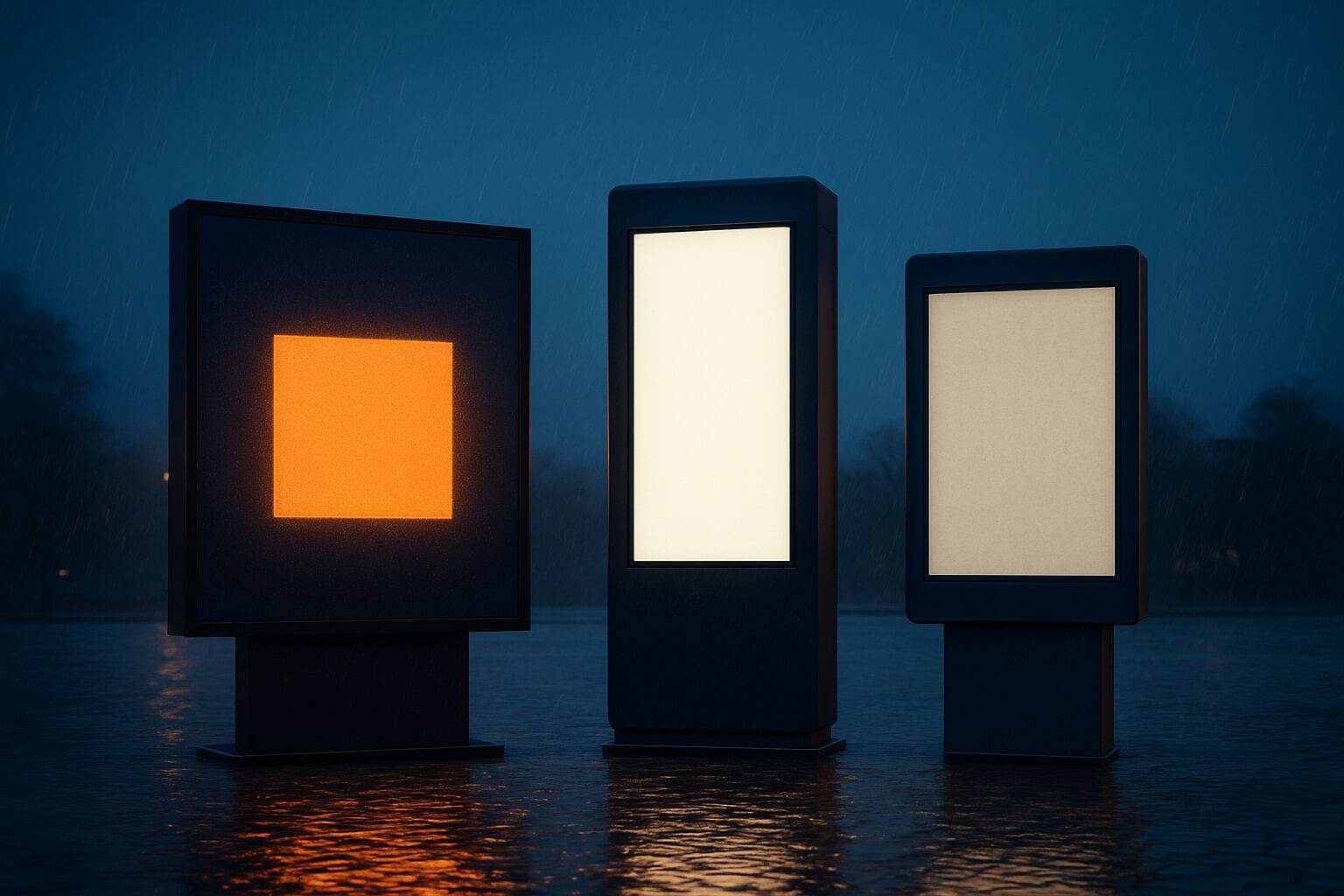
LED, LCD or e-ink: which display type do you choose for the Dutch climate?
For an outdoor installation in the Netherlands, three display technologies are relevant: LED (direct or backlit), LCD with a high-brightness panel and e-ink (electronic paper). Each type reacts differently to Dutch conditions: average 80–85% relative humidity outdoors, frequent temperature fluctuations between -10°C and +35°C, and mostly cloudy light with short periods of bright sun. The choice depends on update frequency, brightness, IP rating and power consumption — not on brand preference.
The Dutch climate as a starting point
The average outdoor humidity in the Netherlands is around 80–85%. In our temperate maritime climate we mainly have wet winters, and summers that are more muggy than pleasantly warm. In autumn and winter, relative humidity above 85% is regularly measured; rain and wet snow drive the humidity level up to high values. This is not a marginal factor: moisture entering through unsealed seams causes corrosion on circuit boards and condensation between the display layers.
Water or moisture entering through unsealed seams, ports or ventilation openings causes short circuits, corrosion and permanent image retention. Even condensation trapped between layers affects viewing angle and colour reproduction over time. For installers, this means an IP rating is not a marketing badge, but a minimum requirement.
In the summer half-year (April to September), sunshine in the Netherlands increased by 16% compared with the start of this century; over the same period, relative humidity fell from 78 to 74% (KNMI). More sun in summer increases the risk of thermal overload in displays without active cooling.
LCD: the most established technology for semi-outdoor use
LCD with LED backlight is the most commonly used type in Dutch outdoor installations — from shop windows to covered bus shelters. The technology is widely available, scalable and compatible with standard CMS software.
The critical specification is brightness. Indoors, ±400 cd/m² is sufficient. A shop window in full sun requires 3.000 nits; a freestanding outdoor display 3.500 nits — the panel, not the size, determines the surcharge. The PixioDisplay Outdoor delivers 3.500 cd/m² and is available in 49″ for current price on request and 55″ for current price on request (price list Q2 2026).
Heat damages more displays than cold: LCD panels exposed to high temperatures for long periods turn yellow and dim. The solution is active cooling with fans and displays that can operate down to at least 50°C. When humidity varies during the day, moisture builds up inside the display. Fans that blow air upwards solve this by ensuring air circulation. Displays without this feature often develop condensation problems within the first year.
For most commercial outdoor LCD displays, IP65 is the preferred specification, because it offers an effective balance between environmental protection, thermal efficiency, product responsibility and maintenance access. Outdoor LCD systems with high brightness (above 2.500 nits) generate considerable internal heat; an enclosure that completely blocks water but retains excess heat can actually reduce reliability.
Suitable for: shop windows, covered outdoor spaces, hospitality terraces with canopies, information kiosks in semi-sheltered locations.
Less suitable for: fully exposed facade locations without active cooling, locations with frequent pressure washing (consider IP66).
LED: maximum brightness for fully outdoors
Direct LED modules (no LCD backlight, but separate LED pixels) deliver the highest brightness: modular LED displays reach 5.000–10.000+ nits. That makes them readable in the brightest Dutch summer sun, even at a long viewing distance.
LED modules also handle temperature extremes better and do not have the yellowing effect typical of LCD panels. For permanent façade installations or large formats along busy roads, this is the most robust type.
The downside is the investment. LED modules start at $15.000–$25.000 for a surface equivalent to a 55″ screen and require specialist installation knowledge. That makes direct LED walls unattainable for most SMEs. For those seeking an outdoor display without the complexity of modular LED, a high-brightness LCD display such as the PixioDisplay Outdoor offers a more practical alternative.
Suitable for: large façade screens, stadium and event installations, DOOH locations with wide reach.
Less suitable for: smaller formats, budget-sensitive projects, locations where specialist installers are difficult to schedule.
E-ink: low consumption, but limited applications
E-ink (electronic paper) is the third option — and underused in the Netherlands. The technology works reflectively: e-ink uses ambient light like paper does, so the screen becomes easier to read as ambient light increases. As a result, e-ink displays are naturally glare-free and easy to read outdoors, even in direct sunlight.
The operating temperature range of E Ink Kaleido 3 Outdoor is between -15°C and 65°C, allowing it to operate in extremely cold or hot environments without expensive heating or cooling equipment, which reduces extra energy use. That range comfortably covers the entire Dutch climate.
E-ink displays only consume power when content changes, which greatly reduces heat generation. This energy-efficient design minimises thermal load on components and makes more efficient outdoor installations possible. E Ink Kaleido 3 Outdoor uses so little power that it can even run on solar power from panels, without a connection to the electricity grid.
The limitations are real. E-ink is not ideal for applications that require fast refresh or vivid colours; it is best suited to static or low-update applications such as digital signs and public information screens. Video or animations are not possible. Colour reproduction is more limited than with LCD or LED.
Suitable for: bus stop information, price boards, parking information, municipal information pillars with low update frequency.
Less suitable for: advertising displays with moving images, high-impact retail or DOOH campaigns.
Comparison table: LED vs. LCD vs. e-ink for the Netherlands
| Criterion | Direct LED | LCD (high-brightness) | E-ink |
|---|---|---|---|
| Brightness | 5.000–10.000+ nits | 1.500–3.500 nits | Reflective (no nits) |
| Readability in full sun | Excellent | Good (≥3.000 nits) | Excellent |
| Moisture resistance | IP65–IP67 possible | IP65 standard | IP65 recommended |
| Operating temperature | −20°C to +60°C | −20°C to +50°C | −15°C to +65°C |
| Power consumption | High | Medium-high | Very low |
| Update speed | Real-time video | Real-time video | Seconds per frame |
| Starting price (NL market) | High (>current price on request) | Medium (current price on request) | Low–medium |
| Maintenance | Modular, complex | Active cooling check | Minimum |
LCD-range prices are based on the Pixio price list Q2 2026; LED range on market averages.
Practical advice: start with the installation location
The question is not which type is best, but which type suits the location. Use this decision rule:
- Fully exposed façade, large viewing distance (>10 m): direct LED or LCD ≥3.500 nits with IP65.
- Shop window or semi-sheltered outdoor space: LCD 3.000 nits, IP54 minimum. The PixioDisplay Window Full Sun (3.000 nits, current price on request for 43–55") is a concrete option here.
- Static information board, low power consumption, no mains connection: e-ink with IP65 and solar option.
- Battery-powered digital A-board: the PixioDisplay A-board (43″, 1.500 or 2.000 nits, 14–18 hours of battery life) is an LCD variant that does not need a power socket — suitable for Dutch shopping streets without a fixed connection, from current price on request (price list Q2 2026).
One point that is noticeably often missing from quotes from multiple suppliers: the costs for extended warranty, transport and content management. Always include in an LCD outdoor display: courier delivery within the Netherlands from current price on request, warranty extension to 2 years current price on request or to 4 years current price on request depending on model (price list Q2 2026).
Not sure about the right choice for a specific location? Then view the full specifications on the PixioDisplay Outdoor product page or schedule a showroom visit in Montfoort to compare the three technologies side by side.
Related articles (without URL): LED, LCD or e-ink outdoors: screen choice for the Dutch climate — Digital signage compliance in Dutch municipalities: tenders, GDPR and contracts — Digital signage trends 2026: what is changing in NL/BE retail
Frequently asked questions
What minimum IP rating do I need for an outdoor display in the Netherlands?
For most outdoor locations in the Netherlands, IP65 is the minimum standard. This protects against water jets from any angle and the ingress of dust. Locations that are regularly cleaned with pressure washers require IP66. Also check whether cable entries and connectors are separately sealed — an IP65 display with standard cables is still vulnerable.
Can I use a regular consumer TV outside if it is under a canopy?
No. Consumer TVs typically reach approx. 300 nits and are not designed for continuous use or changing outdoor temperatures. They lack active cooling and moisture sealing. In a covered but outdoor location, you need at least a commercial display with 1.000–1.500 nits and IP54 protection.
Is e-ink suitable as a digital pavement sign in a Dutch high street?
Only if the content is updated infrequently and you do not need moving images. E-ink is highly readable in daylight and runs on battery or solar power, but a content update takes seconds and video is not possible. For a dynamic pavement sign with changing promotions, an LCD pavement sign on battery power is more practical.
How many nits do I need for a window display in the sun?
Allow for at least 3.000 nits for a shop window that receives direct sunlight. At 1.000 nits, the image is barely readable on sunny days. The PixioDisplay Window Full Sun delivers 3.000 nits and is available from 43 to 55 inches; the Window Shadow (1.000 nits) is suitable for shaded shop windows.
What is the difference between an LED display and an LCD display with LED backlight?
An LCD with LED backlight uses a liquid crystal panel lit by LED backlighting — this is the most common technology in commercial signage. A direct LED display consists of separate LED pixels without an LCD layer, achieves much higher brightness (5.000–10.000+ nits) and is modular in construction. Direct LED is considerably more expensive and requires specialist installation.