
Knowledge and advice
Outdoor displays for terraces: weatherproof and visible
Everything about outdoor displays for terraces: IP ratings, brightness, mounting and maintenance. Choose the right weather-resistant display for your hospitality location.
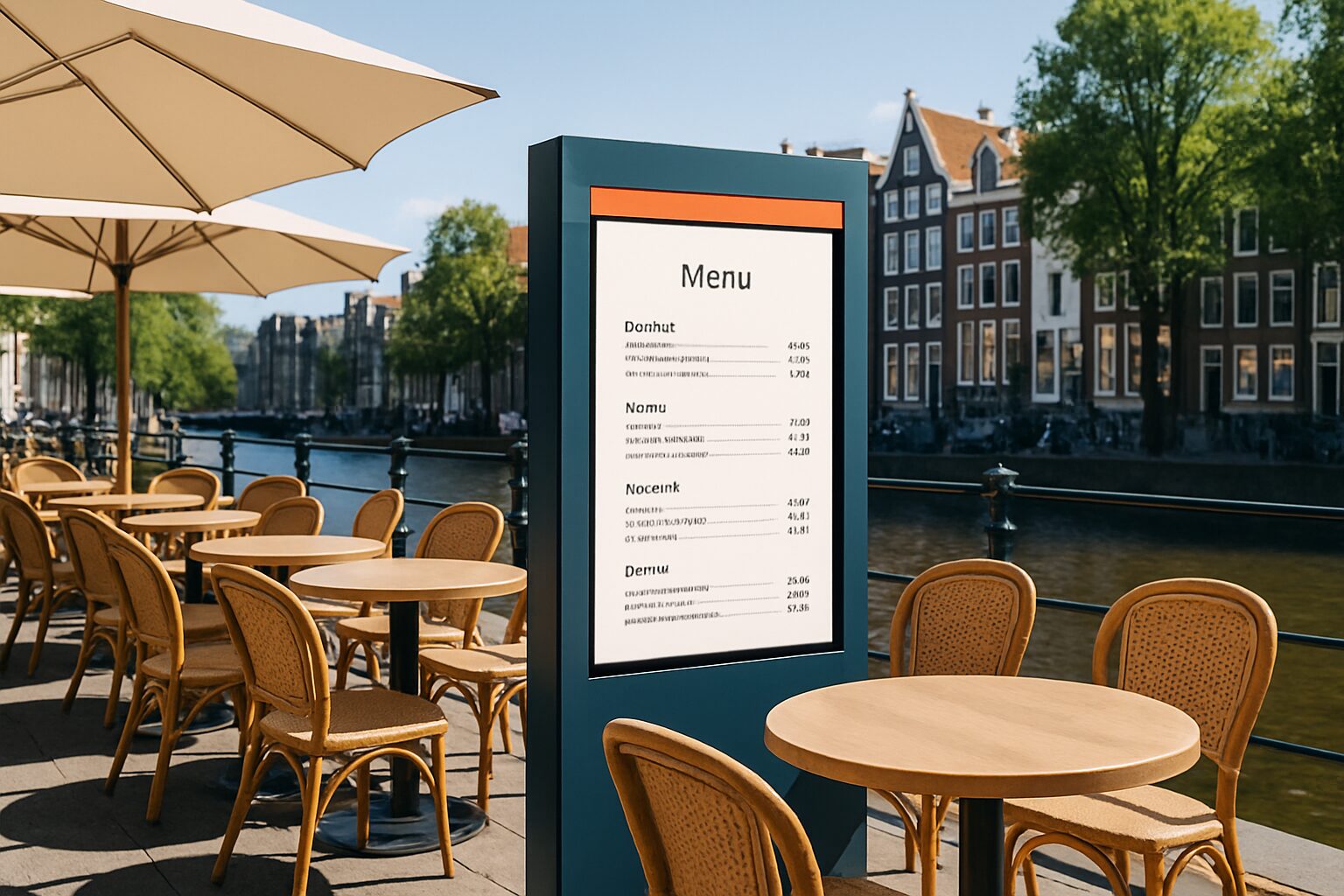
Outdoor displays for terraces: weatherproof and visible
A outdoor display for a terrace, a weather-resistant digital screen specially designed for outdoor use, resistant to rain, dust, direct sunlight and temperature changes. Such screens have a brightness of at least 2.500 nits (versus 300-500 nit for a standard indoor monitor), an IP rating of at least IP55 and an operating temperature range typically from -20 °C to +60 °C. They are used for menu display, promotions and information provision on terraces, exterior façades and event venues.
In short
- Outdoor displays require at least 2.500 nit brightness for readability in direct sunlight.
- IP55 is the absolute minimum; IP65 or higher is recommended for full outdoor use.
- Robust mounting and thermal management are at least as important as the screen itself.
- Total cost of ownership (TCO) is higher than with indoor solutions because of hardware and installation requirements.
- Pixio Display supplies certified outdoor displays for hospitality venues in the Netherlands and Belgium.
Why a regular monitor does not work outdoors
A standard indoor monitor reaches 300 to 500 nit. On a sunny terrace, that is unreadable: direct sunlight quickly reaches 10.000 lux or more. Moreover, the housing of an indoor monitor is not waterproof. One rain shower and the electronics are damaged. The warranty lapses with outdoor use, and the insurer will not cover damage if the device is not certified for outdoor installation. In short: placing an indoor monitor outside is not a temporary solution — it is an expensive mistake.
Brightness: the critical specification
Brightness is expressed in nits (cd/m²). For terraces, the following rules of thumb apply:
| Situation | Minimum brightness |
|---|---|
| Covered terrace, no direct sunlight | 1.500 nit |
| Semi-open terrace, changing sun | 2.500 nit |
| Fully open terrace, south-facing | 3.500–5.000 nit |
| Digital column or façade screen | 5.000+ nit |
A terrace screen of 2.500 nits costs on average two to three times as much as a comparable indoor model. That difference is recouped through higher turnover: research by the Digital Signage Federation (DSF) suggests that well-placed outdoor signage can increase impulse purchases by 15 to 30 per cent (see dsf.org for current figures). When buying, always check whether the stated nit value is peak brightness or average brightness — manufacturers do not always communicate this clearly.
IP ratings and material resistance
IP stands for Ingress Protection. The two digits indicate dust resistance (0–6) and water resistance (0–9) respectively.
- IP54: protected against splashing water from any direction. Suitable for covered terraces.
- IP55: protected against water jets. Minimum for semi-open terraces.
- IP65: fully dust-tight, protected against water jets. Recommended for completely open terraces.
- IP66/IP67: resistant to powerful water jets and temporary immersion. Essential for coastal locations or frequent cleaning with a pressure washer.
In addition to the IP rating, the housing material is relevant. Aluminium dissipates heat better than plastic and does not rust. UV-resistant tempered glass (at least 4 mm) prevents discolouration and scratches. If in doubt, ask for the IK rating: it indicates impact resistance. IK08 (5 joule) is a common minimum requirement for public spaces.
Thermal management: cooling and heating
Electronics work best between 0 °C and 40 °C. Outdoors, the enclosure can heat up to 70 °C in direct sunlight during summer. Without active cooling, the processor throttles and the screen may automatically dim or switch off. Good outdoor displays have integrated fan or heatpipe cooling, a thermostat that controls ventilation and an anti-condensation heater for cold nights. Pay attention to fan noise: on a quiet terrace, a fan of 45 dB(A) is distracting. Choose models with a noise level below 40 dB(A) at 1 metres distance.
Temperatures vary greatly in the Netherlands and Belgium. An operating temperature range of -20 °C to +60 °C covers virtually all conditions. Also check the storage temperature if the screen is stored in winter.
Assembly and installation requirements
Installing an outdoor display is more complex than installing an indoor monitor. Take the following points into account:
Structural load: A 55 inch outdoor display soon weighs 25 to 40 kg. In wind force 8 (Beaufort) on a terrace in Rotterdam or Vlissingen, the wind load on a freestanding column can rise to 150 N/m². The mounting structure must be calculated by a structural engineer or comply with the manufacturer’s specifications.
Cable management: Use outdoor-suitable cables (UV-resistant, minimum IP44 connectors). Route cables through ground ducts or PVC conduit. Ensure an earthed connection on a circuit with an RCD (30 mA).
Orientation: Do not mount the screen facing south if this can be avoided. An east- or west-facing orientation reduces direct sunlight and extends the life of the panel. Use a tilting bracket to adjust the viewing angle.
Permits: In some municipalities (Amsterdam, Utrecht, The Hague), a permit is required for permanent outdoor advertising. Check this in advance with the local municipality or the Environmental Desk (omgevingsloket.nl).
Three concrete examples from Dutch hospitality
Beach pavilion in Scheveningen: A beach pavilion installed two 55 inch outdoor displays (IP65, 3.500 nit) on the facade side. The screens show the daily menu and drinks promotions. Thanks to the high brightness, the screens are also easy to read on sunny afternoons. The displays are connected to a digital signage CMS, allowing staff to update content themselves — see also the article Digital menus and signage in hospitality in the Pixio knowledge base for more on CMS integration.
Brewery café in Amsterdam: A café in the Jordaan installed a 43 inch outdoor touchscreen (IP55, 2.500 nit) at the entrance as an interactive menu board. Guests can view the menu before going inside. The touch function also works with wet fingers thanks to an optimised touch controller. Read more about the implementation of touchscreen menu boards in the article Interactive touchscreen menu boards: how do you implement this?
Event venue in Eindhoven: A congress and events venue used temporary outdoor displays (2.000 nit, IP54) during an outdoor trade fair. The screens were mounted on movable stands and showed the programme and sponsor messages. After the event, the displays were stored and reused at a later event — a cost-efficient approach for locations without a permanent need.
Comparison: outdoor LCD vs. outdoor LED
For outdoor displays, you make a fundamental choice between LCD panels and direct LED panels (also known as direct-view LED or dvLED).
| Feature | Outdoor LCD | Outdoor LED (dvLED) |
|---|---|---|
| Brightness | 1.500–5.000 nit | 3.000–10.000+ nit |
| Resolution | High (4K possible) | Depending on pixel pitch |
| Minimum viewing distance | 0,5 m | 3–5 m (depending on pitch) |
| Dimensions | Standard (43–86 inch) | Fully customised |
| Price (entry-level) | current price on request | current price on request+ |
| Lifespan | 50.000–70.000 hours | 80.000–100.000 hours |
| Maintenance | Replace panel | Replace modules individually |
For café and restaurant terraces, outdoor LCD is in most cases the right choice: lower entry price, high resolution at short viewing distances and easier integration with existing CMS systems. Outdoor LED is interesting for large façades, event venues and situations where customisation is needed.
Content and software: the underestimated component
A technically perfect display delivers nothing if the content is poor. Keep the following principles in mind for outdoor content:
- Use large fonts (minimum 80 pt for text at a distance of 3 metres).
- Choose high contrast ratios: white on dark blue or black on yellow works well in direct sunlight.
- Limit the amount of information per slide: one message per screen.
- Adjust the content to the time of day: breakfast menu in the morning, happy hour in the afternoon. See also Dynamic price display on displays: real-time updates for hospitality for automation.
- Check whether the CMS software supports brightness scheduling: at night the brightness can automatically be reduced to save energy and avoid disturbing nearby residents.
According to Statistics Netherlands, the Netherlands had more than 42.000 hospitality businesses in 2023 (source: cbs.nl, StatLine). Only a fraction use outdoor digital signage. That means early adoption delivers a competitive advantage, especially in busy nightlife areas.
Maintenance and lifespan
Outdoor displays require more maintenance than indoor models. Plan the following:
- Monthly: clean the glass with a damp cloth (no solvents). Check the ventilation openings for leaves and dust.
- Half-yearly: check the mounting brackets for rust and loosened bolts. Check the cable entries for watertightness.
- Annually: have an installer inspect the electrical connection. Replace filters in ventilated housings.
The average lifespan of a quality outdoor LCD panel is 50.000 to 70.000 operating hours. At 12 hours of use per day, that is more than 11 years. In practice, the housing often needs replacing sooner than the panel itself.
Conclusion
An outdoor display for a terrace is a serious investment that requires technical knowledge: brightness, IP rating, thermal management, mounting structure and content strategy all need to be right. If you choose the right specifications and a proper installation, an outdoor display will contribute measurably to the revenue and appearance of a hospitality venue for years. Pixio Display, supplier of digital signage in the Netherlands and Belgium, offers a certified range of outdoor displays for terraces and facades, including tailored advice for installers and hospitality entrepreneurs.
Looking for an outdoor screen? View it weather-resistant outdoor display from Pixio — extra bright and suitable for terrace or façade.
Frequently asked questions
What minimum brightness does an outdoor display need for a terrace in the sun?
For a fully open, south-facing terrace you need at least 3.500 nits. On a covered or semi-open terrace, 2.500 nits is sufficient. A standard indoor monitor reaches 300 to 500 nits and is unusable outdoors.
What does IP65 mean on an outdoor display?
IP65 means the screen is completely dust-tight (first digit: 6) and resistant to water jets from any direction (second digit: 5). This is the recommended minimum rating for fully open terraces. For coastal locations or cleaning with a pressure washer, choose IP66 or higher.
Do I need a permit for an outdoor display on my terrace?
That depends on the municipality. In cities such as Amsterdam, Utrecht and The Hague, a permit is often required for permanent outdoor advertising. Check this in advance via the Environmental Desk on omgevingsloket.nl or with your municipality's Permits department.
What is the difference between outdoor LCD and outdoor LED for a terrace?
Outdoor LCD is cheaper to buy (from around € 2.000), has a high resolution and works well at short viewing distances. Outdoor LED (dvLED) is brighter, fully customisable and has a longer lifespan, but the entry price is soon above € 8.000. For most terraces, LCD is the practical choice.
Can I install an outdoor display myself or do I need an installer?
Simple wall mounting can be carried out by a capable business owner, provided the structure has been approved and the electrical connection is carried out by a certified electrician. For heavy structures, wind load calculations or permanent outdoor installations, you should use a certified installer.
How do I clean an outdoor display?
Clean the glass monthly with a damp cloth. Do not use solvents or abrasives. Also check the ventilation openings for dust and leaves. If you use a pressure washer, the screen must be at least IP66 certified.
How long does an outdoor display last?
A quality outdoor LCD panel has a lifespan of 50.000 to 70.000 operating hours. At 12 hours of use per day, that is more than 11 years. In practice, the enclosure and mounting structure often need replacing sooner than the panel itself.
Can an outdoor display also stay outside in winter?
Yes, provided the screen has an operating temperature range of at least -20 °C to +60 °C. Good outdoor displays have built-in anti-condensation heating that switches on automatically at low temperatures. Always check this in the technical specifications.
Which CMS should I use for an outdoor display on a terrace?
Almost all common digital signage CMS platforms support outdoor displays. Choose a platform that supports brightness scheduling (automatic dimming at night) and allows you to schedule content easily by time or day. Pixio Display advises on compatible CMS solutions for the supplied hardware.
What does an outdoor display for a terrace cost on average?
A 43 to 55 inch outdoor LCD display costs between € 2.000 and € 6.000 excluding installation. Add € 500 to € 1.500 for mounting and cabling. Outdoor LED solutions start around € 8.000 and rise to tens of thousands of euros for large formats.