
Knowledge and advice
Displaying allergy information digitally: which rules do you need to comply with?
What legal rules apply to allergen information in hospitality? Read what the law requires and how a digital display helps you stay compliant.
Displaying allergy information digitally: which rules do you need to comply with?
Every hospitality business in the Netherlands is legally required to inform guests about the 14 recognised allergens in unpackaged dishes. That obligation applies on the basis of European Regulation (EU) No. 1169/2011 and the Dutch Food Information Regulation for non-prepacked foods. The information may be provided in writing, electronically or verbally — provided it is always correct, accessible and immediately available. A digital screen counts as electronic provision and therefore fully complies with the law.
What exactly does the law say?
European Regulation 1169/2011 has been in force since 13 December 2014. From that date, restaurants, cafés, caterers and other hospitality businesses are required to provide allergen information for unpackaged products.
The Dutch Food and Consumer Product Safety Authority describes the 14 mandatory allergens as: cereals containing gluten, egg, fish, peanuts, nuts, soya, milk (including lactose), crustaceans, molluscs, celery, mustard, sesame seeds, sulphites and lupin. There is no lower limit for concentration — if an allergen is in a recipe, you must state it.
The Dutch Commodities Act further elaborates this. Allergen information must be available in writing or electronically at the point of sale, freely accessible, understandable and clearly legible. If you choose verbal provision, additional conditions apply: the information must always be available in writing or electronically for staff, and there must be a visible notice referring guests to staff.
Three permitted ways of provision
The law lets you choose between three methods. Each method has its own requirements:
| Method | What the law requires |
|---|---|
| Written or electronic (for guest) | Directly visible and readable at the point of sale; may be on a menu board, sign or digital screen |
| Verbal | Written/electronic basis always available for staff and NVWA; visible sign referring guest to staff |
| Combination | Digital screen shows the information; staff can provide additional explanation |
A digital display falls under the electronic method. That is the most robust choice: the information is always visible, does not have to be passed on verbally and can be checked immediately by the NVWA.
What has to be correct in terms of content?
The content of your allergen information is at least as important as the format. Three points are critical:
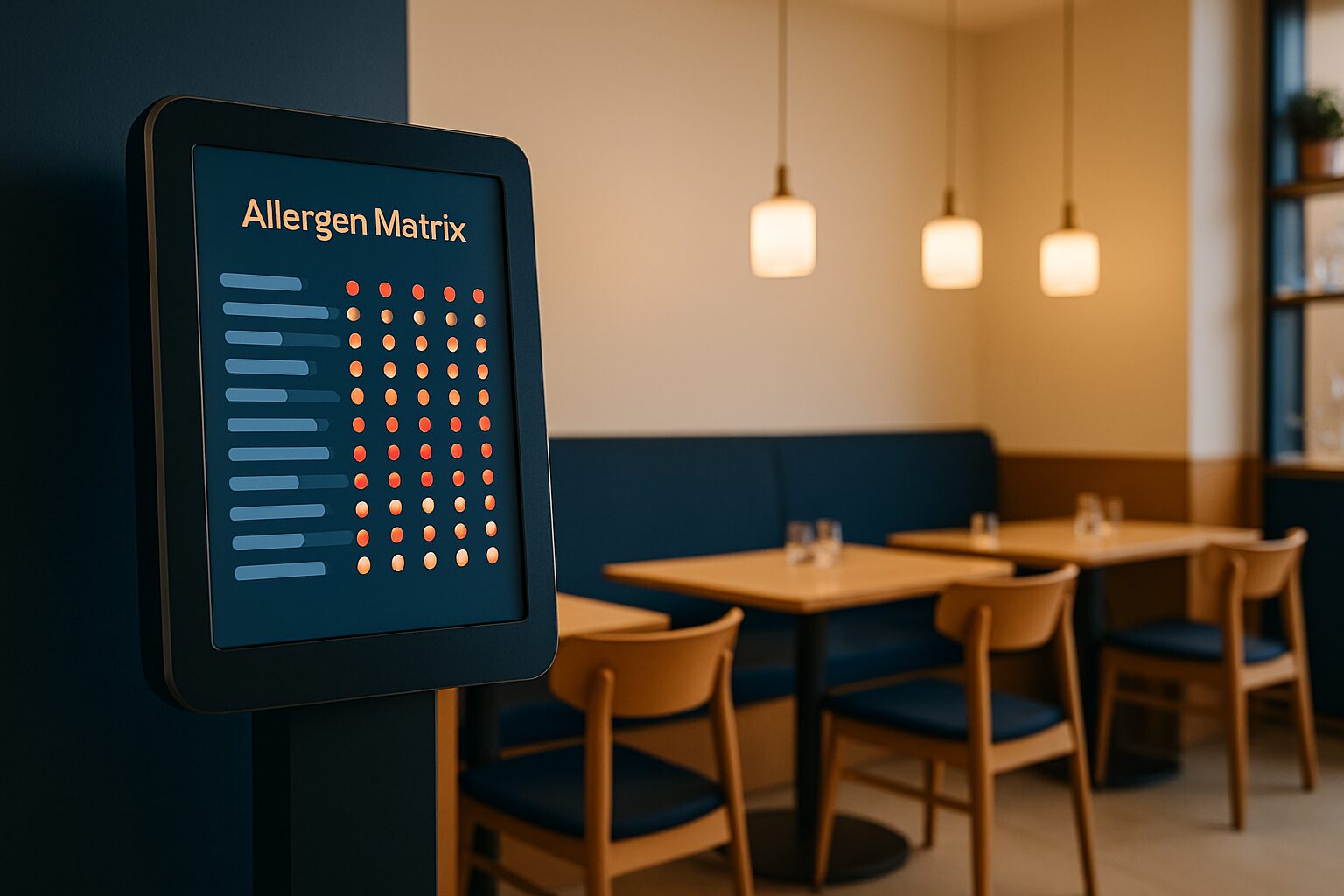
Completeness per dish. You must indicate for each dish whether each allergen is present. A matrix — dishes on one axis, the 14 allergens on the other — is a practical way to keep this clear.
Up to date with every recipe change. If you change a recipe, the allergen information must be updated immediately. On a paper menu card, that is a print cost and time investment. On a digital screen, you adjust the content in a few minutes.
Recorded in your food safety plan. The allergen information card must form part of your food safety plan. Staff must be able to consult the information at all times so that the NVWA can verify its accuracy.
Enforcement: how seriously does the NVWA take this?
The NVWA carries out unannounced inspections and checks allergen information as a standard part of every hospitality inspection. From 13 March 2023, inspection results relating to allergen information are actively made public on openbare-inspectieresultaten.nvwa.nl. Guests can therefore look up your score.
In the event of an infringement, the NVWA imposes administrative fines. These range from current price on request per infringement; for companies with more than 50 employees the fine is always twice as high. Infringements are counted case by case, so the total amount rises quickly.
The NVWA found in an investigation of more than 6.500 addresses that hospitality businesses still too often provide insufficient information about allergens. That makes this topic not only a legal issue, but also a reputational one.
Why a digital display is the most practical solution
A digital screen solves three practical bottlenecks at once:
- Always up to date. Adjust your recipe via the PixioApp or a website URL — the information on the screen is updated immediately, without reprinting.
- Visible to both guest and NVWA. The screen acts as electronic provision and as proof that the information was available.
- Less prone to errors. Passing on allergen information verbally by changing staff is a risk. A screen always shows the same, recorded information.
A concrete example: a restaurant with a seasonal menu that changes weekly updates the allergens matrix in the content software. The screen shows the updated information immediately. Staff do not have to keep a paper list and the NVWA can inspect the electronic record.
The PixioKiosk information column is a suitable option for this. The 32" model costs current price on request (price list Q2 2026) and has an integrated Android computer — no separate media player or laptop needed. For restaurants that prefer to place a standing touch screen on the floor, the PixioDisplay Luxe (49", current price on request to buy or current price on request per month when leasing) enough screen space for a full allergen matrix per dish.
Do you want to try the screen first for a specific period, for example during a seasonal change or a temporary terrace? Via display hire the 21,5" kiosk is already available from current price on request per day with a minimum rental of two weeks.
Conclusion
Displaying allergen information digitally is legally permitted and fully complies with the requirements of the Commodities Act Regulations and EU Regulation 1169/2011 — provided the information is freely accessible, understandable and up to date. Start with an allergen matrix per dish, record it in your food safety plan and choose a display solution that lets you update the content quickly.
Read more about how to use digital screens more broadly in your business in the article Digital menus and signage in hospitality: from menu board to terrace display.
Frequently asked questions
Do I always have to show all 14 allergens on a screen?
For each dish, you must indicate which of the 14 mandatory allergens are present. You do not need to list all 14 if none are present, but the information must be complete and correct for every dish you offer. An allergen matrix per dish is the most straightforward way.
Does a digital screen count as official allergen information?
Yes. The Warenwetregeling allergeneninformatie niet-voorverpakte levensmiddelen expressly allows information to be made available electronically. A digital screen meets that requirement, provided the information is freely accessible, understandable and clearly legible at the point of sale.
May I give allergen information verbally instead of on a screen?
That is allowed, but additional requirements apply. The information must always be available in writing or electronically for staff and the NVWA, and there must be a visible sign directing guests to staff. In practice, a digital screen is simpler and less error-prone.
What happens if the NVWA finds that my allergen information is incorrect?
The NVWA can impose an administrative fine of €525 to €2.100 per infringement. For companies with more than 50 employees, the fine is twice as high. In addition, inspection results concerning allergen information are published on the NVWA website, visible to everyone.
How do I keep my allergen information up to date if my menu changes regularly?
Record the allergen matrix digitally and link it to your display content. If you change a recipe, update the information on the screen immediately via the content software or app. This keeps the information up to date without reprinting menus, and meets the legal requirement that the information is updated whenever a recipe changes.