
Knowledge and advice
AVG and digital signage in hospitality: what are you allowed to do with customer data?
Interactive displays in hospitality collect customer data — this falls under the GDPR. Read which rules apply, when a DPIA is required and how to remain compliant.
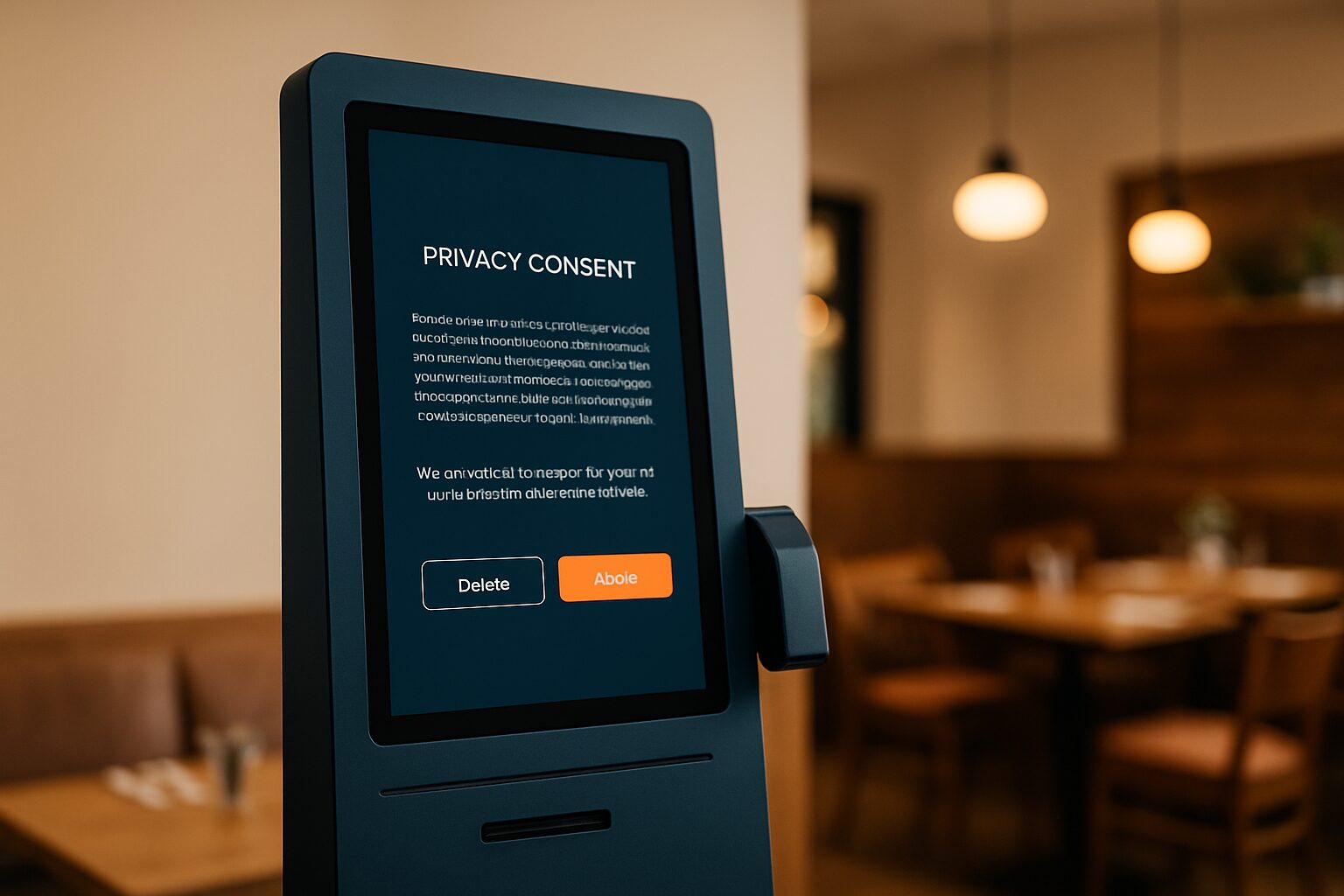
An interactive display in horeca falls under the GDPR as soon as it processes personal data — think order history, email addresses for loyalty programmes or camera footage for visitor analysis. The General Data Protection Regulation (GDPR) applies to every organisation in the EU that collects or processes personal data, with fines of up to 20 million euros or 4% of global annual turnover for breaches. Knowing which rules apply to your screens prevents problems later.
When does a display fall under the GDPR?
Not every screen processes personal data. A digital menu board that only shows images falls outside the GDPR scope. However, as soon as the screen asks for input — name, email address, order linkage — or analyses images, the GDPR applies.
The most common situations in hospitality:
- Self-service kiosk with account: the guest logs in or enters an email address for a receipt or loyalty points.
- Loyalty programme via touchscreen: name, purchase history and customer number are personal data.
- Camera module for visitor analysis: counts visitors or analyses age groups — depending on the method, quickly GDPR-relevant.
- Review kiosk: if a guest enters their name or email address in a review, you process personal data.
A passive interactive touchscreen menu board without an account function is in most cases GDPR-neutral. If you add a loyalty scheme, that changes immediately.
The six GDPR lawful bases: which applies to you?
You may process personal data only if there is a legal basis for doing so. For hospitality businesses, three bases are most relevant:
- Consent — the guest gives voluntary, explicit and informed consent. Consent must be freely given: refusal may not lead to refusal of the service.
- Performance of an agreement — processing is necessary to fulfil the order or send the invoice.
- Legitimate interest — you have a legitimate business interest that outweighs the guest's privacy interests. This requires a balancing test and is not self-evident.
Choose the legal basis before you start processing, and record it. Do not then switch legal basis — that is not allowed under the GDPR.
Processing register: also for small hospitality businesses
Article 30 of the GDPR requires almost every organisation to keep a record of processing activities. This also applies to hospitality businesses that systematically store customer data via a display or kiosk.
The register contains at least:
- Name and contact details of the controller
- Purposes of processing (e.g. loyalty programme, order management)
- Categories of data subjects and personal data
- Retention periods
- Description of security measures
The Dutch Data Protection Authority can request this register at any time. If you do not have a register, you risk a fine — even if you are otherwise compliant.
Practical advice: create one row per processing purpose. A self-order kiosk with loyalty function quickly results in three separate rows: order management, loyalty points and any marketing emails.
Facial recognition and camera analysis: almost always prohibited
Some displays offer a camera module that recognises visitors or estimates demographic data. This is where the biggest GDPR risks lie.
The Dutch Data Protection Authority states that facial recognition is in principle prohibited, because it processes biometric data — a special category of personal data subject to a stricter protection regime. There are only two exceptions: the explicit consent of the filmed person, or a compelling public interest such as security at a nuclear power plant. The security of a hospitality venue does not fall under that.
What is allowed:
- Anonymous counting cameras that only record numbers without identifying faces.
- CCTV for security, provided it is clearly indicated, and images are kept for a maximum of 4 weeks.
If you still want some form of visitor analysis via camera, choose systems that store only aggregated, non-traceable data. Check with the supplier explicitly whether the system processes biometric data.
DPIA: when is it mandatory for an interactive kiosk?
A Data Protection Impact Assessment (DPIA) is mandatory if processing is likely to pose a high privacy risk. The Dutch Data Protection Authority has drawn up a list of processing activities for which a DPIA is mandatory before you start.
For a hospitality kiosk, a DPIA is mandatory if you:
- Special categories of personal data at scale processed (e.g. dietary information linked to a profile).
- Systematically follows people in a publicly accessible space via camera.
- Applies profiling based on ordering behaviour with significant consequences for the guest.
A standard self-order kiosk without profiling or camera analysis usually falls outside the DPIA requirement. Unsure? Use the GDPR rule guidance from the Dutch Data Protection Authority to check whether a DPIA is needed.
How to set up a GDPR-compliant kiosk
Compliance starts with the selection and configuration of the screen, not with the privacy statement. A concrete approach:
1. Data minimisation — collect only what you really need. Does the loyalty programme need a date of birth, or is an email address sufficient?
2. Opt-in on the screen — show a clear consent request before the guest enters data. The opt-in must not be pre-ticked.
3. Privacy policy accessible — refer to your privacy statement on the screen, for example via a QR code or a 'Privacy Policy' button.
4. Automatic removal — set a retention period and ensure data is automatically deleted after that period. A digital system with encrypted storage and automatic deletion is GDPR-compliant; a paper alternative rarely is.
5. Data Processing Agreement — if an external software supplier processes the data, then conclude a processing agreement. That also applies to the content management software behind your display.
The PixioKiosk (21,5″ from current price on request, 43″ from current price on request — price list Q2 2026) runs on an integrated Android computer without an external media player. You manage content and forms via the PixioApp or your own URL. That makes it easier to determine which data the kiosk processes and where it goes — an advantage when drawing up your processing register.
Conclusion: start with the foundation, not with the screen
It is best to ask the GDPR question before installing an interactive kiosk: what data am I collecting, on what legal basis, how long do I keep it and who has access? If you answer those questions first, the technical setup becomes much simpler.
A passive digital menu board without data input is GDPR-neutral and the fastest way to get started. If you later want to expand with loyalty functions or visitor analysis, build the compliance layer in from the start — not afterwards.
For broader context on display selection and implementation, also read the step-by-step guide for a digital menu board or see the hospitality applications of Pixio Display.
Frequently asked questions
Does a digital menu board that only shows images fall under the GDPR?
No. A display that only plays content without data input or camera analysis does not process personal data and falls outside the scope of the GDPR. As soon as guests enter data or the screen analyses images to identify people, the GDPR does apply.
Do I need to keep a processing register if I use a self-order kiosk?
Yes, if the kiosk processes personal data structurally — such as email addresses or order history — you are required to include that processing in a processing register (article 30 GDPR). The Dutch Data Protection Authority can request this register at any time.
May I use facial recognition on my hospitality display to recognise regular customers?
Almost never. Facial recognition processes biometric data, a special category under the GDPR. That is, in principle, prohibited. The only relevant exception is the explicit consent of each individual guest — which is hardly workable in a hospitality setting.
When is a DPIA mandatory for my interactive kiosk?
A DPIA is mandatory if the processing is likely to result in a high privacy risk. This is the case with systematic profiling based on ordering behaviour, large-scale processing of special personal data, or camera surveillance by which people are systematically monitored. A standard ordering kiosk without these functions will usually fall outside the DPIA requirement.
What retention period applies to data collected via a kiosk?
GDPR does not prescribe a fixed retention period, but it does require you not to keep data longer than necessary for the purpose. Set the retention period based on your processing purpose, record it in your processing register and ensure automatic deletion when that period ends.