
Knowledge and advice
Planning permit vs. advertising notice for outdoor display: what is the difference?
When do you need an environmental permit for an outdoor display and when is a notification sufficient? Read the legal nuance and know what to apply for.
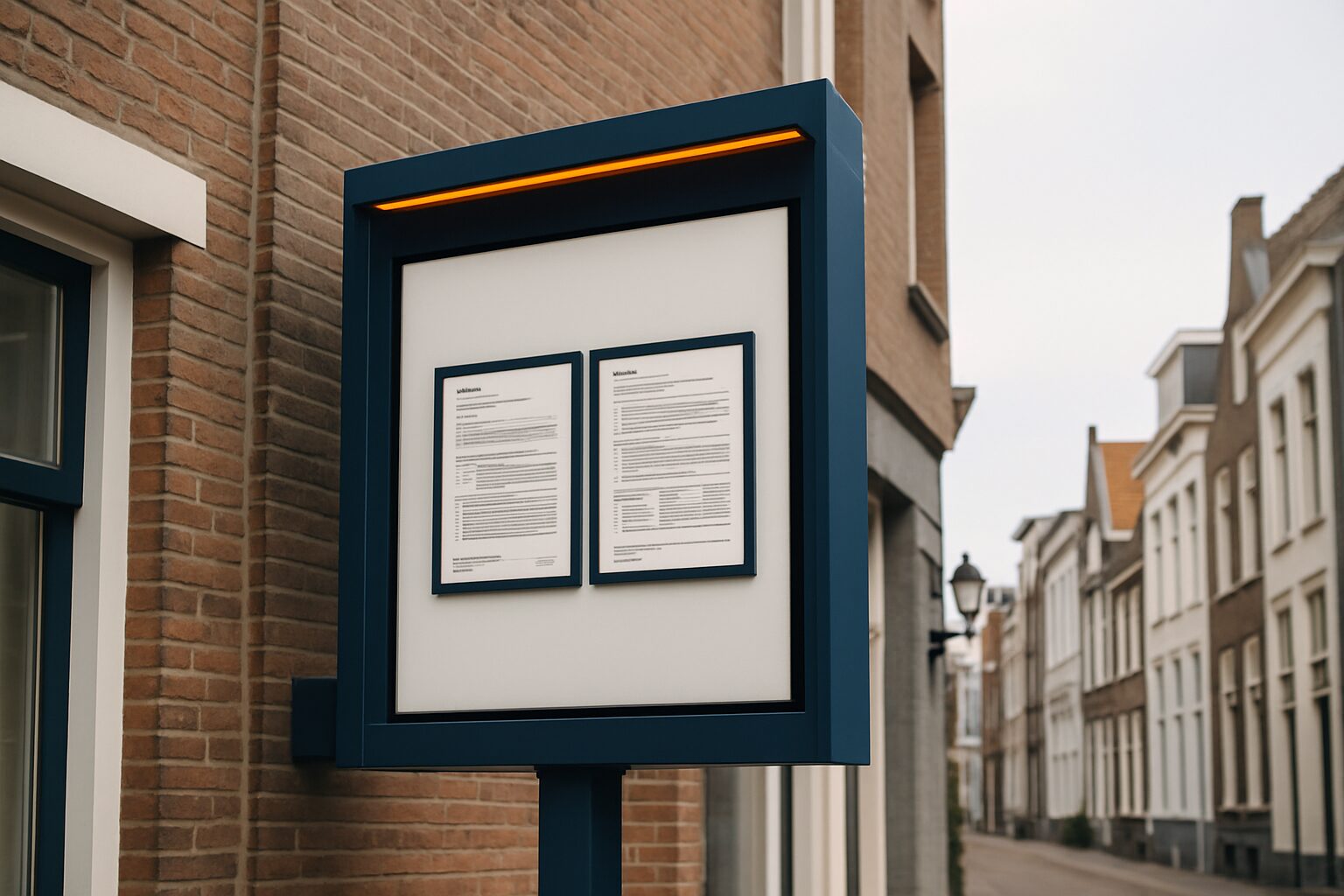
For an outdoor display in the Netherlands, two legal frameworks apply: the environmental permit (regulated through the Environment and Planning Act) and the advertising notification or APV exemption (municipally regulated). An environmental permit is required as soon as the display is regarded as a structure or is attached to a building. A notification is sufficient in limited cases where the advertising display is small, temporary in nature, or explicitly falls within the municipality's permit-free threshold. Both frameworks can apply at the same time.
What does the environmental permit regulate?
The environmental permit is the permission you need for the physical placement of an advertising object as a structure. Since 1 January 2024 this has been regulated by the Environmental and Planning Act, which replaced the former Wabo. Applications go via the Environment and Planning Portal.
Specifically: a freestanding advertising column, a screen mounted to a façade or a totem on a terrace will almost always require a permit. For example, Laarbeek municipality states that advertising boards on a property larger than 0,5 m² are subject to a permit. In Utrecht, there is a threshold of 1,5 m²: above that area, an environmental permit for the activity 'building' is required.
The municipality assesses your application against building regulations, the environmental plan and the quality of life policy document. For a municipal monument, the processing time is 8 weeks; for a national monument, 26 weeks. Take this into account when planning an outdoor display project.
What does the advertising notification (APV exemption) regulate?
The APV exemption — also known as an advertising notification or APV permit — regulates the use of public space and is granted by the mayor and aldermen. It is separate from the environmental permit and focuses on the visibility and impact of the advertisement on the surroundings.
For some types of advertising, a notification requirement applies instead of a permit requirement. You then do not need to apply for a formal permit, but you do need to inform the municipality of your plans. If you hear nothing within five weeks, you may place the advertising. This usually applies to small, non-permanent displays that fall within the municipality’s policy rules.
For temporary advertising — think of a display for an event or seasonal promotion — an APV permit is required in most situations. A permanent screen on the façade almost always requires an environmental permit.
The crucial difference: permit vs notification in one table
| Situation | Environmental permit | Advertising notice / APV |
|---|---|---|
| Free-standing advertising column (own premises) | Yes, classified as a building structure | May also be required |
| Screen on facade (> municipal threshold) | Yes | Yes, when visible from the public road |
| Temporary display (event) | No (unless the structure) | Yes, APV permit |
| Small sign (< municipality threshold) | No | Notification or permit-exempt |
| Display on municipal land | Yes + private-law permission | Yes |
Important rule of thumb: a planning permit concerns the structure and its spatial integration. The local bye-law concerns the advert itself and the use of public space. They complement each other — and both can apply at the same time.
When are both required?
For a freestanding outdoor display visible from the public road, in many cases you need both a planning permit and an APV exemption. The planning permit covers the structure; the APV exemption covers commercial advertising in public space.
Take as an example a PixioDisplay Outdoor of 49″ with a brightness of 3.500 cd/m² (from current price on request excl. VAT, price list Q2 2026), free-standing beside a business entrance. This screen is classed as a structure once it is permanently founded. You then need an environmental permit for the activity 'construction' and an APV exemption for the trade advertising visible from the road. Submit both applications at the same time to avoid delays.
For a temporary digital pavement board — such as the PixioDisplay A-board (43", battery-powered, 14–18 hours' runtime, no power socket needed, from current price on request excl. VAT) — the situation is different. This display is on wheels and is not fixed to the ground. As a result, in most municipalities it falls outside the permit requirement for the environmental permit. Nevertheless, there is often an APV notification or exemption requirement, especially if the screen is on the public road.
What does the Environment and Planning Act say about illuminated advertising?
Since 1 January 2024, the Environment and Planning Act replaces the Wabo. For illuminated advertising — and an outdoor LED display is always illuminated advertising — this means that the application via the Environment and Planning Portal is in progress. Municipalities have a transitional period of around eight years to fully align their regulations with the Environmental and Planning Act.
Practical consequence: always ask the municipality explicitly whether an application goes through the Omgevingsloket or via the APV exemption procedure. In some municipalities both procedures still run in parallel. Illuminated advertising with changing images — such as a digital screen — must also comply with the NSVV Light Nuisance Guideline. Many municipalities make an automatic dimming function a condition for granting a permit.
Rijkswaterstaat has also determined that moving objects or images are not permitted along motorways and that advertising must not dazzle. If you place a display near a motorway, additional national rules apply alongside the municipal APV.
Practical step-by-step plan: what do you do first?
Always start with the permit check via the Environment and Planning Portal. This determines whether you need a planning permit, a notification or nothing for the construction. Then check your municipality's APV for commercial advertising.
Step 1 — Permit check Omgevingsloket: fill in location, dimensions and mounting method.
Step 2 — Request zoning regulations: Request the outdoor advertising notice from the council. Many councils have specific requirements for digital screens.
Step 3 — Technical documentation: state the brightness (cd/m²), dimensions, dimming function and mounting method. This is mandatory for the application.
Step 4 — Submit simultaneously: submit an environmental permit and APV exemption at the same time. The processing time for a standard environmental permit is 8 weeks; for a listed building this can rise to 26 weeks.
Step 5 — Wait for decision: do not begin installation until all permits are final and all notifications have been made.
Read more about the specific APV rules by municipality in the article Municipal by-laws and outdoor digital signage: what does the council regulate?. For a comparison of the advertising rules in Amsterdam, Rotterdam, The Hague and Utrecht, see Advertising rules in Amsterdam, Rotterdam, The Hague and Utrecht compared.
Conclusion: choose the right procedure before you order
The distinction between an environmental permit and an advertising notification lies in the nature of the structure and the type of advertising expression. A permanent, fixed or building-mounted outdoor display always requires an environmental permit. A temporary, movable display may be sufficient with an APV notification or exemption — but always check this per municipality. Both procedures can run at the same time and complement each other.
Start the permit check before ordering a display. This prevents you from buying a screen that your local authority does not permit at the desired location.
Frequently asked questions
What is the difference between a permit and an advertising notification for an outdoor display?
A planning permit regulates the physical placement of a display as a structure or construction on a building. An advertising notification or APV exemption regulates the advertising expression itself in the public space. They are legally separate and both may be required at the same time.
Do I need an environmental permit for a temporary digital A-board?
Usually not. A movable pavement sign on wheels is generally not regarded as a structure and falls outside the planning permission requirement. Even so, an APV notification or exemption requirement often applies, especially if the screen is on or by the public road. Always check this with your municipality.
How long does the processing of an environmental permit for an outdoor display take?
The standard processing period is 8 weeks. For a municipal listed building, this can extend to 8 weeks, and for a national listed building to 26 weeks. If your application covers multiple activities, the extensive preparatory procedure may apply with a period of 26 weeks.
Does an outdoor LED display have to comply with the NSVV Light Nuisance Guideline?
Yes. Illuminated advertising with changing images must comply with the NSVV Light Nuisance Guideline. Many local authorities require an automatic dimming function as a condition for granting a permit. Always state the brightness in cd/m² and the dimming function in your permit application.
Where do I do the permit check for my outdoor display?
Via the Environment and Planning Portal at omgevingsloket.nl. Enter the location, dimensions and fixing method — the system will indicate whether you need an environmental permit, a notification or nothing. Then also check your municipality’s local by-laws for the rules on commercial advertising.