
Knowledge and advice
Advertising rules in Amsterdam, Rotterdam, The Hague and Utrecht compared
Advertising rules for outdoor displays differ by city. Read what Amsterdam, Rotterdam, The Hague and Utrecht require for permits and digital screens.
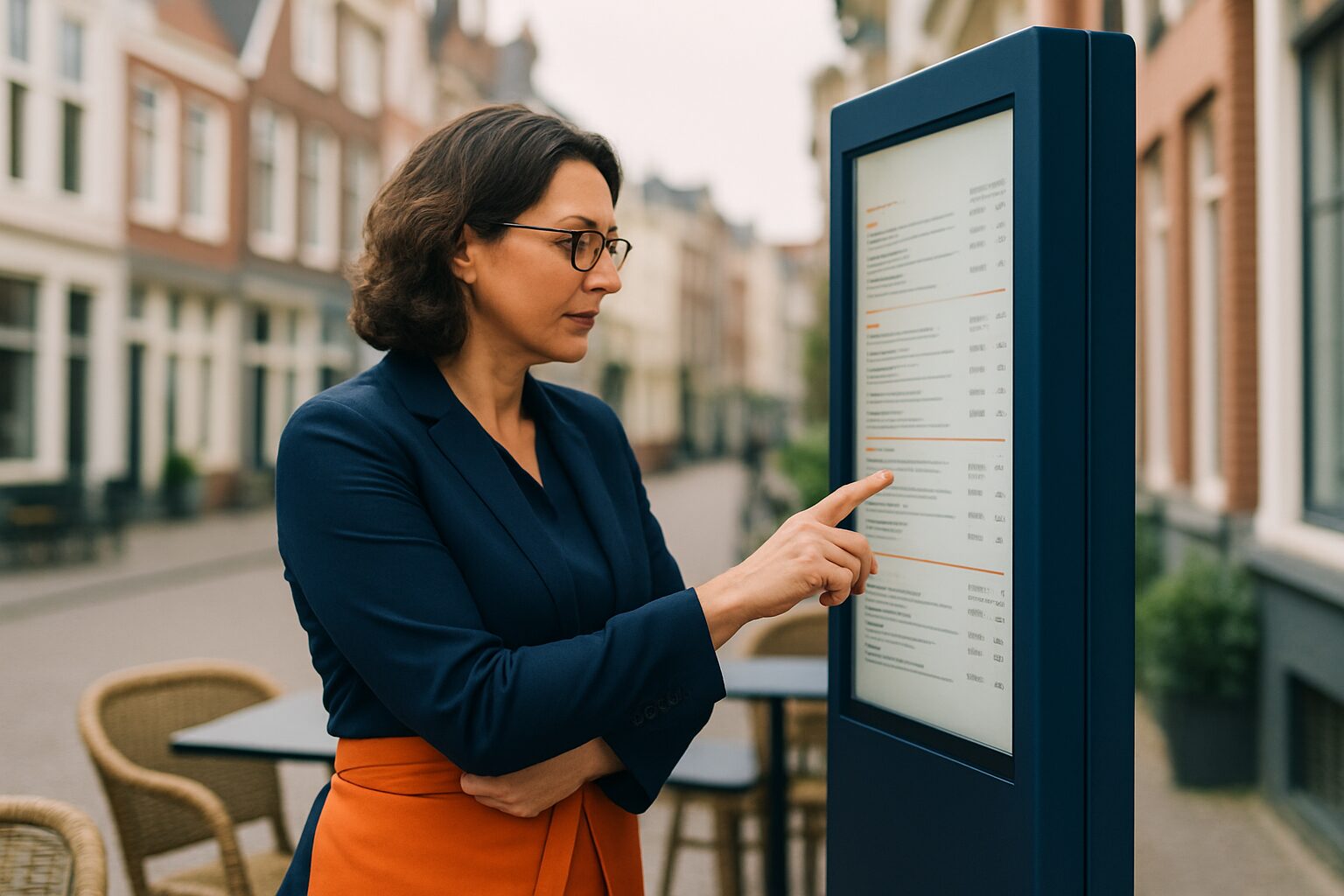
Advertising rules in Amsterdam, Rotterdam, The Hague and Utrecht: the differences
Every Dutch municipality regulates outdoor advertising itself via the General Municipal By-law (APV) and the zoning plan. For a restaurant or café owner who wants to place a digital screen on the façade or on the terrace, this means: what is allowed in one city without a permit requires a formal application in the neighbouring city. This article compares the four largest cities side by side, so you know exactly where you stand before ordering a display.
Why the rules differ from one municipality to another
The Netherlands has no national advertising law. The basis lies in the Environment and Planning Act and the municipal local regulations. Each municipality translates those frameworks into its own policy, design standards and rules. The result: four major cities, four different systems.
There are two legal routes that can always apply:
- Environmental permit — needed if the advertisement is regarded as a structure (façade mounting, frame, light box).
- APV exemption or permit — required when placing an object in public space, such as a pavement sign on the pavement.
Sometimes both are required. Ondernemersplein.overheid.nl always advises first carrying out the permit check via the Omgevingsloket.
Amsterdam: strict policy, exemption required for public space
Amsterdam has one of the strictest regimes in the Netherlands. For advertising in public space — that is, on the pavement or on a lamppost — a ban applies. You can request an exemption, but it costs current price on request per request and is not granted automatically.
For façade advertising — including a lightbox or digital screen on the front façade — you need an environmental permit or must make a notification to the City Desk. If you alter the façade (for example by mounting a bracket or frame), a full environmental permit is always required.
Particularly in Amsterdam: district Centrum actively refuses exemptions for distributing advertising material on the street. Digital screens in public spaces are only permitted on a pilot basis, via early consultation with several municipal departments. A free-standing digital pavement board on the public pavement is therefore, in practice, almost impossible to permit in the city centre.
Practical advice for Amsterdam: Choose a display you place on your own premises — inside your building, on your terrace or directly on your façade — and always check the permit first via the Environmental Desk.
Rotterdam: no separate advertising permit, but also not permit-free
Rotterdam works differently. The municipality does not have a separate advertising permit. That sounds simpler, but in practice it means you have to check via the appearance policy whether your advertising fits within the front desk criteria.
For façade advertising of modest size — name sign, logo, small lightbox — in many cases no permit is needed, provided the advertising complies with the Rotterdam Advertising Guide. If you do not meet those criteria, a planning permit via the building route is required.
Rotterdam has specific rules for digital screens. In the Further rules for illuminated advertising Rotterdam 2020 states that for new permit applications only static and slowly changing images are permitted. Full motion video and rapidly changing images are no longer permitted. Advertising for third parties on your own digital screen is no longer possible at all: Rotterdam does not grant new permits for this.
Freestanding advertising — such as a digital sidewalk sign — is only allowed on private property in Rotterdam, not on the public pavement.
Practical advice for Rotterdam: Use the planning permission check to see whether your façade screen falls within the permit criteria. Choose a screen with adjustable brightness and no moving video if you want the permit process to go smoothly.
The Hague: permit as standard, with size exceptions
The Hague uses planning permission as the standard for commercial advertising. The official name is the environmental permit for the environmental plan activity: commercial advertising. You request it via the Environment and Planning Portal.
There are two exceptions where no environmental permit is required:
- Advertising that is not visible from a publicly accessible place.
- Texts smaller than 0,5 m² where the longest side is at most 1 metres.
A digital screen of 43″ (approx. 95 × 54 cm) therefore falls outside the exemption and requires a permit. The Hague will make a decision within 8 weeks; the municipality can extend that period by 6 weeks.
The Hague is working on a new framework for outdoor advertising 2024–2029. Outdoor advertising in public spaces is regulated there via concession agreements with operators. For façade advertising and displays on private land, the environmental permit remains the correct route.
Practical advice for The Hague: Submit your request early. The lead time of 8 to 14 weeks means you cannot install a display at short notice. Apply for the permit for both the advertisement and the mounting (construction activity) at the same time.
Utrecht: permit for façade, city centre with its own rules
In Utrecht, advertising on the façade — including a hanging sign or digital screen — requires an environmental permit. This can be an environmental permit for advertising or an environmental permit for building work, depending on how the fixing is carried out.
The Commission for Visual Amenity and Monuments assesses the application. The advertising must not attract too much attention and must suit the building and its surroundings. In a shopping area, advertising may be more eye-catching than at a monument. The outcome can therefore differ from one building to another.
Utrecht city centre (within the canals) has stricter rules than the rest of the city. For displays on the pavement — such as a digital pavement board — different conditions apply in the city centre than in other districts. Outside the city centre, a display is often permitted without a licence, provided you comply with the additional rules.
Practical advice for Utrecht: Check whether your premises are inside or outside the singels. That determines which regime applies. If in doubt: contact the municipality before buying the screen.
Comparison at a glance
| City | Façade advertising | Pavement sign public space | Digital screen | Special feature |
|---|---|---|---|---|
| Amsterdam | Environmental permit or notification | Exemption required (current price on request); centre: practically not permitted | Pilot basis only in public spaces | Strictest regime of the four |
| Rotterdam | Often exempt from permits via front desk criteria | Permitted only on your own premises | Static/calmly changing image required; full motion prohibited | Advertising guide as a practical tool |
| The Hague | Environmental permit (exception: < 0,5 m²) | Environmental permit required | Permit required; lead time 8–14 weeks | New policy framework 2024–2029 in preparation |
| Utrecht | Environmental permit (visual impact assessment) | Often allowed outside city centres | Aesthetic review by committee | City centres have stricter rules |
Which screen suits this situation?
For a hospitality business owner who wants to advertise without permit risk, there are two logical choices:
Inside or behind the window: A shop window screen falls outside the permit requirement in all four cities, provided the screen is behind the glass and not visible as a structure on the façade. The PixioDisplay Window Full Sun reaches 3.000 nits and is visible in direct sunlight — relevant for a shopfront aimed at a terrace. Dunkin' Donuts already uses this approach with the PixioDisplay Window for digital shop window posters (reference).
On your own terrace or courtyard: The PixioDisplay A-board runs on battery power (14–18 hours runtime, no mains connection required) and stands on private property — outside the APV permit requirement for public roads. The version with 1.500 nits costs current price on request (price list Q2 2026), the 2.000 nits version current price on request This also meets Rotterdam’s requirement for quietly changing images: you set the content yourself via the PixioApp.
Do you want to mount a screen on the facade? Then bear in mind the permit lead time — especially in The Hague and Amsterdam — and apply for the permit before you install the screen. The PixioDisplay Outdoor (3.500 cd/m², 49″ from current price on request, price list Q2 2026) is suitable for permanent outdoor placement, but requires an environmental permit in all four cities.
Conclusion
The advertising regulations in Amsterdam, Rotterdam, The Hague and Utrecht differ greatly. Amsterdam is the strictest: public space is in principle closed to advertising objects. Rotterdam offers more scope via counter criteria, but bans full-motion digital screens. The Hague and Utrecht both use the environmental permit as standard, with lead times of up to 14 weeks.
Start with a screen on your own premises or behind the window: that is the fastest and least risky route in all four cities. If you still want a façade screen, start the permit application early. For the broader context, read the article Outdoor digital signage: everything about choosing, placing and permits or see the PixioDisplay pavement sign page for a permit-friendly option on your own premises.
Frequently asked questions
Do I need a permit for a digital pavement sign in Amsterdam?
Yes. In Amsterdam, it is prohibited to place an advertising object in public space without an exemption. An exemption costs €174,80 and is not granted automatically. In the Centrum district, exemptions for advertising objects on the street are actively refused. If you want to use a pavement sign without permit risk, place it on your own terrace or courtyard.
May I hang a digital screen on my façade in Rotterdam with moving images?
No, not anymore for new permit applications. In new situations, Rotterdam only allows static and slowly changing images on digital screens. Full motion video is no longer permitted. This is set out in the Further rules on illuminated advertising Rotterdam 2020.
What is the difference between an environmental permit for advertising and an APV exemption?
You need an environmental permit for advertising if the advertising display is attached to or on a building and is regarded as a structure. An APV exemption is needed if you place an object in public space, such as a pavement sign on the pavement. Sometimes both are required at the same time, for example with a façade screen on a frame above the pavement.
Is a window display (behind the window) permit-free in all four cities?
In most cases, yes. A screen located behind glass and not attached to the facade as a structure usually falls outside the permit requirement. Do check whether the screen does not appear to be a construction on the outside of the building, because then a notification or permit may still be required.
How long does a permit application for façade advertising take in The Hague?
The Hague makes a decision within 8 weeks on an application for a commercial advertising environmental permit. The municipality can extend this period by 6 weeks. So allow for a lead time of 8 to 14 weeks and submit the application before mounting the screen.