
Knowledge and advice
Dynamic price display in retail: what is legally permitted in the Netherlands and Belgium?
What is legally allowed for dynamic price display on digital screens in the Netherlands and Belgium? Read the rules on reference prices, discounts and permits.
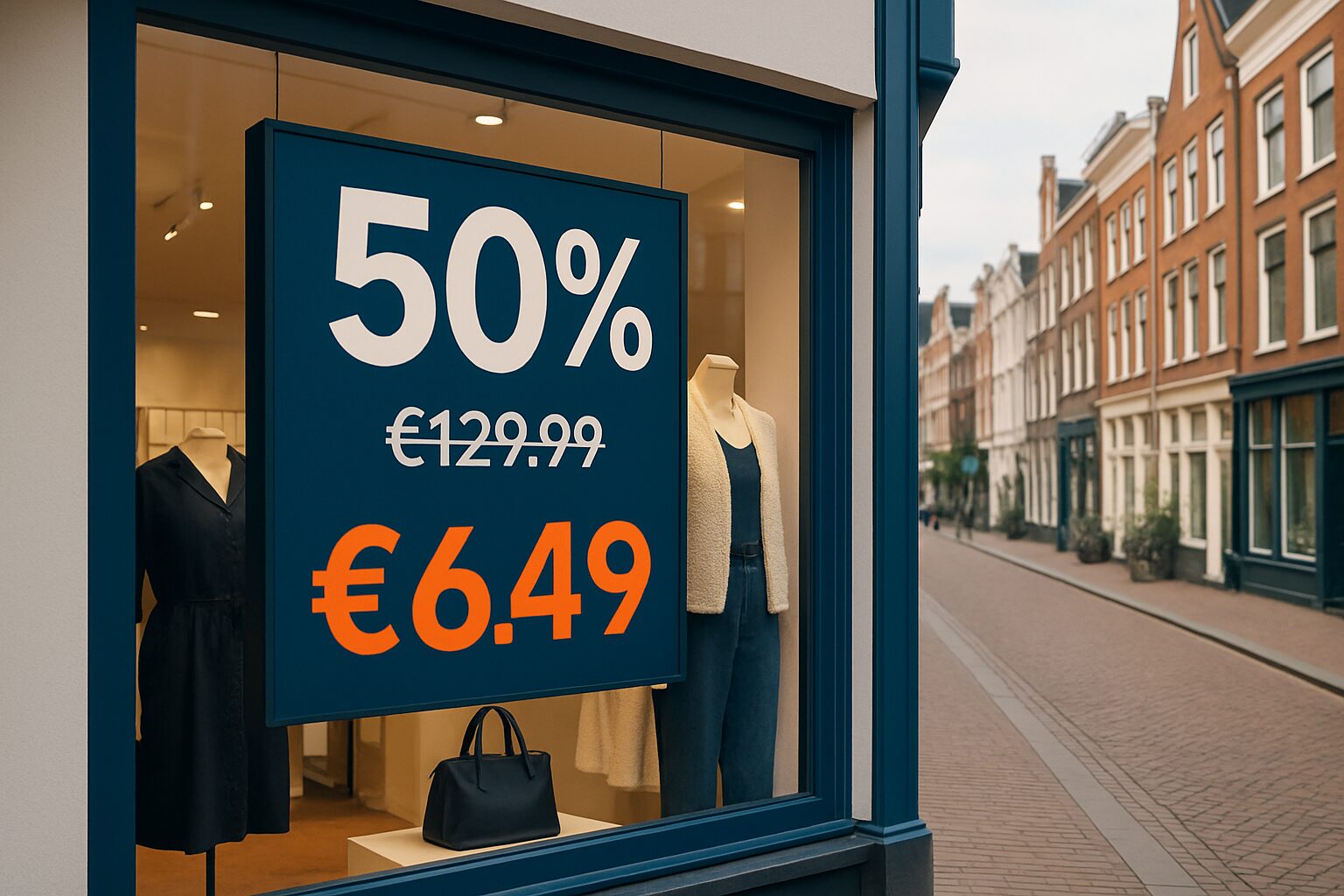
Dynamic price display in retail: what is legally permitted in the Netherlands and Belgium?
Dynamic price display is the automatic or manual adjustment of sales prices and discounts on digital screens in a retail environment — in the shop window, on the shop floor or outside the premises. In the Netherlands this falls under the Product pricing decision (Bpp) and the Prices Act; in Belgium under the Economic Law Code (WER). Both countries implement EU Directive 98/6/EC and the Modernisation Directive (EU) 2019/2161. The key rule: every displayed price must be unambiguous, including VAT, and every discount announcement must refer to a demonstrable reference price from the previous 30 days.
In short
- 30-day rule: for discount announcements in both the Netherlands and Belgium, the lowest price you have charged in the past 30 days counts as the reference price — not the recommended price or a fictitious from-price.
- Price always includes VAT: every stated price on a digital screen must be the total consumer price, including all mandatory taxes and charges.
- Permission outdoors = mandatory: a digital screen outside the premises or visible from public space requires a planning permit in almost all municipalities; indoors, this is not necessary.
- The ACM actively enforces: the Netherlands Authority for Consumers and Markets (ACM) checks both physical shops and online channels and can impose fines for misleading price displays.
- Synchronisation is crucial: in Belgium, when there is a price difference between screen and checkout, the lowest price always applies — technical synchronisation is therefore not a luxury but a legal requirement.
What exactly is dynamic price display?
Dynamic price display differs from a static paper price label because the price can be changed centrally at any time — via an app, a URL or a content management system. A supermarket discounting fresh produce in the afternoon, a clothing store applying a seasonal reduction or an electronics shop showing a flash sale: these are all forms of dynamic price display.
This is distinct from personalised pricing, where an individual consumer sees a different price based on profile data. The latter form has additional transparency obligations: businesses offering personalised prices must explicitly inform the consumer (Rijksoverheid.nl).
For most retail applications — time-limited offers, seasonal discounts, daily prices — these are non-personalised dynamic prices. The standard rules from the Bpp and the WER apply.
The 30-day rule: the core of Dutch legislation
From 1 January 2023, a stricter version of the Product Price Indication Decree applies in the Netherlands. Article 5a of the Bpp requires the seller to state, in discount announcements, the lowest selling price they applied during a period of at least 30 days before the discount promotion. This applies to both physical shops and online channels.
The practical meaning for dynamic screens: if you temporarily marked down a product yesterday from current price on request to current price on request, then current price on request is your mandatory reference price for the next promotional discount — not current price on request. Ignoring this risks an ACM fine. In just the first half of 2024, the ACM fined five webshops for listing misleading from-prices (Boels Zanders).
There are three exceptions to the 30-day rule:
- Perishable products (e.g. fresh food): you may use the immediately preceding sales price as the reference.
- Progressive discounts: in an uninterrupted series of increasing discounts (e.g. first 20%, then 30%, then 50%), you may continue to refer to the reference price before the first reduction for up to three calendar months after the first discount.
- New product: if a product has been in your range for less than 30 days, you do not need to keep a 30-day history.
These three exceptions are laid down in article 5a, second to fourth paragraphs of the Bpp (Official Gazette 2022, 485).
Regulations in Belgium: the WER and the FPS Economy
Belgium implemented the same EU Modernisation Directive through the Code of Economic Law. The basic rules are similar to those in the Netherlands, but there are practical differences.
Every business offering goods to consumers must state prices in writing and unambiguously. If goods are displayed — including in a shop window — the price indication must be clearly visible and readable. The price indicated must be the total price payable, including VAT, other taxes and the cost of all mandatory additional services (legalnews.be).
A specific Belgian point of attention: if the price on the digital screen differs from the price at the checkout, as a retailer you are obliged to sell the product at the lower of the two prices (Ombudsman for Trade). This makes technical synchronisation between your display content and your till system legally relevant — not just operationally.
For discount announcements, Belgium also applies the 30-day reference price. The reference price must be determined per sales channel or point of sale: the price in your physical shop in Antwerp may differ from that in your webshop, but within each channel the 30-day rule applies separately (UNIZO).
Additional Belgian points of attention:
- Waiting period: announcing discounts is prohibited during the closed period in the clothing, footwear and leather goods sectors.
- No loss leader: in the event of a price reduction, you may not sell below the purchase price in Belgium.
- Comparative advertising: stating two prices (for example outlet versus retail) may be regarded as comparative advertising and must meet additional conditions.
Comparison: the Netherlands vs Belgium on the main points
| Subject | Netherlands | Belgium |
|---|---|---|
| Legal basis | Dutch Pricing of Products Decree (Bpp) + Prices Act | Economic Law Code (WER) |
| Reference price after discount | Lowest price in 30 days before discount | Lowest price in 30 days before discount |
| Supervisor | ACM | FOD Economy |
| Screen price ≠ till price | No explicit legal text; unfair commercial practice possible | Legally required: lowest price applies |
| Embargo period discounts | Not applicable | Yes, for clothing/shoes/leather goods |
| Loss-making sale | Permitted | Prohibited |
| Progressive discounts | Allowed, max. 3 months | Permitted, max. 30 days unless progressive |
| New product < 30 days | Exempt from reference price requirement | Shortened reference period possible |
Permits for digital screens: outdoors vs indoors
The content rules on pricing are one thing; the placement rules are another. Here there is a clear distinction.
Inside the building — A digital screen placed solely inside the shop space and not visible from the public highway does not require an environmental permit. LED screens placed indoors are not subject to a permit (leddisplayexpert.nl).
Shop window and façade — Once a screen is visible from public space — even if it is behind glass — municipalities generally regard it as an advertisement. If the screen is considered an advertisement, an environmental permit is often required; this applies especially to larger screens or screens in public places such as on façades or in outdoor areas (q-lite.com). The permit is issued by the municipality, and the decision period is usually 8 weeks (Business.gov).
Outside the building — The strictest requirements apply to freestanding outdoor screens, facade displays and pavement signs on public roads. Municipalities assess applications on visual impact, road safety and light pollution. The rules can differ greatly from one municipality to another; factors such as screen size, brightness and type of content play a role. Always do a permit check in advance via the Digital Environment Desk.
Practical example: a fashion store in the centre of Utrecht that wants to hang a 43″ screen behind the shop window should ask the municipality of Utrecht whether this falls under the APV advertising rules. A bakery on a shopping street in Ghent that places a digital pavement board on the pavement applies for a permit from the city of Ghent — and must take Belgian municipal advertising regulations into account.
Three concrete examples from practice
Example 1 — Fashion chain during the sale period
A clothing chain in Amsterdam runs a flash sale on 1 July with 30% off. On the digital shop window screen, the system automatically shows the crossed-out former price. Correct: the former price is the lowest price the item had in the 30 days before 1 July. Incorrect would be: the former price is the manufacturer’s recommended price that the shop itself never charged. The ACM considers a crossed-out recommended price misleading if the seller has never used that price itself (inretail.nl).
Example 2 — Supermarket with fresh daily products
A supermarket in Rotterdam discounts fresh salads at 17:00 hours via a digital screen above the chiller. Because these are short-life products, the supermarket may use the immediately preceding selling price as a reference — the 30-day rule does not apply here. This is the exception for perishable goods in Article 5a paragraph 2 Bpp.
Example 3 — Electronics retailer in Brussels
An electronics retailer in Brussels shows a laptop on its digital in-store display for current price on request (was current price on request). Its till system is not synchronised and still charges current price on request Belgian law is clear: the consumer is entitled to current price on request — the lowest indicated price. The retailer also risks a complaint to the FPS Economy. This example illustrates why POS integration is not a technical afterthought but a legal necessity. Read more about that integration in the article POS displays and digital till systems: integration and best practices.
Technical compliance: what must your screen be able to do?
A digital display that complies with all legal requirements has at least these technical properties:
- Central content management: price changes must be rolled out quickly and without errors on all screens at once.
- Audit trail: you must be able to show which price was displayed when — this is your evidence in the event of an ACM inspection or complaint.
- Integration with till system: when prices change, the screen and checkout must be updated at the same time (or checkout first, then screen for price increases; the reverse for price reductions).
- Readable display: the price must always be clearly legible, even in bright ambient light.
That last point directly affects the hardware choice. An indoor shop display of 400 cd/m² is sufficient in most retail environments. A window display in direct sunlight requires at least 3.000 nits to remain readable. The PixioDisplay Window Full Sun (3.000 nits, 43–55") is specifically designed for this application and is available from current price on request (price list Q2 2026). Dunkin' Donuts uses the PixioDisplay Window for digital window posters — an application where readability during the day and evening is both critical (reference).
For the shop floor or checkout area, where there is no direct sunlight, the PixioDisplay Luxe (49″ touchscreen, 67×185 cm, current price on request buy or current price on request p.m. lease, price list Q2 2026) a suitable choice for interactive price presentation. All PixioDisplays have an integrated Android computer (Android 13/14), so you do not need a separate media player or laptop — that saves current price on request per screen in installation.
Enforcement: who checks and what are the risks?
In the Netherlands, the ACM is the regulator for the Bpp. The ACM has indicated that it will monitor both physical shops and online sales channels for compliance with the discount rules. In the event of an infringement, the ACM can impose fines or an order subject to a penalty payment. Anyone who does not follow the rules also risks a complaints procedure at the Advertising Code Committee (Boels Zanders).
The ACM also opts for a stricter interpretation than the European Commission requires in some respects. For example, the ACM requires traders to be able to demonstrate that a recommended price has actually also been used by other traders — a requirement that goes beyond the EU directive itself (Lexology).
Elsewhere in Europe, active fines are already being imposed: in July 2025 the French competition authority imposed a fine of current price on request million on Shein for misleading discount practices. PrettyLittleThing was fined current price on request million in September 2025 for fictitious discounts. This indicates the direction in which European enforcement is moving.
In Belgium, the FPS Economy supervises this. The Belgian rules are implemented through the Code of Economic Law and apply to all sales channels, including digital shop windows and in-store displays.
Advice: start with an internal audit of your price history before activating dynamic discounts on screens. Document which price applied when per point of sale. That way you are well prepared for any inspection.
Conclusion
Dynamic price display on digital screens is fully permitted in the Netherlands and Belgium — provided you comply with the 30-day rule for reference prices, show all prices including VAT, keep screen and till synchronised and apply for the correct environmental permit for outdoor installations. The technical choice of your display also partly determines whether you meet the legibility requirement: a shop window screen in sunlight needs at least 3.000 nits. See the application page for retail and shop window communication for an overview of suitable display solutions.
Frequently asked questions
May I change the price on my digital screen every hour?
Yes, that is allowed. There is no legal minimum period for which a price must apply. However, any displayed price must include VAT and be clearly readable. If you show a discount announcement, the from-price must be the lowest price you have charged in the past 30 days.
Does the 30-day rule also apply to a digital pavement board outside my shop?
Yes. The 30-day rule from the Product Price Indication Decree (Bpp) applies to all sales channels and all physical display media, including a digital pavement board. It makes no difference whether the price is shown on paper, on a screen or outdoors.
Do I need a permit for a digital screen in my shop window?
This depends on the municipality and the placement. A screen that is completely indoors and not visible from the public highway usually does not require a permit. If the screen is visible through glass from the street, many municipalities regard this as advertising and a planning permit is required. Do a permit check via the Digital Environment Desk (omgevingsloket.nl).
What happens if the price on my screen differs from the price at the till?
In Belgium this is regulated by law: the consumer is entitled to the lowest of the two prices. In the Netherlands there is no explicit statutory text, but a higher till price may be regarded as an unfair commercial practice. Always synchronise your display content and till system at the same time.
May I show the manufacturer's recommended retail price as a from price?
Only if you have also actually used that recommended price as your selling price. The ACM considers a crossed-out recommended price misleading if you have never charged that price. In addition, the ACM requires proof that other traders have also genuinely used that recommended price.
Are there special rules for discounts on clothing and shoes in Belgium?
Yes. In Belgium, it is prohibited to announce discounts during the closed period for the clothing, footwear and leather goods sectors. This also applies to discounts on digital screens. Outside the closed period, the standard 30-day rules apply.
What type of screen do I need for a shop window in direct sunlight?
A shop-window display in direct sunlight needs at least 3.000 nits of brightness to remain legible. A standard monitor (±300 nits) or a regular retail display (400 cd/m²) is unsuitable for this. Choose a screen specifically designed for high-brightness shop-window use.
Do I need to keep track of price history for my digital displays?
Yes, that is strongly recommended. The ACM may ask during an inspection which price applied when. An audit trail in your content management system — with a timestamp for each price change per location — is your evidence. Without this evidence, it is difficult to prove that you complied with the 30-day rule.
Does the 30-day rule also apply to a new product I have just added to the range?
Not in the Netherlands. If a product has been in your range for less than 30 days, you are exempt from the reference price requirement. Once the product has been available for longer than 30 days, the standard rule applies. In Belgium, there is a similar exception for products that have been on the market for less than 30 days.
What is the difference between dynamic price display and personalised pricing?
Dynamic price display adjusts the price based on time, season or stock level — for all customers at once. Personalised pricing shows an individual customer a different price based on profile data or behaviour. With personalised prices, an additional transparency obligation applies: you must explicitly inform the consumer that the price is personalised.