
Knowledge and advice
Dynamic price display in shops: what is allowed according to the ACM?
What may you show on a digital price display in your shop? ACM rules, the 30-day rule and Belgian legislation explained for NL and BE retailers.
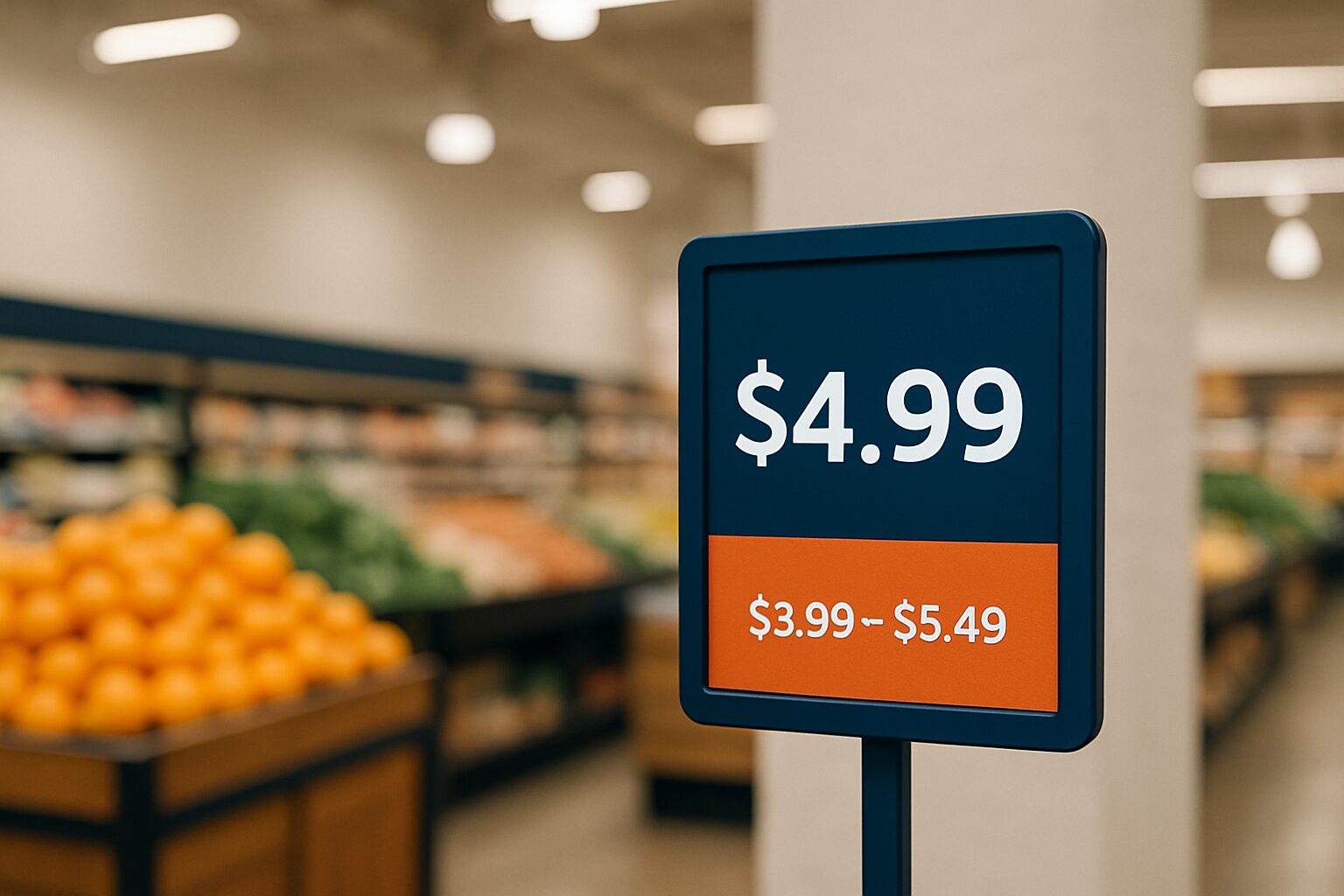
Dynamic price display means that a digital screen in a shop automatically adjusts prices — based on time, stock or promotion rules. In the Netherlands and Belgium this is fully permitted, provided the displayed price is always legible, inclusive of VAT and unambiguous. If you also show a discount or crossed-out price, additional rules from the ACM (Netherlands) and the Code of Economic Law (Belgium) apply. Violations can lead to fines of up to current price on request per infringement.
The legal basis: Product Price Indication Decree
In the Netherlands, the Decision on product price display every retailer to state a selling price. That price must be in euros, inclusive of VAT, and clearly readable for the relevant product. A digital screen meets this requirement — as long as the screen is visible at or directly next to the product and the price is current at the time of purchase.
For packaged products, there is also the obligation to show the price per unit of measure (per kilo, litre or metre). Supermarkets and drugstores therefore need to take this into account when setting up their digital shelf cards.
Belgian retailers fall under the Economic Law Code (WER). The basic rule is identical: the total price must always be stated in writing and unambiguously, including VAT and all mandatory costs. If the price on the screen differs from the price at the till, in Belgium you are obliged to sell the product at the lower price.
The 30-day rule: how does it work for digital screens?
This is the most critical point for retailers combining dynamic pricing with discount communication. The ACM states: a price reduction may only be presented as a discount if it is actually lower than the lowest price the seller has charged for the same product in the past 30 days.
This rule — stemming from the European Omnibus Directive — came into force in the Netherlands on 1 January 2023 in Belgium at 28 May 2022. It applies to all sales channels: physical store, webshop and app.
Concrete example: a clothing store shows on a digital screen next to a jacket "current price on request → now current price on request, 33% discount". This is only permitted if current price on request was the lowest price the store has applied for that jacket in the past 30 days. If the jacket was temporarily raised a week earlier from current price on request to current price on request, then the reference price is current price on request — not current price on request
For highly perishable products (such as fresh vegetables or bakery products), an exception applies: no reference price needs to be stated for these.
What the ACM specifically enforces
The ACM publishes its Guidance on price display and comparisons (September 2025) and inspects both physical shops and online sellers. An ACM study of 24 large retailers in sectors such as home, clothing and consumer electronics showed that 75% of shops still display discounts incorrectly — both physically and online.
In 2024, the ACM imposed fines totalling current price on request on five webshops (including Leen Bakker, Koopjedeal, G-Star and JYSK) for using fake discounts. The maximum fine per infringement is current price on request. The court upheld these fines in November 2025.
The ACM uses five basic rules:
| Rule of thumb | Additional information |
|---|---|
| Only genuine discounts | The 'from' price is the lowest price in the past 30 days |
| No crossings-out of prices not applied | Recommended prices may only be used if they are realistic and presented transparently |
| No excessively long discounts | A promotion that lasts for months can be regarded as misleading |
| Clarity about the reference price | State explicitly what the discount is based on |
| Applies to all channels | Physical shop, webshop and app are all subject to the same rules |
Personalised and algorithmic pricing
A specific point of attention for retailers showing AI-driven or personalised prices: if the price is personalised through automated decision-making, the consumer must be informed. This follows from the European Consumer Rights Directive.
Important distinction: a digital screen that adjusts prices based on time of day (e.g. happy hour) or stock level is not a personalised price — as long as all customers see the same price at that time. Only when the price differs per individual (e.g. via a loyalty app) does the information duty arise.
In Belgium, the same principle applies via the CEL: if the personalised price concerns a notice of a price reduction, both the Price Indication Directive and the Consumer Rights Directive apply.
Practical checklist for your digital price screen
Start with these checks before you go live with a dynamic pricing system:
- Readability: is the price readable with the associated product, even in bright ambient light?
- VAT included: does the screen always show the total price including VAT?
- 30-day archive: does your system store price history per product, per sales channel?
- Discount communication: is the reference price the demonstrably lowest price of the past 30 days?
- Point-of-sale synchronisation: does the screen price match the till price? In Belgium, the lowest price otherwise applies.
- Customised prices: are customers informed when the price has been set individually?
A PixioDisplay Window Full Sun (3.000 nits, price list Q2 2026 from current price on request) is an example of a shop window screen that remains readable even in direct sunlight — a practical requirement if you are legally obliged to show a readable price. The built-in Android computer enables direct connection to your price database via URL or the PixioApp, without a separate media player.
Conclusion: technically much is possible, legally there are clear limits
Dynamic price display offers retailers great flexibility: adjusting prices based on time, stock or campaigns is perfectly allowed. The limit lies with discount communication. If you show a from-price or struck-through price, it must demonstrably be the lowest price of the past 30 days — in both the Netherlands and Belgium.
Choose a screen with a direct link to your ERP or pricing database, so that the price shown always stays in sync with your administration. That is not only legally sensible, but also the basis for reliable customer communication. Read more about the technical integration in the article Real-time stock management on digital displays: integration with retail systems.
Frequently asked questions
May I show a price on a digital screen that changes by the hour?
Yes, that is allowed. You may adjust prices dynamically based on time, day or stock levels. Do make sure the displayed price is current at the time of purchase, including VAT, and clearly legible next to the relevant product. If you also show a discount price, the 30-day rule applies to the reference price.
What is the 30-day rule and does it also apply to my physical shop screen?
The 30-day rule states that the 'from' price in a discount must be the lowest price you have charged for that product in the previous 30 days. The rule applies to all sales channels: physical shop, web shop and app. In the Netherlands this rule has been in force since 1 January 2023, and in Belgium since 28 May 2022.
What happens if the price on my screen differs from the price at the till?
In Belgium, you are legally obliged to sell the product at the lower of the two prices. The same principle applies in the Netherlands: the consumer may demand the price you have communicated. Always synchronise your screen price with your POS system.
Do I need to inform customers if I show personalised prices?
Yes. If the price differs per customer based on automated decision-making (for example via a loyalty app or algorithm), you must inform the consumer. A screen that shows the same time-limited price to all customers does not fall under this.
How high are the fines for breaching the pricing rules?
The ACM can impose fines of up to €900.000 per infringement. In 2024, the ACM imposed a total of €621.000 in fines on five webshops for fake discounts. The court upheld these fines in November 2025. The rules also apply to physical shops.