
Knowledge and advice
Dynamic pricing in retail: what is and is not allowed?
Dynamic pricing in your shop: what does the law say? Read the ACM rules, the 30-day rule and how digital displays help you communicate compliantly.
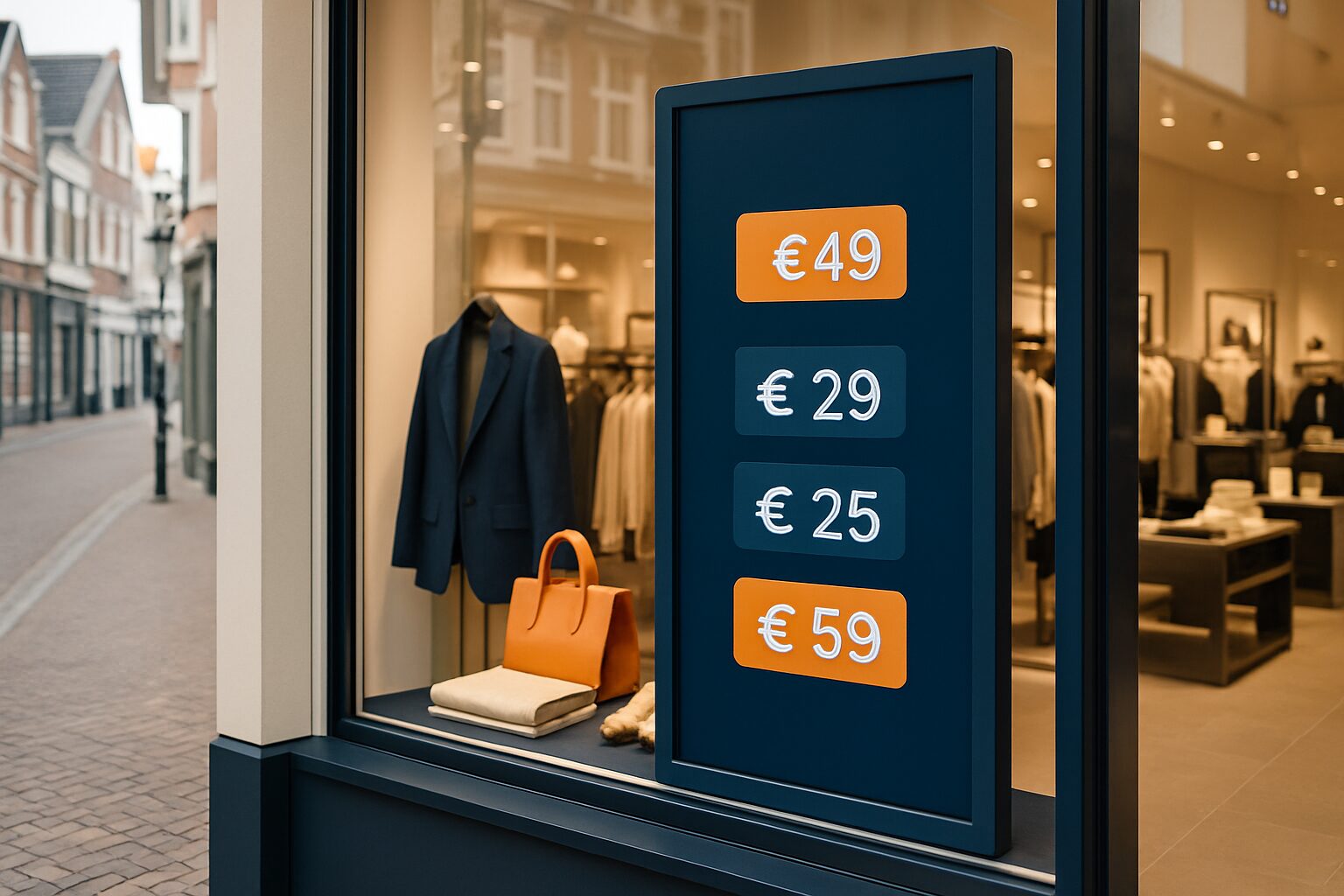
Dynamic pricing in retail: what is and is not allowed?
Dynamic pricing — prices that vary based on time of day, demand or stock levels — is permitted in the Netherlands and Belgium. You may adjust your price at any time. What you may not do is communicate those price changes misleadingly. The Authority for Consumers and Markets (ACM) actively enforces fake discounts, false reference prices and unclear discount communications. Those who break the rules risk a fine up to current price on request
What exactly is dynamic pricing?
Dynamic pricing means that you adjust prices automatically or manually based on external factors. Think of time of day (morning versus evening), remaining stock, season or day of the week. This differs from personalised pricing, where the price varies per individual customer based on personal data.
Those two are often confused — and that distinction is legally relevant. Different rules apply to dynamic prices based on supply and demand than to prices you differentiate by customer profile.
What does Dutch law say?
Since 1 January 2023, the amended Decision on product price display, as implementation of the EU Consumer Protection Modernisation Directive. The key point: if you communicate a discount, that discount must be genuine.
The basic rule is the 30-day rule: the 'from' price you show for an offer must be the lowest sale price you applied in the 30 days before the offer. You may not first artificially raise a price and then discount it heavily.
The ACM publishes a Guidance on price display and comparisons with concrete rules of thumb and examples of permitted and prohibited price displays.
Specifically prohibited:
- Crossing out a price that was not the lowest price of the past 30 days
- Showing a discount percentage compared with a recommended price you have never charged
- Letting a discount run so long that it is no longer a discount, but the normal price
Allowed:
- Increase or decrease your price at any time — without discount communications
- Comparing it with the manufacturer’s recommended retail price, provided it is clearly labelled and not misleading
- Progressive markdowns in the fashion sector, up to a maximum of 3 months after the first price reduction
Personalised prices: additional transparency obligation
Do you use algorithms to calculate a different price per customer? Then additional obligations apply. The EU directive requires you to actively inform consumers if the price was determined through automated decision-making based on personal data.
The Dutch Authority for Consumers and Markets has already taken action against platforms that did not do this. Tinder received a warning for lack of transparency about personalised prices. After an ACM investigation, platform Wish decided to stop personalised prices in the Netherlands altogether. For physical retailers this scenario is less common — but relevant if you link loyalty programmes or app prices to customer profiles.
Enforcement: the ACM is taking active action
The ACM monitors both online and physical shops. It has already imposed fines totalling current price on request on five online shops for fake discounts. The maximum fine is current price on request per breach, or 4% of annual turnover if that is higher.
The regulator does not only look at the letter of the law. An offer that technically meets the 30-day rule, but where the 'was price' applied for only one day two months ago, can still be assessed as an unfair commercial practice. It is about the overall impression the consumer gets.
Practical advice: document your price history. Keep data on the sales prices for at least the past 30 days, so that you can demonstrate your lowest price in the event of an ACM investigation.
How digital displays help with compliant price communication
A digital screen in your shop window or store offers one concrete advantage over paper price labels: you can adjust the price and the context immediately. If you lower the price, you also show the correct reference price and validity period — without a staff member having to walk through the store.
This is exactly where dynamic price communication and compliance meet. A screen that shows the current price without a 'from price' is always compliant. If you add a discount statement, it must meet the 30-day rule — but updating it takes seconds.
A concrete example: a fashion chain implementing seasonal markdowns can use a digital shop display communicate the progressive discount step by step. Day 1: 20% discount. Week 2: 30%. Week 4: 40%. Each screen automatically shows the correct reference price at that moment — and the campaign stops automatically after 3 months, in line with the exception for progressive markdowns in the fashion sector.
For shop window communication without an internal socket, the PixioDisplay A-board (43", battery-powered, 14–18 hours' runtime) a practical solution: buy from current price on request or lease from current price on request per month (price list Q2 2026). You update the price content centrally via the PixioApp — no member of staff walking around the shop to swap cards.
For larger window communication in full sun, the PixioDisplay Window Full Sun is available with 3.000 nits brightness, in sizes from 43 to 55 inches, from current price on request single-sided (price list Q2 2026). Dunkin' Donuts uses this type of window display for their digital shop window posters.
Conclusion: dynamic is allowed — misleading is not
You may adjust your price whenever you want. That is commercial freedom and legally fully permitted. The boundary lies in the communication: if you show a discount, then that discount must demonstrably be genuine. Document your price history, adhere to the 30-day rule and be transparent about the nature of the reference price.
Digital displays make compliant price communication operationally easier: one change in your system, immediately visible on all screens. For the full technical and legal explanation, read the pillar article Dynamic price display in shops: regulations and technical implementation in the Netherlands and Belgium.
Frequently asked questions
May I raise my price during the day and lower it in the evening?
Yes, that is allowed. You are free to change your sale price at any time. As long as you do not add discount communication (no 'was' price or percentage discount), no additional obligations apply. If you do use a 'was' price, it must be the lowest price of the past 30 days.
What exactly is the 30-day rule?
If you communicate an offer with a 'from' price, that 'from' price must be the lowest selling price you yourself applied in the 30 days before the offer. You may not first increase the price in order to show a bigger discount afterwards. The ACM actively enforces this.
Does the 30-day rule also apply to my physical shop?
Yes. The Product Price Indication Order applies to all distribution channels: physical shop, web shop, app and catalogue. There is no distinction between online and offline.
May I charge a different price per customer in my shop?
In principle yes, but then you must actively inform the customer that the price was created through automated decision-making based on personal data. The ACM has already fined platforms that did not communicate this transparently. For physical retail this scenario is rare, but relevant for app-linked loyalty programmes.
How does a digital screen help with compliant price communication?
With a digital screen, you adjust both price and context in one go. You always show the current price, the correct reference price and the validity period — without staff having to manually change cards. That reduces the risk of errors and makes your price communication demonstrably consistent.