
Knowledge and advice
Digital signage and the GDPR: what may you show and measure?
What may you show on a digital screen and which measurement data may you collect? Everything about the GDPR for digital signage in the Netherlands — practical and concrete.
Digital signage and the GDPR: what may you show and measure?
Digital signage falls under the General Data Protection Regulation (GDPR) as soon as your screen shows or collects personal data. Names, photos and camera footage of identifiable people are personal data. Audience-camera measurement data in displays can also be personal data. Ignoring this risks a fine from the Dutch Data Protection Authority (AP) of up to current price on request million or 4% of global annual turnover (article 83 GDPR).
When is your screen subject to the GDPR?
A screen that shows only product prices, the weather forecast or a company logo does not process personal data. The GDPR therefore does not apply. However, as soon as you display names, faces, staff photos or customer data on the screen, you are processing personal data within the meaning of the law.
The same applies on the measurement side: a camera in or next to a display that analyses visitor flows also falls under the GDPR if the images can be traced back to individuals. The The Dutch Data Protection Authority has already drawn up a statutory assessment framework for data collection via Digital Out-of-Home, after major outdoor advertising operators had built cameras into their digital screens.
A practical rule of thumb: if the camera counts numbers without recording faces (for example via infrared), you are not processing personal data. If the camera captures recognisable images, you are.
What you may show: content with personal data
Names and photos of employees on a welcome screen or intranet display are personal data. You may show them, provided you have a valid basis. The most commonly used basis in an employment relationship is consent, recorded in a processor agreement.
In such an agreement, an employee states whether he or she may be shown by name and/or image on internal screens, social media or narrowcasting. The same principle applies in education: pupils and parents are asked every year whether they consent to personal data being shown publicly.
A concrete example: a retail chain wants to show an 'employee of the day' daily on a digital advertising screen. That is allowed, but only if that employee has given written permission and can withdraw that permission at any time. Are you showing photos from a staff party on a screen in a public space? Then the same rules apply — and the threshold is higher because visitors will also see the images.
Important: intellectual property also plays a role. Putting newspaper articles, press photos or stock images without a licence on a screen is unlawful, regardless of whether personal data is involved.
Audience measurement and cameras in displays
Many modern displays and kiosks have a built-in camera for audience measurement: how many people pass by, how long do they look, what is the age range? Here, commercial interest clashes directly with the GDPR.
The AP distinguishes three situations:
- Counting without personal data: an infrared camera that only records numbers without recognisable images. This falls outside the GDPR and may be used freely.
- Anonymous demographic analysis: software that estimates gender or age category without storing the person. Legally controversial — the AP assesses this on a case-by-case basis.
- Facial recognition or identification: biometric data are special personal data and, in principle, processing them is prohibited (Article 9 GDPR). Exceptions exist only with explicit consent or a compelling public interest.
If you choose to put a camera in your display, switch off facial recognition and work with anonymous counting data. That is the safest route and aligns with the AP's advice: first see whether you can achieve the same goal with less intrusive measures.
Touch screens and interactive kiosks
An interactive information kiosk or touchscreen kiosk quickly collects more data than a passive screen. Think of input fields for name or email address, QR code scans or login functions. Every input of identifiable data is processing under the GDPR.
For this type of application, three concrete obligations apply:
- Basis: you need a valid reason (consent, contract or legitimate interest).
- Transparency: the visitor must know which data you collect, for what purpose and how long you keep it.
- Retention period: do not keep data longer than necessary for the purpose.
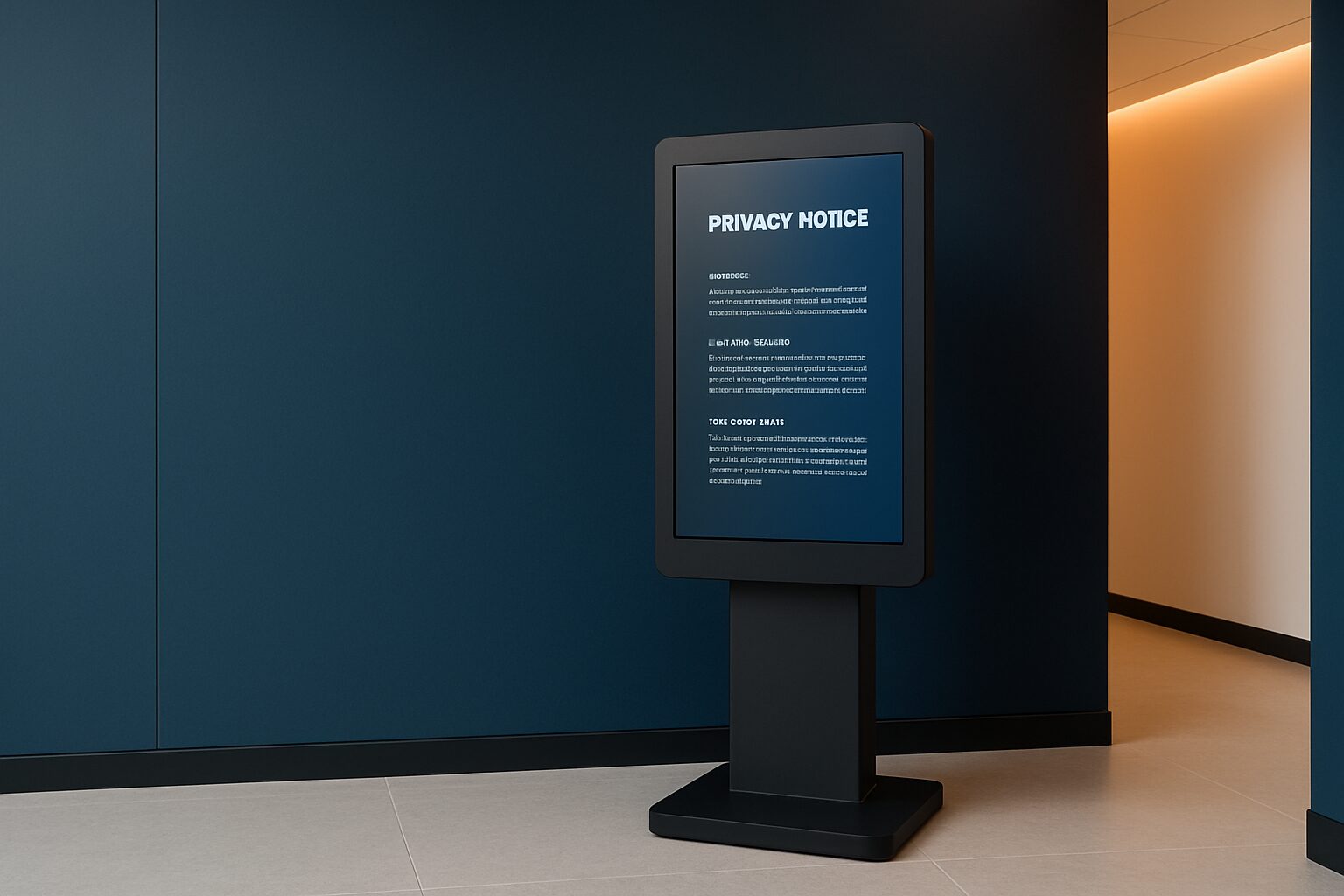
A practical example: a PixioKiosk of 21,5″ (current price on request, price list Q2 2026) used as a sign-up point at an event processes names and email addresses. Then place a short privacy notice on the screen itself — one sentence with purpose, retention period and contact person is enough in most cases. Link the kiosk to a data processing agreement with your software supplier if that data is sent to an external server.
What you need to arrange: a practical checklist
Below are the minimum requirements for GDPR-compliant digital signage:
| Situation | What you need to arrange |
|---|---|
| Staff photo on internal screen | Written employee consent |
| Visitor name on welcome screen | Legal basis + privacy notice on screen |
| Public camera (infrared, anonymous) | No GDPR obligation |
| Public camera with facial analysis | DPIA required, lawful basis required |
| Touchscreen with input fields | Privacy policy + data processing agreement |
| Third-party photos (press, stock) | Licence or permission from the rights holder |
A Data Protection Impact Assessment (DPIA) is required if you process personal data on a large scale or structurally via your screens — for example, with a network of kiosks with login function or with camera analysis across multiple sites.
Conclusion: start with the question of whether you are processing personal data at all
Most digital signage applications — product information, opening hours, menus, weather data — do not involve the GDPR at all. So start with the question: does my screen or software process identifiable data about people? If the answer is no, you do not have a GDPR issue. If the answer is yes, you need a legal basis, must be transparent, and may not keep data for longer than necessary.
Want to know how to manage and schedule content without introducing privacy risks? Then also read the article about narrowcasting software: how do you choose the right system for your displays.
Frequently asked questions
Can I put a photo of an employee on our digital screen?
Yes, but only with the written consent of that employee. Record this in a data processing agreement or employment contract. The employee may withdraw that consent at any time, after which you must remove the photo from the screen immediately.
Is a public-facing camera in my display allowed under the GDPR?
That depends on what the camera does. An infrared counter that only registers numbers without recognisable images falls outside the GDPR. A camera that analyses or stores faces processes personal data and requires a legal basis. Facial recognition is almost always prohibited in commercial contexts.
Should I put a privacy notice on my touchscreen kiosk?
As soon as visitors enter data (name, e-mail, telephone number), you are obliged to inform them about the purpose, retention period and who is responsible for the processing. A short notice directly on the screen is the most practical solution.
When is a DPIA required for digital signage?
A Data Protection Impact Assessment (DPIA) is mandatory if you process special categories of personal data on a large scale or structurally, or if there is a high privacy risk. Think of a network of kiosks with a login function or displays with camera analysis at multiple locations. If in doubt, consult a privacy lawyer or the Dutch Data Protection Authority.
May I show newspaper articles or news items on my screen?
Not without the rights holder’s permission. Newspaper articles and press photos are copyright protected. If you display them on a narrowcasting screen without a licence, you infringe copyright — regardless of whether personal data is included.