
Knowledge and advice
Digital signage implementation: cost savings by retail type
What does digital signage cost in Dutch retail, and when does it pay for itself? Break-even analysis by store type, with concrete prices and savings figures.
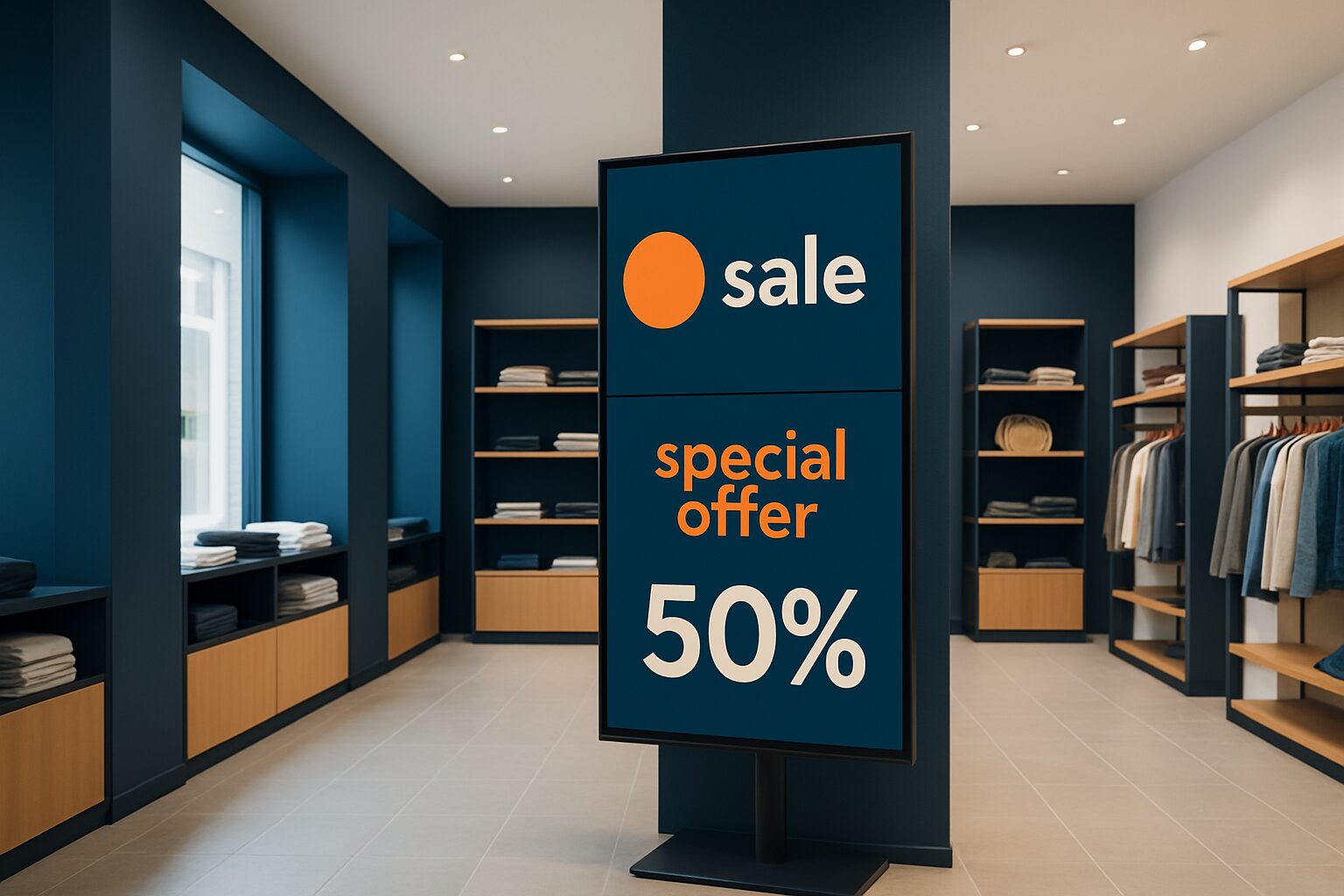
Digital signage implementation for a small retail system (5–10 screens) costs between current price on request and current price on request initially, plus current price on request per month for licences and maintenance. A medium-sized chain with 20 branches and 2 screens per location should budget current price on request as the initial investment. The payback period varies greatly by store type: food retail and hospitality often reach break-even within 6–12 months, fashion stores and furniture shops more likely in 12–24 months.
What determines the total investment?
The costs of digital signage consist of four components: hardware, software, installation and content creation. Hardware is a one-off investment; software continues as a monthly subscription. Installation and content are often underestimated by many retailers — but they partly determine whether the system pays off.
An important advantage of modern commercial displays is the integrated media player. All PixioDisplays run on a built-in Android computer (Android 13/14), so you do not need a separate media player at current price on request per screen. That saves current price on request straight away on the initial investment for a network of 20 screens.
For software, the rule is: standard cloud CMS platforms cost current price on request per screen per month. With 10 screens, that adds up to current price on request per year — an item that is often missing from quotes or only appears later.
Cost savings per retail type
Not every retail type has the same cost structure, and therefore not the same savings. Below is a comparison based on the three most common applications.
| Retail type | Primary saving | Typical payback period |
|---|---|---|
| Food retail / supermarket | Printing costs for price tags and promotional material | 6–12 months |
| Fashion chain / clothing shop | Campaign print, shop window materials | 12–18 months |
| Home furnishings / DIY | Product information, floor plans | 18–24 months |
| Hospitality / QSR | Menu boards, seasonal offers | 6–12 months |
Food retail has the shortest payback period. Price changes and weekly offers require new print runs every week. One branch with 4 screens can quickly save hundreds of euros per month in print, design and distribution costs. The move from paper to digital eliminates recurring expenditure: design, printing, shipping, placement and removal of POS material.
Fashion shops invest heavily in seasonal campaigns and window materials. Those are high, recurring costs — exactly what digital signage replaces. Moreover, screens in strategic locations encourage cross-selling: according to a Yodeck survey among retailers, 79% of respondents said digital signage helped them with upselling and cross-selling in-store.
Home furnishing stores have a longer payback period because footfall is lower and the screens are used more informatively than promotively. Still, the ROI is real: fewer questions for staff, better product orientation and higher conversion on large purchases.
The savings side: print costs are the silent expense
The saving on print costs is structurally underestimated. With a network of a few dozen branches, annual savings can run to tens of thousands of euros — think design, printing, transport, installation and removal of POS materials. These are costs that return with every campaign and disappear with digital signage after the one-off hardware investment.
There are also sales effects. Research by Nielsen shows that digital signage can increase impulse purchases in retail by an average of 29,5% — which quickly justifies the investment at sufficient scale (Nielsen Digital Signage Study, via nielsen.com). Retailers see the strongest correlation with revenue growth when screens are used in a targeted way on end caps and checkout areas.
Buying, leasing or renting: the mathematical break-even point
The question retailers ask us most often is: buy or rent? The arithmetic break-even point is around 8–10 use days per year. If you use a display more often than that, buying or leasing is structurally cheaper.
A concrete example: the PixioDisplay Luxe (49″ touchscreen) costs current price on request when purchasing or current price on request per month when leasing (price list Q2 2026). With leasing, after 60 months you have paid current price on request — and the screen is meanwhile working continuously for your shop. Renting makes sense for temporary campaigns or pop-up retail: the daily rate for the PixioDisplay Luxe starts at current price on request per day for 3 days' hire.
Leasing has an additional advantage for retail chains: the monthly cost is predictable and fits within the operating budget, while the initial capital expenditure disappears. For a rollout of 20 screens, that immediately saves current price on request in starting capital.
Hidden costs that quotes miss
In the showroom in Montfoort, customers regularly compare quotes from multiple suppliers. Transport, extended warranty and content management are notably often missing from them. For any serious implementation, always budget for:
- Courier delivery: within the Netherlands from current price on request per shipment (price list Q2 2026)
- Warranty extension: 2 years costs current price on request per display, 4 years current price on request depending on model (price list Q2 2026)
- Content management: structurally 2–4 hours per month, or outsourced at an hourly rate
- Installation: wall mounting or floor stand, depending on location
An extension of the warranty to 4 years costs at most current price on request per display. By comparison: one day of replacement hire for a faulty screen already costs current price on request The extension pays for itself with a single fault.
Break-even calculation: a worked example for a fashion chain
Suppose: a fashion chain with 5 branches wants to place 2 screens per location — a total of 10 screens.
Initial investment (purchase):
- 10× PixioDisplay Luxe at current price on request = current price on request
- Warranty extension 4 years at current price on request on average = current price on request
- Installation and transport = current price on request (estimate)
- Total: ±current price on request
Annual saving (conservative):
- Printing costs for campaign materials per branch: current price on request/year → 5 branches = current price on request
- Design and distribution: current price on request
- Total savings: approx. current price on request/year
Breakeven: ±18 months — without taking turnover effects into account.
If you add a conservative sales uplift of 5% on advertised products (with an average branch turnover of current price on request/year), the payback period falls to 10–12 months.
Do you want to know which display types best suit your retail format? Then read digital signage in retail: applications by store type for an overview by sector. And see the application page for digital retail displays for concrete deployment scenarios.
If the approach itself is not yet fixed — simple digital signage or centrally controlled narrowcasting? The decision tree digital signage vs narrowcasting for retailers guides you to the right choice for your chain in four questions.
Frequently asked questions
What does digital signage cost on average for a retail chain in the Netherlands?
A small-scale system of 5–10 screens costs €5.000–€20.000 initially, plus €100–€300 per month for software and maintenance. A medium-sized chain with 20 branches and 2 screens per location budgets €30.000–€80.000 in start-up investment. Lease spreads those costs over 60 months.
When does digital signage pay for itself in retail?
The payback period varies by store type. Food retail and hospitality often break even within 6–12 months thanks to high savings on weekly print. Fashion stores are at 12–18 months, home stores at 18–24 months. Turnover effects from impulse purchases shorten the payback period further.
Is buying or leasing a display cheaper for a retailer?
The break-even point is around 8–10 usage days per year. If you use a display on a structural basis (daily in the shop), buying or leasing is always cheaper than renting. Leasing has the advantage that the monthly cost is predictable and the initial investment disappears — useful when rolling out across multiple branches.
Which costs are often missing from a digital signage quotation?
Transport, extended warranty and content management are all too often missing from quotes. Also allow for installation costs and a separate media player — unless the display has a built-in computer. Always compare quotes on total cost of ownership over 3–5 years, not just the purchase price.
How much do you save on printing costs with digital signage?
The saving depends on print volume. In a network of several dozen branches, the annual saving can run to tens of thousands of euros — including design, printing, transport and installation of POS material. Food retail and fashion shops with weekly campaigns benefit the most.