
Knowledge and advice
Digital menu board costs: what do you pay per month?
How much does a digital menu board cost per month? Hardware, software, lease and installation explained with concrete Dutch prices for hospitality business owners.
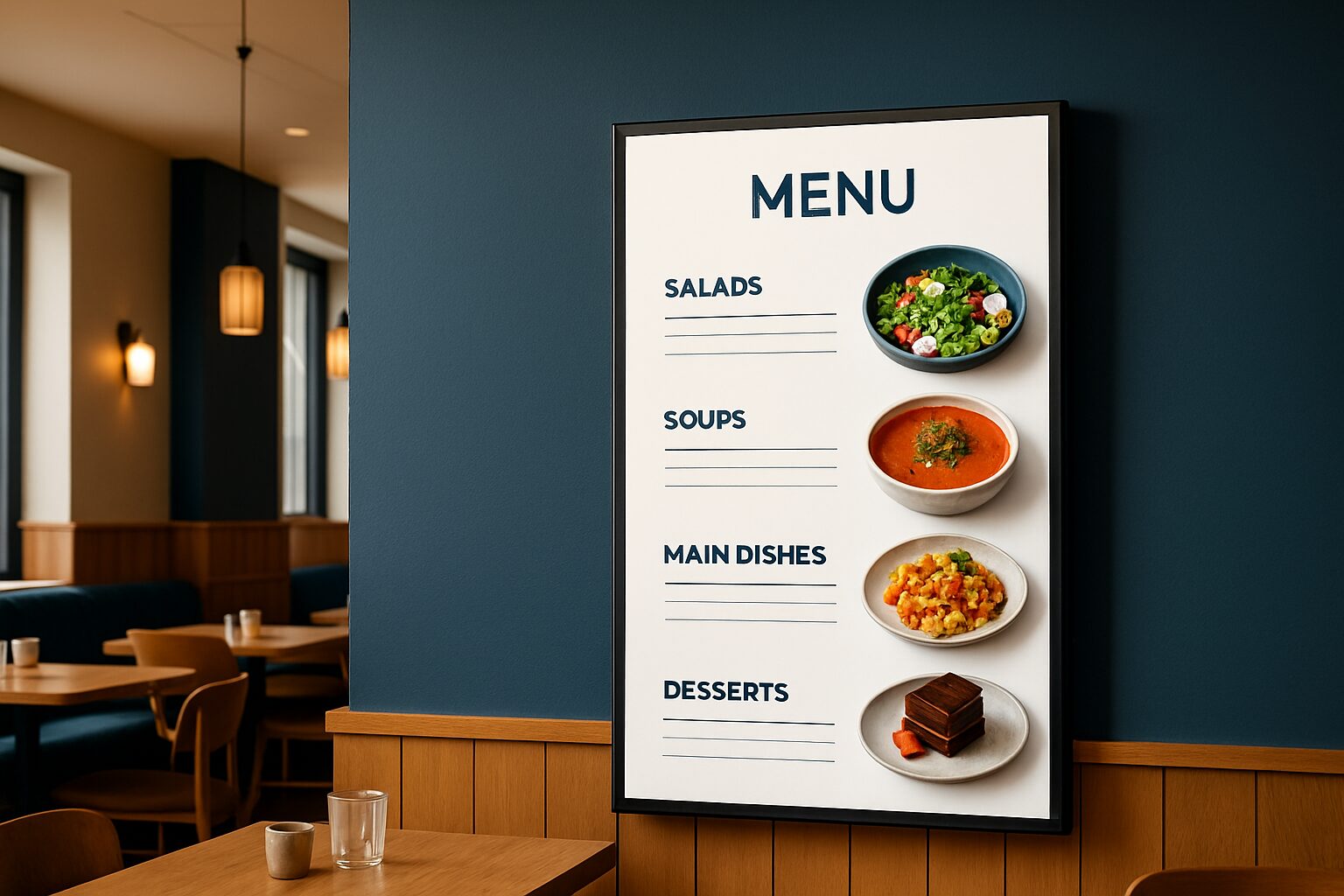
Digital menu board costs: what do you pay per month?
A digital menu board for a restaurant or café consists of three cost items: hardware (the screen), software (the CMS) and any installation. The monthly total costs range from current price on request for a simple QR software solution to well over current price on request for a leased commercial display including CMS. If you buy the screen outright, the monthly costs after payback drop to software only. This article explains each item concretely — with Dutch prices.
Three cost models side by side
There are three common ways to finance a digital menu board. They differ greatly in initial investment and monthly costs.
| Model | Start-up costs | Monthly costs | Suitable for |
|---|---|---|---|
| Buy (screen + CMS) | current price on request | current price on request (software only) | Fixed location, long-term |
| Lease (screen + CMS) | current price on request one-off | current price on request total | Distribution without a large investment |
| QR software solution | current price on request | current price on request | Addition to existing map |
When buying, you pay once for the hardware and then only the CMS subscription. With leasing, you combine hardware and software costs in one monthly instalment. A purely QR-based solution — where guests see the menu on their phone — does not need screen hardware and is therefore the cheapest.
What does the hardware cost?
The screen is usually the largest investment. Commercial displays are designed for continuous use and have a higher brightness than a consumer screen — that makes them more expensive, but also more reliable in a hospitality environment.
Concrete example: the PixioDisplay Mobile (43″ touchscreen) you buy for current price on request (price list Q2 2026). If you lease the same model, you pay current price on request per month over 60 months. That is the only monthly hardware cost — no separate media player or laptop required, because all PixioDisplays have an integrated Android computer on board.
Do you want a smaller setup as an information totem at the entrance? The PixioKiosk (21,5″) is available from current price on request buy or current price on request per month lease (price list Q2 2026). That way you match the screen choice to your budget and your business.
Important note: do not use an ordinary consumer display from the shop for a digital menu board. Consumer TVs are built for ±300 nits and a few hours a day — not for the 12 to 16 hours that a hospitality screen runs daily.
What does the software (CMS) cost?
Alongside the screen, you need software to manage and display your menu. This is called a Content Management System (CMS). The monthly costs mainly consist of this CMS subscription, which ranges from current price on request per screen per month for standard software.
For most hospitality businesses, a basic subscription is sufficient. It allows you to adjust prices, daily menus and allergen information without technical knowledge. If you want automatic schedules (breakfast menu in the morning, dinner menu in the evening) or integration with your till system, you are quickly in the higher price range.
Some screens — including the PixioDisplays — can also play content via a website URL or USB. That can reduce or even eliminate software costs if your content is not too complex.
Installation and one-off costs
Installation is an item many entrepreneurs forget when planning their budget. Think about:
- Wall mounting or floor stand: current price on request depending on the model
- Cabling and power supply: varies by location
- Courier delivery within the Netherlands: from current price on request
- Content design (initial menu layout): current price on request if you work with a template yourself, current price on request via a graphic agency
These costs are one-off. They count towards the payback period, but do not affect your monthly costs.
Comparison: digital versus printed
A traditional menu set (lunch, dinner, wine list, daily specials) costs current price on request per reprint. With four menu changes per year, that soon adds up. A digital menu board has no reprint costs — every price change or seasonal update is free and visible immediately.
That makes the calculation simple for businesses that regularly change their menu. With two reprints per year, you already save current price on request in print costs. That covers a large part of the hardware investment.
Dunkin' Donuts chose digital window posters via the PixioDisplay Window — a solution that also works for smaller hospitality venues if you want to attract passers-by with a current offer in the shop window.
When do you choose which model?
Start with leasing if you want to spread the initial investment and be sure of warranty and support. The monthly cost is predictable and fits into a fixed operating budget.
Buying is more economical in the long term. After the payback period — typically 18 to 36 months — you only pay for the software. That makes buying the cheapest option for businesses that stay in the same location for at least three years.
A QR menu solution is not a replacement for a screen, but an addition. Guests read the menu on their own phone. That works well at the table, but not if you want to inform passers-by or create a premium look at the entrance.
Unsure which model is right for your business? View the price list or schedule a visit to the showroom in Montfoort to compare the screens live.
Conclusion
The monthly costs of a digital menu board depend on three choices: purchase or lease, screen size and CMS subscription. With lease, you pay current price on request per month all in. With purchase, the monthly costs after repayment drop to current price on request for software only. Savings on printing costs pay back the investment within two to three years for most hospitality businesses. Want to see the full calculation — including staff time and the turnover effect of a digital price list? Then see Hospitality digital signage ROI: calculating and saving costs.
Want to know how to make the transition step by step? Then read the article Implementing a digital menu board: step-by-step guide in this knowledge base.
Frequently asked questions
What is the cheapest way to start a digital menu board?
The lowest entry point is a QR software solution: guests scan a code and see the menu on their phone. That can be free or for a small monthly subscription. If you want a physical screen in your venue, start with leasing — that way you avoid a large initial investment and pay a fixed monthly amount.
Do I need a media player or laptop as well as the screen?
Not with all screens. Commercial displays with an integrated Android computer — such as the PixioDisplays — play content via USB, website URL or an app, without extra hardware. With screens without a built-in player, you need a separate media player, which costs an extra €80 to €300.
What does a digital menu board cost per month with lease?
With a 60-month lease contract, you pay from €42 per month for the hardware for a 43″ touchscreen display (price list Q2 2026). On top of that comes a CMS subscription of €20 to €60 per month. In total, that works out at €60 to €110 per month all in.
Does a digital menu board pay for itself?
That depends on how often you change your menu. A traditional menu set costs €300 to €800 per reprint. With four changes per year, you already save €1.200 to €3.200 in printing costs. For most hospitality businesses, the payback period is two to three years.
May I use a regular TV as a digital menu board?
Technically it can be done, but it is not advisable. Consumer screens are built for a few hours of use per day and have low brightness (±300 nits). A hospitality screen runs 12 to 16 hours per day and has higher brightness for readability in a lit room. A consumer screen fails much faster under continuous use.